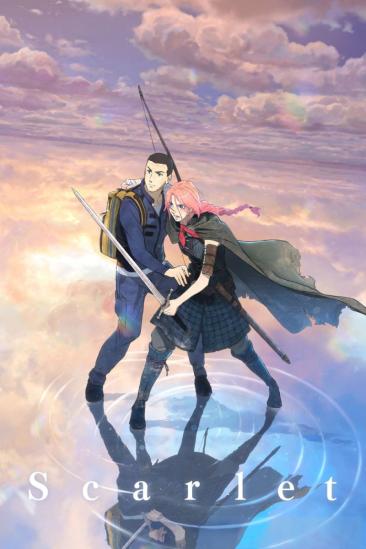
After failing to avenge her father's murder, Princess Scarlet, wakes up in the "Land of the Dead." In this world filled with madness, if she does not achieve her revenge against her nemesis and rea...
The last film of Mamoru Hosoda’s I’ve watched, “Belle”, wasn’t one that I held in high regard. It’s a problematic Congo-line of misguided messages, archetypical characters, lopsided presentation and a story with such a botched execution that it feels like it had multiple drafts crunched down to make due for the stellar animation and bloated runtime; sure, it never neglects its characters and actually attempts to highlight some of the positives of being online on top of dissecting into child abuse, self-sacrifice and community responsibility, but it's a case of trying to do too much with too little and vice versa.
“Scarlet” is not an improvement; if anything, it’s somehow even more frustrating.
Let me preface this: I haven’t seen much else of Mamoru Hosada’s work, so I hoped what I saw with his directing with Belle was just a one-off; apparently this is just how he operates. He’s taken a liking to being very elaborate with this frustrating cursory eye for everything that sometimes overlooks his unwavering sincerity. Every scene is stretched and inflated until it strains at a compulsive, almost aggressive rate, rewiring everything to feel as grand and sprawling and mythical as possible while the actual intent behind it stays almost disarmingly simple. Curiously hollow yet restless, his direction is the very definition of whiplash.
Picking apart the animation here is destined to be tiring because while similar to how Miyazaki combines magic with a sense of realism, it’s a lot more obvious how hollow it rings here. Every individual frame shown looks like something torn straight from the pages of Jean Giraud; lofty-statured and sharply etched with 3D-augmentation that are immaculate to a near-photorealistic degree, and somehow transcend beyond even that as backgrounds unfurl with illuminated manuscripts dense with detail….which makes it all the more jarring when the cartoonish, hand-drawn 2D elements stick out like a sore thumb. Stylistic choice—yes, I know—and the film really pops when the two properly blend together, but it hits this uncanny valley that the disconcerting hybrid of the two never coalesces to give the imagery some kind of thematic or emotional heft, and that bleeds into Anri Jojo and Tadagiro Uesugi’s combined production design also. The actual overarching design of the Otherworld (don’t bother, it defies logical evaluation) is dreary despite the intriguing metatext it carries and the Elden Ring/47 Ronin aesthetics go unfounded since the complex mythology of this world are never properly established.
This seems to me like a movie where the presentation’s main goal was to expand the scope, scale and potential of the anime medium first and foremost; it’s maximalism of the highest order. Again, the uncanny digital feel which worked for Belle’s virtual world resembles a mid-tier early PlayStation 3 cutscene here, and it announces spectacle without earning it, the foundation beneath all that sprawl being thinner than the scale suggests it has any right to be. But that doesn’t stop other factors from actively working against it—Akiko Saitô’s cinematography chief among them. Wide-angle and establishing shots dominate at a near-exhausting frequency, vast landscapes swallowing the frame at every opportunity, with at least one montage that openly courts Lawrence of Arabia, it’s generous how rare the camerawork actually closes in. There’s genuine flow to them, and enough kinetic energy to keep you from noticing the world at arm’s length, but it starts to feel less like a stylistic choice and more like…evasion.
Shigeru Nishiyama’s editing more or less operates under that same philosophy: generous to a fault.
Honestly, the pacing didn’t bother me as much as I expected, but with yet another bloated runtime—an hour and fifty-two minutes (eight minutes shorter than Belle’s runtime)—it still lollops about and drags its feet with the unhurried confidence of something that feels entitled to your time. I found much of the tension manufactured with a lot of fake difficulty and thus negating the overabundant physical and emotional stakes, focus is somehow spread too thin and too wide simultaneously, much of the choreography between the action sequences and dance scenes are stunted and stiff to a distracting degree and…..oh boy, the tone. Gothic fantasy colliding with occasional out-of-left-field preppy J-Pop campiness and musical-like whimsy, and there is the faintest attempt at consistency threading through any of it. To its credit, when the film needs to take itself seriously it snaps into place almost immediately, and the constant swinging between registers isn’t too jarring—but it does feel like a coin flip every single time.
Taisei Nishiyama’s score is surprisingly minimalistic in contrast to the rollicking chaos surrounding it—spare, unhurried phrases that open up into vast, cathedral-like silences, as if the music itself is trying to breathe inside a room too large for it; rather unfortunate I can’t remember much else of it and what little I can remember sounds pretty par of the course. Cacophonous sound design washes over everything like a raging ocean, costumes are emblematic of the roles each character plays in telegraphing their given profession and emotional register while never pushing past that baseline, and honestly, I had to do a double take on whether the PG-13 rating was accurate. With all the violence that was shown here, even this seemed somewhat at odds with whatever the general vibe of the story was aiming for.
Our voice cast is exceptional here, each performance landing with the type of conviction and committed deliveries that cut through the noise surrounding them; if only the dialogue they’re given wasn’t so painfully average and the characters actually had more bite and agency to them. Some are vaguely two-dimensional in practice, but the rest are thinly conceived which is extremely disappointing given how consistent Hosoda normally is with keeping the characters intimate and never neglecting them. Neither Scarlet nor Hijiri as our leads are developed enough to sell the emotional baggage the story demands of them while everyone else is reduced to either one or two character quirks; Hijiri is the one who has the most dimension out of the entire roster here, and he even doesn’t come out unscathed, often ripping the focus away from Scarlet and his constant cries for peace and pacifism can be irritating to a nauseating degree.
Mana Ashida is sensational as the voice for Scarlet, putting in double the work to sell the personal journey of grief, rage and acceptance that the story couldn’t meaningful give her character; she practically runs circles around the rest of the voice cast, not that they’re any less impressive in their portrayals also.
If Belle was an ambitious modern retelling of Beauty and the Beast, then this one is a modern, albeit, very loose retelling of Shakespeare’s beloved Hamlet—only this time replace Hamlet with a hardened female knight in medieval times, have her actually fail at following through with her vengeance and awaken in a purgatorial liminal space while being paired with a pacifist trying to persuade Scarlet to forgo the cycle of vengeance and move on. Adaptive, nifty and intriguing, it has the bones of a compelling update to the classic literature piece; after all, given the grandiose thematic gestures Shakespearian tragedies and anime's normally have in common, this felt like the most logical progression. The future shock time-traveling story still has some merit to it after all these years (it’s proving to be Hosoda’s two favorite narrative devices) and it retains the play’s grim fascination with death and power while buoying itself off this video-game-inspired hero's quest structure; progression from place to place, meeting allies and friends, and then successive "bosses" that Scarlet must defeat. But it's the very specific way in which Hosoda drives every individual avenue in this narrative that all his lofty ambitions crumble like castles in the sand.
We all know that, through her main companion, Scarlet will gradually soften, escape her emotional prison, and question her role in the endless chain of violence and revenge or vice versa, but the narrative is very busy in how much it juggles beside that to where nothing is really given 100% attention, let alone 50%. So many characters, so many concepts, so much choppy plotting here plays out as schematic, repetitive or dips into becoming episodic so close and so often; thankfully, it isn’t completely scattershot but if you’re going to overcomplicate a story this straightforward, at least try not to drown it out with these many ellipses so it doesn’t feel extraneous for the sake of it. As is, it just makes it that much more forgettable and exhausting to sit through and this is the type of film that either announces or contradicts almost every turn before you've even buckled in….and still believes it can bowl you over with sheer largesse. It stretches itself out far too thin attempting to be both a dark epic fantasy and a children’s fairy tale adventure…..only to end up as neither.
Even with the semi-genuine intrigue I had with the Otherworld’s more intriguing conceits—souls and tribes from entirely different continents, times and eras forging unlikely connections, the karmic logic behind each soul’s assigned role in a realm stripped of meaning and profit—the fact that ALL of that: the internal architecture, the gateway to Eternity, the elastic rules of how time operates in this afterlife, amounts to this one elaborate red herring effectively cheapens the experiment, the entire contraption nearly folding in on itself the moment its weight gets tested.
Thematically speaking, the film also fumbles the general didacticism of what it's actually trying to say and what emotional register to build towards. Maybe I would’ve been more inclined to ponder the questions it asks if the film actually followed through on critiquing the cycle of violence, the tedious minutiae of trying to stay compassionate and decent in indecent times, humankind overcoming the natural instincts of using violence and war to achieve revenge or some other desired dominant outcome and the politics of the lost masses without food or a home among other things. Similar to Belle, intentions are noble—timely, even—but the execution is so tangled up in its own excess, the signal gets scrambled to the point of giving off mixed signals. Putting aside how well-trodden this particular critique on senseless violence and the embrace for compassion is, Hosoda pokes at the very DNA of Hamlet to such an extent that the original tragedy’s central warning—no one walks away clean from a blood feud—gets lost entirely; complicating it with a less-effective coda and blatantly manipulative twist just screams naïveté, slightly condescending, and a misguided misunderstanding of the original text. Merely skimming the surface of the supposed big ideas while trampling over other equally important themes, the inconsistency of it all means said ideas never get more interesting or incisive beyond the occasional lip service and the well drys up fast.
It’s giving me serious Balan Wonderland flashbacks. It’s as if Hosoda reads as a man in the grip of a single obsessive belief, or one perpetually ambushed by every other idea orbiting it, and he had to keep dismantling the film and reassembling it to fit into the mold he was interested in.
Hosoda’s corny, earnest, hopeful writing just doesn’t clash well with the darker material of the original text for Hamlet; its ambition that outpaces the execution, while the execution outpaces the runtime on a massive island in a sea of overreach and Scarlet constantly suffers from placing multiple eggs in multiple baskets no matter how ambitious it strives to be.