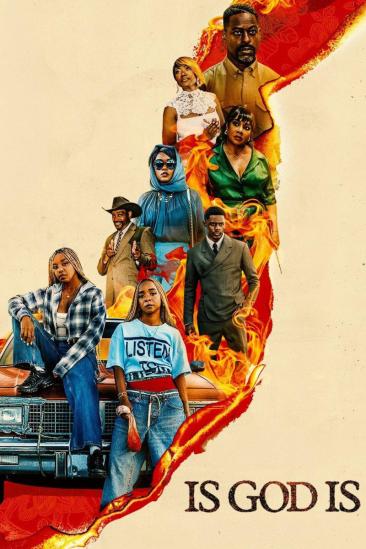
Okay, I’m desperate to watch a great film now; we’re nearly halfway through the year now, and I’ve been STARVING for a credible contestant to really burst my bubble and remind me that “OH YEAH, I LOVE MOVIES”. Enter “IS GOD IS”, a revenge tale that surprisingly had its legs cut off its theatrical run with a speed that felt almost deliberate. Like somebody out there was nervous about this succeeding the same way Sinners did.
It’s not at that level of greatness….but it comes pretty damn close.
You know how you can tell when a director is THAT intimately connected and woven into the fabric of what they make? Playwright-turned-filmmaker Aleshea Harris’s direction metabolizes her own creation like an extension of a single nervous system. There’s a specific gravitational pull to her work that oozes confidence, bursts with conviction and carries a ripe near-archival attention to detail that only comes from someone who has lived inside this story long enough to know exactly where every single nerve is buried; Aleshea has that quality in abundance.
Don’t let the simplistic appeal of the settings and locale fool you: Freyja Bardell’s production design is imperative to shaping the story. Most stage-to-screen adaptations never quite shake the ghost of being anchored to one spot, with the source material’s invisible walls still standing in the way; this one suffers no such drawback. The South unfurls into something beyond just a mere backdrop— it threatens to swallow you whole. Framed like a Neo-Western frontier, it’s a gorgeous, sweeping collision of the urban and the desolate that really luxuriates on both the scope and scale of the journey: each location remote, stoney and modern all at once, grubby in a way that feels earned rather than costumed as decay fills every scene. Cluttered but cozy one minute to sweltering and merciless the next, it’s the kind of geography that gives the general locale its own sovereign country with its own brutal set of laws.
Some of the best presentations in film are the ones that highlights and, dare I say, mythologizes every worldview and perspective we come across while never cheapening or flattening the thorny rules, plights and contradictions of the world it establishes. In keeping just enough theatricality from the play to make every new stop on the girls’ quest feel organic, it balances that sense of fatalism and exhilaration, and Alexander Dynan’s cinematography understands that assignment in spades. That being said, I’m of two minds on his camerawork; on one hand, it’s visually alluring especially on the ARRI Alexa 35 camera. The monochromatic color palette alternating between vintage sepia-toned flashbacks and multihued present tense creates this sense of a world both embracing and haunted by its own history; a double consciousness if you will. What gives me pause is the static, straight-on framing of the lenses; it’s a deliberate choice, clearly, one that mirrors the twins’ tunnel vision faithfully enough that it occasionally inherits their blind spots too, holding you at arms-length from the carnage just when you most need to be inside it. I felt the camera so committed to withholding that I worried I’d lost the thread of what we were even chasing.
Jay Rabinowitz’s editing does a great job in compensating for that, thankfully.
Clocking in at an hour and forty minutes, it never once betrays its runtime—no dead air, no overstaying its welcome— due to the pacing being much more calibrated and claustrophobic than it lets on. It works like a tightening knot, never announcing itself and covering enormous ground even as the walls are quietly closing in like this receding horizon; you hardly even catch on to how little room you’ve been given to breathe. Dreamlike visuals are aplenty; the Afropunk, spaghetti western and cyberpunk influences are all over this, and they don’t come off as a maximalist distraction but a necessary genuine extension to the story’s DNA, makeup and practical effects are exquisite, it harbors a very strict focus that feels strangely comfortable, the humor is ripped straight out of a standard Boondocks episode through a satirical, darkly absurdist lens, and my god, the tone is not just a chef’s kiss but a french chef’s french kiss in a Michelin-starred kitchen that’s also somehow on fire; operatic without the self-congratulation, brutal without the exploitation, and stranger and more alive than anything it had any right to be. This had every chance to feel glib or exploitative or just incredibly uneven like every Tyler Perry film released, well, ever….and it never does. Unlike the previous film I watched, the multi-layering doesn’t fight against how heightened and mythic and exaggerated the material gets; it demands it while stretching it wide enough to firmly grasp and laugh alongside it.
Oh glorious day, this soundtrack and musical score from Joseph Shirley and Moses Sumney is both soulful and haunting in its variety. Between the percussions, flutes, guitars, whistling, clapping Americana, gospel-like hymns and spiritual delta blues that’s unapologetically Black, this feels less like a score and more like a séance: the sound of a geography processing its own grief. It synthesizes the South while drifting west, pulling you through red dirt and open highway in the same breath, sacred and profane and thoroughly alive all at once. All of the sound design is strategic in prioritizing isolation and clarity emphasizing Harris’s theater background, Angelina Vitto’s costume design ’s costume design is very specific in color coordination and the southern punk rock aesthetic to offset not just Racine and Anaia’s distinct visual identity but everyone else's, and let's not forget that glorious R-rating. Equal parts stomach-churning and exorcizing, it wears it less like a warning label and more like a war banner; nothing gratuitous or wasted.
I cannot give out accolades to this ensemble fast enough; everybody arrives fully loaded, and the cumulative voltage of all of them together in the same film feels like a controlled detonation—each performance its own fuse, each scene the moment the charge finally finds the powder. Every line of dialogue, every monologue and diatribe, feels authored down to its marrow—theatrical in its bones, but charged with the kind of spiritual electricity required to carry a stage, and the characters feel less like people but grand ideas in human form…..and I mean that as the highest form of praise I can. Every single character in this movie embodies different facets of power, complicity, and trauma, exhibiting a psychological behavior pigeonholing and crippling them while also keeping them larger than life.
Vivica A. Fox and Janelle Monae both carry different types of fragility in the guise of their situations, and casting Sterling K. Brown who normally imbues his roles with a clear moral ambiguity and authority as the antagonist that anchors every other character in this story was an ingenious piece of work. But the real stars of the show are the two main leads: Kara Young and Mallori Johnson. The former’s simmering volatility and impulsive drive for accountability actually gives the angry Black woman stereotype a direction while the latter’s quiet shyness doesn’t come off as stiff or stoic; they clash with and against each other with such symmetry and their chemistry together is impeccable.
Similar to Forbidden Fruits, this is an adaptation of a play by the hands of the writer/director also but this time, the vignette structure in which it warps its entire story around is picaresque with a lot of loud echos to Kill Bill and Thelma and Louise. Yes, it borrows from an old narrative formula and on the basis, the story is deceptively simple and straightforward and almost laughably blunt: twin sisters, scarred across half their bodies, standing over “God”, their mother also boiled with burned scars, told to go south and deliver the same fire that scalded them to their abusive father. But all that simplicity gets detonated the way a jazz soloist detonates a basic twelve bar; it plays itself like a sermon, consciously taking the structure of the classic hero’s journey and improvising not for its own sake but for the sake of expressing something truer than the neat, tidy version of events. While making the journey helical and recursive as a relentless play of call-and-response, it makes sure you feel every tremor with an unmistakable fury that doesn’t feel performative or glib. It feels justified.
Can I also point out how refreshing it is seeing a film like this explore domestic violence and narcissism without completely glorifying Black suffering? For a film centered directly around the ramifications of different types of abuse and how it affects an entire family lineage, the fact it rarely forces the audience to sit directly inside its graphic violence or that none of said violence is aestheticized without purpose….is kind of refreshing (Promising Young Woman, eat your heart out).
Perhaps the biggest strength the script lends itself isn’t even something it had to try hard to suss out: mythmaking. Going back to The Boondocks again, most of this spins multiple genres or subgenres to deconstruct everything: the misogynoir Black men dish out, condemning the pillars of women who enable or are complicit of men and the violent system of patriarchy to the detriment of themselves and others, the general crisis of Black men murdering their own families, shining a harsh light on religion keeping Black people and Black women in particular from the full range of our humanity and emotions or the justified rage one feels to lash out at the world for all the horrific things done to you. But the way this spins how everyone creates their own mythologies to cope, to alleviate, to survive is what I found truly astonishing and it all stems from this existentially fascinating tension between “Creator” and Creation. Technically, both “God” and “The Monster” are creator’s in their own way not just in who they lead or leave behind but how their presence warps those they claim to follow. The woman hold all the narrative power despite it being the result of an abusive man tethering all of them at the center, and it’s all one giant pilgrimage through the national wound, dragging vengeance, guilt, blind faith and the smell of kerosene behind them.
Maybe that’s what I’m supposed to take away from the film’s title. Outside of evoking an African-American twist on the response of God from the Burning Bush when Moses asked who He was, it is meant to imply a question and statement simultaneously regarding uncertainty and fragmented identity. The incomplete truth. The weaponization of children being drafted to finish a “war” they should have no part in. Rage becoming legacy, giving us permission to crash out, to unleash ourselves, to feel justified in letting revenge be our only identity either in service of or in spite of the unprotected, disrespected, underestimated. The list goes on and on.
If I had to struggle to point out one such criticism, it would be the ending; more specifically, a main character death that occurs mere minutes before the credits roll. Now the film did foreshadow their inevitable demise a lot and how they go out is rather poetic given what the narrative built up about them, but the execution felt way too rushed. Arriving and evaporating before the weight of it can really settle, maybe sliding it back a few minutes earlier would’ve helped give the event more room to reckon with it and add to the emotional devastation of the entire journey.
Playful with pastiche and zeal, vicious in its deconstruction of Christianity and oppression and downright mythic in the way it transforms personal vendetta and Black Southern heat into something ancient and inevitable, this odyssey has a firecracker’s worth of energy to spare and the structural discipline to never let it detonate all at once. “Is God Is” is what you would consider a stellar blueprint for a Greek tragedy.