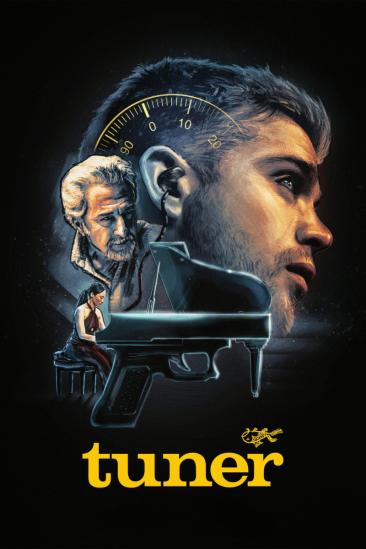
A talented piano tuner's life is turned upside down when he discovers that his meticulous skills for tuning pianos can equally be applied to cracking safes.
I don’t know if the question of “when will the next modern-day heist movie classic come along” persists in the year of our lord 2026, but as I mentioned with Den Of Thieves 2, the allure hasn’t exactly faded. Streaming’s endless churn keeps the bank-robbing, vault-smashing, general stealing tradition alive, if rarely vital, despite the focus continuing to be spent less on upending the formula and more on shuffling it around like a deck of branded playing cards. Still, I decided to take a gamble on one people insisted was one of the year's best.
Sorry to be the contrarian here: “Tuner” is a few octaves, three broken keys, and a quarter tone off from being fine-tuned into truly sensational. But I’ll be damned if this wasn’t mildly entertaining regardless.
For a documentarian making his first official foray into narrative filmmaking, Daniel Roher opts for a surprisingly expansive, almost anthropological approach. Yet, he also follows a semi-strict direction with very limited boundaries for implementation or imagination. This is a very loose, guerilla-esque foundation that unfolds with the meandering, observational quality of a documentary and thus drifts through its scenes rather than driving them forward, focusing less on the finesse of traditional narrative clockwork and more on capturing the raw, unvarnished texture of its world.
That carries over into Peter Cosco’s production design, which operates on a scope and scale wide enough to suggest a whole city breathing around the action, even if it never quite commits to the job. The film doesn’t convincingly integrate New York as an actual character within said narrative (it was filmed in Toronto), nor does it fully highlight the contrast between the wealthy and the apparent middle class — two missed opportunities in a story that practically begs for them. But what it does do, and do expansively, is augment the visual and physical spaces to reflect our protagonist’s dual nature: intimate, dusty workshops; wide, echoing instrumental spaces where every footstep carries, and the type of heist environments that dwarf the people moving through them.
Playful, pithy and composed in form and content, this film’s presentation is one that rarely takes itself too seriously while maintaining a decent balance of interiority, outwardness and verve. There’s a commendable attention to detail that’s noticeable right from the start and in not letting up, it becomes enough of a small fixation by mid-film to become its own brand of expressive amplification—so much so that it carries over to the other technical elements involved; there were two clear objectives here Lowell A. Mayer chose to abide by when ensuring his cinematography played the part it needed to: be willing to play around with the camera angles and find a way to make the visual presentation work. Since it has to throw a lot at the wall stylistically without giving into finesse, the warm color palette, quick cuts and variety of shots have to play like a collision of influences filtered through a distinctly personal lens.
Greg O’Bryant’s editing properly benefits the most from that flow outside the sound design. For every distracting little flourish and jagged cut, there’s about three more rhythmic choices that help minimize the far-fetched aspects.
For the most part, this is refined pacing here: clocking in at an hour and forty-seven minutes, it’s a lean runtime that feels justified and never seeks to purposely inflate itself for the sake of speed; the only downside to that is there’re multiple dialogue-heavy stretches that sap the film’s forward momentum considerably. Visual effects are used sparsely here but whatever does show up in isolation are decent, tension and suspense isn’t exactly achieved organically here (most of it comes from the hyperacusis affliction), neither the physical or emotional stakes were gradually risen enough to keep me thoroughly invested and even putting to one side the precarious balance between resonance and silliness, tonally speaking, it only just manages to walk over that tightrope. Less a hard-boiled, white-knuckled thriller and more of a laid-back noir with crime elements baked in, it’s a particular genre that knows exactly what it is and leans into that identity without fear of embarrassment; essentially dorky as hell about its own milieu, and it charms when it leans into its niche.
Will Bates’s musical composition isn’t quite a wonderful stroke of genius but it’s damn sure memorable. Centering itself on both a wonderfully jazz-infused soundtrack, and diegetic sound to better tie the protagonists auditory disability into the plot— both as a weakness and unique strength—it’s a propulsive that has to do much of the heavy lifting alongside the stellar sound design. Speaking of, said sound design from Johnnie Burn is nothing short of breathtaking, utilizing silence and subtle textures to create an immersive, dialed up, tactile atmosphere that puts you exactly in the moment….even if sometimes it can get too immersive and aggressive; Sarah Millman’s costume design leans into the warm color palette of the camerawork a little bit that help make some nice visual cues, and the MPAA rating Is a bit underwhelming. It’s a rather tame R-rating that shows very little blood and a lot of expletives but at least it actually passes as what it sells itself as.
As for our titular motley ensemble, they’re uniformly firm and well-rounded enough as a collective whole; all of them add their own varying degrees of texture without pulling any focus away from one another, going off of decently well-rounded dialogue exchanges and mostly committed, refined character work blossoming out of otherwise basic templates. Most characters here can’t escape being surface level, embodying the standard archetypes you expect in a crime thriller….which makes the hints of depth we do get out of two-thirds of our main trio equal parts refreshing and frustrating.
Dustin Hoffman has this fuzzy, irresistible warmth to his impish portrayal, Havana Rose Liu hits the ground running with this headstrong aura that makes her a focused, goal driven and complex love interest and Leo Woodall harbors something of a quiet intensity as a means to balance this craft-confident, anxious bundle of nerves simultaneously but he can’t quite pay off being this charismatic heartthrob with a sensitive stick up his ass; he comes off more conventional than I would’ve liked, and his range feels stilted. The rest play their roles solidly enough, though.
Despite how mouth-watering and hypnotic these heist narratives prove themselves to be each and every time, they all eventually harken back to the same formulaic blueprint in some shape or form, so forgive me if I wasn’t immediately blown away by what appeared to be a simple gimmick. Centering the entire structure around this, it bares a spiritual familiarity to Baby Driver, Sound of Metal and Whiplash (if only in the faintest sense of the word) and the comparisons here means it doesn’t have to pretend to reinvent the genre, because in some ways, it understands the same truth those films do: sound is not just texture. It’s psychology and identity….and this film does its damnedest to build itself around that idea in the same way as an actual piano suite: languid charm in the first, frenetic tenderness in the second, tempest loud brashness in the third before ending on a rather nice elegy. What begins as a lightly comic look at an eccentric profession slowly unveils two halves: sometimes, it’s the film it wants to be: patient, curious, willing to sit in the small moments and trusting them to accumulate a well-tuned engine with confidence. The film at least knows when to push forward and when to pause, allowing character beats to land without undercutting momentum. Other times, it’s strictly unimaginative and paint by-the-numbers and to anybody who has even a rudimentary understanding of storytelling, many of these twists will be seen coming a mile away, if only because certain details keep getting overemphasized; they choreographed these early and often. Not to mention despite the few nuggets of intrigue, I didn’t care as much for the main relationship between Niki and Ruthie as probably I should’ve; it’s a slowly burgeoning romance that gives both tight-lipped individuals permission to drop their respective guard, and is tracked with enough drama and care to feel important. But the chemistry between them kept throwing me off.
As a total package, it’s clearly designed to be an intentional stylish, mid-budget throwback to 1970s and 80s character studies (something I have to remember I literally took a class in back in college); it has a clear enough voice and strong sense of identity to get away with being deliberately evaporative. Still, guess it makes for a more accurate portrait of the deaf experience than whatever the fuck Square ENIX tried to do with The Quiet Man.
What really anchors the technical elements and keeps the story from being a mere scaffold for its aesthetic however….is an emotional thoroughline regarding human desire and the law of diminishing marginal utility: people with too much shit don't appreciate their stuff as much as people with less stuff. We want things differently when they are absent; romanticize them, obsess over them, make them feel like the most important thing in the world. But once we achieve them or they are back in our possession, they become ordinary again and the high wears off. On top of that, it carries an undercurrent of class consciousness (especially when enough seeds had been planted), ambition, passion, he idea of craft and how society assigns value to it, the terror of losing what defines you, and the strange, unexpected ways life can offer a new shot for those who feel they already missed it. For something as romanticized as music and sensationalized as crime, the film insists on honoring that labor, even when it leads to morally compromised places. Now, it is true that upon closer inspection, this extreme socioeconomic divide between the haves and have-nots is more half-hearted than I led you on to think; not much of it is substantial enough to truly stand out beyond the surface level but the pieces are all there to warrant discussion.
Unfortunately, the rest of the story doesn’t have that same amount of discipline. The issue is less on how predictable the story is….and more on how many loopholes pile up that become impossible to ignore, and by the final act, I almost stopped caring due to the bludgeon of mediocrity rapidly being thrown at the screen. People get away with murder, nobody seems particularly interested in investigating a robbery, Niki pays $36,000 in cash without anyone asking questions, the robbers somehow know things about Niki they shouldn't, Niki can show up at a hospital with half his ear cut off without the police becoming involved, the entire third act is one giant convenience….and eventually, it becomes just another crime thriller. From a logistical standpoint and through the perceived outliers of criminal mechanics, how do you expect me to not ask questions?
On a minor flip side, there is something rather morbid about the ending that I appreciated: how any obvious mistakes being made actually carry some consequences. No pretending everything will work out fine here; the bad guys get away and there’s an unfairness that’s quietly acknowledged due to falling for the temptation of a shortcut.
Most of the keys being played are familiar and the syncopation practically succumbs to formula due to how tropey and forgettable it is, but enough of the overall foundation of “Tuner” is alive and committed to its sensory world that slipping into autopilot is just downright impossible. It might not extract every ounce of dramatic potential from its simple idea, but you can’t deny it gives you plenty to talk about.