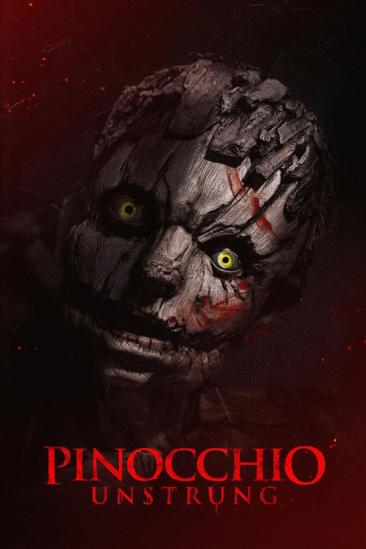
Influenced by a sinister Cricket and created by Geppetto, Pinocchio launches a violent crusade to carve himself into a real boy like his brother James, one piece at a time.
My tolerance for the Twisted Childhood Universe has undergone a strange and uncomfortable evolution—what started off as full-body cringe calcified into shivering annoyance before settling on a quasi-pseudo…begrudging respect. I’ve sort of made my peace with the fact that these movies keep coming, and at this point it seems like nothing short of a court order is going to stop them. What’s more unsettling is that when a new one gets announced, there’s a small, embarrassing part of me that gets more genuinely excited for that than I have for any MCU installment in recent memory.
“Pinocchio: Unstrung” continues the tradition of improving in some areas while also regressing; strengthening its technical prowess and broadening its adoration for the genre while trading in old weaknesses for new ones.
Once more, Rhys Frake-Waterfield returns to the director’s chair, and as per usual, his direction is still every bit as straightforward and formulaic as his efforts on the Blood And Honey films. Like, the way he offsets every scene and idea with an intended focus and trajectory for what’s to come is still admirable, and he rounds that out with enough technical resourcefulness and wit here to make you raise a few eyebrows. But at the end of the day, it’s still mostly pedestrian.
I swear, the more I look back at these movies, the more I realize the production design for all of these is like the least interesting thing. To Jamie Sneddon and Vito Velev’s credit, their combined production design feels the most….vaguely twisted…as far as atmosphere is concerned. Being set within the confines of an elite London prep school system, most locations work within the confines of the limited budget despite the lack of variety to them, so that when the movie actually does broaden its scope a little bit, the small, marionette-level scale makes for plenty scrappy, tactile visuals that don’t entirely pull you out. All that being said, it’s still tethered to a world-building approach that seems allergic to expanding its own universe; the lore it gestures toward remains teasingly underdeveloped, with breadcrumbs and loose threads either too heavy and/or literal to build momentum or mystery.
Operating on yet another shoestring budget, the presentation at the very least leans toward the general feel of shadow theater (even if only the opening is stylized to fully evoke it). Sketchy set-up aside, it also seems to mirror both the compositional restraint of its predecessors and the narrative structure of a fractured fairy tale, where the seams of its construction remain deliberately visible. There’s something almost endearing about how little it pretends to be more polished than it is—wearing the artifice of the thing like a badge of honor even as the occasional flourish of genuine craft peeks through, and it rears its head in most during its technical elements; by default, Vince Knight’s cinematography has the most purpose and ingenuity by default in this series, but strip away that context, and it barely holds up on its own merits. Overhead and medium/wide shots do a lot of the heavy lifting, with a practical sensibility informing every placement I can recall, and the lighting is arguably the most consistent the franchise has pulled off yet.
For as much as I want to praise the combined efforts of Rhys’s editing alongside Dan Allen, not much really sticks out with a few exceptions. It seems to come most alive during the kill sequences where an odd inversion comes into play, to where it actually works against itself; i.e, growing less purposeful and motivated the more elaborate the kills become.
One such factor with this franchise that I keep begrudgingly going back and forth with is the visual effects, and this film once again adds fuel to that fire; from merely the design of Pinocchio alone, it makes a genuine love letter to practical effects—animatronics over cheap CG, with digital work supporting, not supplanting, the handmade craft. That being said, whatever CG is used is laughable. Clocking in at a tight 82-minute runtime, there’s actually a better sense of pacing here despite occasionally stumbling into a ditch and holding everything up; the gags and quippy humor feel dated rather than charming, even with the few that do land; focus is still sporadic enough to feel lacking, and the kills are surprisingly in-depth. Most movies in this franchise are brutal with their kills and gore, but this has to be the most excessively vicious entry yet, with the kind of gleeful Terrifer-coded gratuity that’s abundantly gross and grisly in all the ways a cheap-and-cheerful slasher should be. But it takes nothing away from how muddled the actual scares themselves are and how much it borders on tasteless.
Christ, I’m just beating a dead horse at this point talking about the tone: the way it recklessly veers between B-movie schlock and grim stone-faced seriousness without ever settling down is a maddening seesaw that continues to be the franchise’s most memorable asset and most frustrating commodity. THAT BEING SAID, I will give this one a reprieve because it actually does nudge closer and lean harder into its own ridiculous absurdity more than its predecessors, fully committing to the camp in places instead of fighting it. It just isn’t the most fleshed out, nor does it go completely Cocoa for Cocoa Puffs as I wanted, yet it dips a toe in the glittery waters of self-awareness, and for this franchise, that’s something.
Andrew Scott Bell has always showed up and showed out with a resounding, hearty, strong atmospheric presence in his musical compositions, but this is probably the most memorable of his scores yet, with a clockwork pulse keeping the whole thing ticking with this mechanical dread. Still, it can get repetitive with the same few themes until there's a groove in the floor. Not all but enough of the sound design and mixing Rhys Warrington comes across as a little muddy and samey; there’s not much to the costume design that helps it stand out beyond looking casual or rustic; tension and stakes go hand-in-hand with how limited they feel despite the increasing escalation and of course, the ever-expected MPAA rating was always destined to be an R. It’s disgusting, bordering on cruelty as the violence accelerates, but I must stress there is a garish overlay here that the movie was probably better served without.
Do we actively expect greatness from the ensembles in this franchise? Because one of two scenarios happens here and there’s no in-between: either they all crash and burn or the uneven fluctuations between different performances unveil slivers of untapped potential the cast or the movie itself can’t quite play into. As per usual, we’re dealing with the latter here, as well as intensely remedial dialogue being dragged out by mostly one-note, uninteresting characters, many of whom are somehow more wooden and thinner than the puppet they’re orbiting, and the rest exist mostly as warm bodies queued up for the chopping block.
Richard Brake offsets his Geppetto with the obsessive, grief-stricken layers we’re familiar with alongside a chilling uneasiness, Jude Evan Lloyd supplies this Pinocchio with a familiar curiosity and innocence while threading an infuriatingly shrill, incel-like energy, and Robert Englund is gleefully cruel here while wisely doesn’t dip back into his Freddy Kruger reserves; instead marinating this oily, delighted patience and hunger for mayhem as essentially a devil on Pinocchio’s shoulder.
So if we dissect the original ORIGINAL story of Pinocchio all the way back to 1881, written NOT by the Brothers Grimm but instead by Italian author Carlo Collodi, we can see this narrative borrows strictly the obscene, morbid, and the macabre from said source material beyond that of an aesthetic degree; it actively looks to reach into the marrow of it while using the whimsical as a coat of paint to further reveal layers. Now, yes, you look at this narrative with a plot revolving around a devoted puppet becoming obsessed with protecting its person from every kind of “evil” and starts killing the people around them for the sake of that protection….and this is essentially M3GAN crossbred with Child’s Play again. Ironic how a Pinocchio obsessed with scalping victims to turn himself human has a movie needing to scalp the bone marrow, DNA and blood plasma just as greedily from better-known entries to justify its own existence—standard operating procedure for this franchise at this point—and yet the more genuinely surprising development is that the gimmick of reanimating another piece of stolen childhood no longer seems to be the only load-bearing wall holding the scaffolding. Similar to Peter Pan’s Neverland Nightmare, it feels more at home in horror as it did in the whimsical realm, but where most Poohniverse movies, or even the deplorable Mickey’s Mousetrap movie, seem content to let story and character fend for themselves, there’s a more genuine attempt here to actually see both through to something with a beginning, middle, and end.
Confidence is very important for a film’s execution, and the gradual growth and stride of rhythm it exudes the longer the narrative progresses is admirable. For as ridiculous the premise is and as tired as the anatomy penis jokes quickly become, it does a halfway decent job at twisting the original mission statement of the character into something morbid and semi-appropriate to mold into a horror movie; taking Pinocchio’s dream to become a real boy and twisting it toward a nigh-obsessive degree, one where he lets his restless, rule-breaking curiosity get the better of him and completely overtake his sense of right and wrong. Not only that, there’s a litany of Faustian motifs littered throughout here: Geppetto having a sort of god complex, Pinocchio being reminiscent of Gretchen/Margarete, his soul ultimately corrupted by his desire to be human, the very concept of shifting and warping one's morality as a means to cheat death and play God (similar to Blood and Honey 2 as a matter of fact), etc. All of this messaging is heavy-handed by the way, but when you consider it does somewhat tie back to the original’s themes of identity, morality, autonomy, and rising above the expectations that are placed on us…
…at least it lands somewhere in the general vicinity of thematic coherence.
Unfortunately, it doesn’t take away from how anemic the project still occasionally turns out to be. It’s no surprise that these plots are vaguely more semi-coherent than I initially give them credit for, but they all suffer from familiar drawbacks like lurching from one exaggerated set-piece to the next with little to no gameplan, essentially simply letting the pacing sag in a perpetual waiting game. Logic frequently takes a back seat to the outrageous kill scenes; subtlety isn’t invited to the party (this one in particular is very egregious with that); what little tiny threads of character development are present are raced through to an absurd degree and for as much as the Faustian elements are present, announced, sometimes even underlined, they rarely resolve into anything more satisfying beyond another gruesome set piece.
Most of the “best” bits of this movie are replays of other slasher clichés with not much in the way of satire—that being said, it’s not like it’s trying to be vaguely tongue-in-cheek and high art—but it’s not enough for it to develop a genuine personality of its own. It keeps getting undermined by a screenplay that comes off reckless and harmful in its depiction of school kids, displays an unpleasant and downright deplorable misogynistic streak in its victimization and language—there’s nothing hippy-dippy about the incredulous senselessness, and it’s not presented in the same fashion as Ride To Hell: Retribution treats most of its female characters, but it somehow feels more deliberate here—and runs on twists so obvious you’d have to be stone-cold drunk not to catch ‘em coming. Sure, you could say the big twist near the end was a preordained inevitability if you’ve seen enough of these movies play out—I sure as hell have—but it can’t help landing like an eleventh-hour spray-paint job meant to disguise a borrowed chassis rather than rebuild it.
Not to mention, the way the movie flirts with Pinocchio’s fixation doesn’t feel as strong a concrete trans allegory as it seems to think it is.
Keeping myself no strings attached to this installment only reinforced every cynical reservation I’ve ever had with this franchise to begin with. And yet, annoyingly, against all odds and better judgment, “Pinocchio: Unstrung” sputters to life just enough to suggest a faint, threadbare pulse behind this bloody stupid idea is still very much there. Let's not get it twisted: this still isn’t good….but in its own clunky, half-realized way, it does manage to carve out something marginally more distinct than its predecessors—whether that’s genuine improvement or simply the result of lowered expectations calcifying into a new baseline, I’m increasingly unsure.