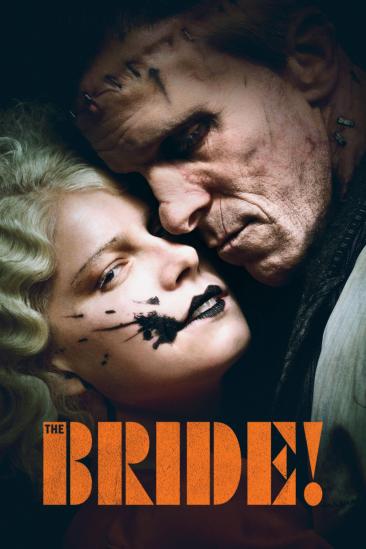
A lonely Frankenstein travels to 1930s Chicago to ask groundbreaking scientist Dr. Euphronious to create a companion for him. The two revive a murdered young woman and The Bride is born. But what e...
Hollywood sometimes feels so allergic to, if not success then betting on itself to tell more out-there stories; it’s gotten so used to taking the well-trodden, bland, algorithmic, ‘take no risks whatsoever’ watered down path of pre-tested plot points and characters designed by committee to offend no one, that it practically feels like a frictionless sweatshop with a constant metallic aftertaste of deja vu.
So allow me to preface that by saying the following: we need more movies like “The Bride!” But it doesn’t take away from how messy the final product actually is.
With this being Maggie Gyllenhaal’s sophomore outing as a director, I don’t know whether to classify this as discordant or grotesquely harmonious. She harbors such an unglued, manic, caterwauling style that leaves not an ounce of room for explanation or contemplation in anything other than the broad strokes she paints. Every brief instance Maggie warps the chaos into something vaguely ghoulish and operatic, there are ten more that harbors the spirit of a rambling orchestra—half the the musicians playing Tchaikovsky and the other half smashing their instruments against the wall.
Karen Murphy’s striking art deco-meets-gothic sci-fi production design is so theatrical it hurts. Like an endless pop-up book, its variety of flashy vaudeville and cabaret backdrops is meant to stretch beyond its borders with this bodacious form of experimentation as a love letter to classic cinema….and while yes, this grafting of modern culture onto the 1930’s is meant to feel slightly off-putting, it still feels oddly more scatterbrained than if she went fully anachronistic. Its a bloody nether-realm between reality and multiple layers of fiction, magic realism and artifice that sometimes gels and other times cracks, especially when the rules and stipulations of this world and the possession are just never established or followed up on.
Frustratingly abstract, a movie presentation such as this is imperative in showcasing how too much maximalism dilutes the core focus and it outpaces whatever control Gyllenhaal wants to exert. Luckily, Lawrence Sher’s cinematography is effective at communicating the chaotic nature of Ida and Frank’s adventure, its anarchic commitment to stylistic excess becoming oddly compelling between its bombast lighting, shadowplay and decent framing. Although the occasional dutch angle does bring back Battlefield Earth PTSD.
Editing-wise, I can only call out three separate transitions I like; the rest are just fine.
Pacing within itself is a paradox—simultaneously feverish and sluggish with an intoxicating energy to it, like watching a hummingbird trapped in amber. Yet somehow, I remained mesmerized by its peculiar temporal distortion despite the two hour runtime stretching out like taffy at an exhausting rate. Visual effects showcase impressive technical prowess—clearly benefiting from every dollar allocated to their creation, I can’t say there’s much in the way of meaningful tension or suspense, and the tone is the dictionary definition of hodgepodge. This horror-gangster-musical-romance mashup doesn’t know where it ends, where it begins or when enough is enough….and that’s ironically part of its charm. This chaotic pile-up between 1930s noir, punk-rock riot, and Mary Shelley possession is constantly fighting for oxygen like its gnawing at its own entrails, and yet—like a wounded animal—it keeps moving and you can’t look away.
Hildur Guðnadóttir’s score is very atmospheric and brooding and overzealous in the way it lurches between haunting deep orchestral whispers and thunderous raw punk crescendos like a submerged leviathan, scraping against itself like tectonic plates. The sound design and aural landscape rivals—and sometimes eclipses—its musical score, Sandy Powell’s costume design is nothing short of remarkable; being mostly accurate to the time period despite her wardrobe choices not entirely telling their own parallel story entirely through fabric and form, makeup and prosthetics are impressive, the few dance numbers we get are supplied with sufficient, better-than-average choreography and for what its worth, the MMPA rating is accurate; this wasn’t going to be anything but an R-rating.
Something is very obvious regarding the performances here: everyone is alternating at a different wavelength. Nobody is terrible here per se but they all feel like they’re coming out of vastly different flicks. Most of the more memorable dialogue is given only strictly to Ida’s character while almost every other character here is strictly underdeveloped, dampening the performances behind them and stagnating them.
Christian Bale throws himself head and heart-first into Frank’s uncomfortably comfortable triage yearning even though he has to race to keep pace with what’s happening around him and despite playing a character this bizarre, counterintuitive, and utterly chaotic (also with a lot of screaming), Jessie Buckley carries out the task with gusto in a manner as equally frustrating as it is strangely fixating. It limits her down to only a few separate quirks and the dynamism wears off but hot damn, does she truck along and give it her all.
Sorry to say, but the narrative never plays out like it has a consistent vision and flounders not just to convey larger ideas, but what’s even going on from sequence to sequence. It keeps rebounding in such a way that the unwieldy script comes off underwritten and overwritten at the same time despite barely having a story to speak of. Ok, I’m being a bit harsh there; its more of a gothic reanimation/reimagining of 1990’s Wild At Heart with a really fascinating set-up, playing with Mary Shelley's authorship and self as being interspersed with the Bride character, blurring the line between creator and creation. By weaving Shelley’s identity into the Bride character, the film attempts to reclaim the Frankenstein mythology from dusty horror conventions and transform it into a howling, politically charged manifesto that's as much about incendiary female rage as it is about reanimation.
It, unfortunately, just doesn’t do it that well to me.
So many tonal extremes and gapping wide branches of logic and none of them are bridged properly in favor of the film riffing off Bonnie & Clyde, Babylon, Poor Things, Fritz Lang’s Metropolis, Joker: Folie a Duex and other Frankenstein films like a greatest hits package on top of various Lady Gaga and Billy Idol music videos with the faintest of connective tissue. Events unfold less through cause and effect than through sheer creative impulse: things happen because they feel exciting in the moment rather than because the story demands them, its embrace of its genre juxtapositions leads to a narrative scruffiness that feels exposing and the end result is a film that scrambles to be everything and nothing at once. I kept waiting, in vain, for SOMETHING to latch onto— a monster movie that would disturb me, a gangster flick that would thrill me, a love story that might move me or a comfortable conglomerate between the three that wasn’t so bloody derivative—but it never trusts the audience enough to feel just one thing for themselves. Even when the kaleidoscope briefly stops spinning and the film attempts something resembling traditional storytelling, it feels like you’re stuck in quicksand.
You remember these lyrics from Heavydirtysoul—Rappin' to prove nothing, just writin' to say somethin','Cause I wasn't the only one who wasn't rushin' to sayin' nothin'? Cause that’s the general feeling I’m getting towards the way the film approaches and then discards its themes. At best, it’s too overcrowded and at worst it constantly insists upon itself only to contradict itself in favor of whatever' the movie’s next passing fancy is. For fucks sake, even Folie a Deux had something interesting to say regarding its critique into a system that has long since exploited the mentally ill, the escape into idealism and how shielding yourself from the world’s cruelty makes you cruel in return, propagating the fantasy you create in a way that effectively destroys your life and everything you touch. The only consistent weighty themes this film constantly back up is the interrogation of consent and female rage in a patriarchal society, the rigid thematic spine of the many different types of abuse of women meted out by men and revolution via rebirth….and its delivered in such an intentionally hamfisted, phony, ‘hear-me-roar’ postsigny fashion that any good will it could’ve garnered just gets smothered.
Upon closer inspection, the best way I can explain this or grasp at some straws to work my way around this is point out the faint contextual tissue that the films constant limbering aimlessness and fragmentation is meant to mirror The Bride’s own external crisis. Just as she lurches from scene to scene searching for meaning in a world that sees her as merely a creation rather than a creator, the film itself refuses to settle into any recognizable pattern highlighting her lack of a purpose and her drive for one; its a structural chaos that feels experimental in itself, beautiful in isolation but grotesquely uneven in its forced union and would’ve bolstered the movie’s dance between non-consensual usurpation and certified self-agency….if it didn’t try to tackle too little with too much. Even upon throwing up my hands and just allowing myself to go along for the ride, I could never overlook that.
Similar to the now-famous creature, The Bride’s relentless ambition to bring a creature of this nature to life is both a feature and a bug; filled with half-finished flourishes, tics and stringent approaches but also plugged up with such radiant energy and audacious anarchy that suggests a far more interesting movie buried beneath the noise.