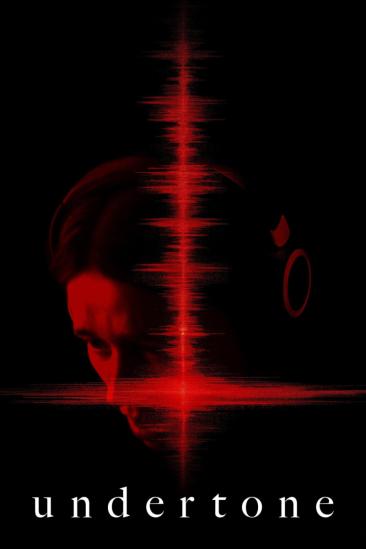
Some of the best horror movies we’ve watched and made throughout history are amplified not by what we see…..but what we hear. The aural landscape of making a horror movie is very important in transforming the mundane and ordinary into unearthly instruments of terror—whether it be the spine tingling violin screeching, whispers of static beneath dialogue, the strategic absence of ambient noise that strains your ears into silence, its these types of sonic manipulations that help convince anyone to be slaves to a conjuring trick.
On that regard, “Undertone” achieves exactly what it set out to do. In regards to LITERALLY EVERYTHING ELSE, it’s a victim of its own competence.
Canadian filmmaker Ian Tuason’s feature-length debut as director is one where it constantly feels like he’s calling attention to himself. You can see the Paranormal Activity influences plastered all over his work and while Tuason demonstrates a functional literacy in the basic grammar of haunted-house horror to a degree, there’s something….coldly mechanical in how he applies them that cripples any genuine dread or intrigue from taking root; despite coming so close to nearly exploiting a relatably vulnerable position we’ve all put ourselves in, he never commits to capitalizing on that psychological territory.
The prioritizations of negative space within this otherwise terminally drab house setting come so close to bolstering something real out of Mercedes Coyle’s production design….mostly because of how much she lingers on our imagination to make the most out of it. Much of the faded, old-fashioned religious decor looks unsettling at first and stays wholly within the realm of its small scope and scale without overreaching and trying to break itself to feel bigger, making effective use of the modest budget…..but with such a limited range, the novelty of the place wears off fast with the the setting’s limited scope quickly exhausting its welcome. It looks convincing but despite Merecede’s best efforts, the very restraint it preaches indefinitely traps it in an atmosphere of indifference and can’t help but feel synthetic; after half an hour. We’ve seen all the house has to offer.
Everything about this presentation just screams two words to me: poorly defined. It’s a cinematic magpie that snatches shiny pieces from so many other successful horror formulas but never alchemizes or molds it together into something doesn’t feel hollowed out and….odd; just this taxidermy of palette, posed in an awkward, uncanny valley stance. Props to cinematographer Graham Beasley for trying to make the visually appealing though; his cinematography deserves recognition for its visual ambition, even if the execution falls short. While he relies heavily on standard wide, medium, and close-up shots typical of the genre, and employs unremarkable color grading and lighting choices, there’s still something to appreciate in his efforts to elevate the material.
Sonny Atkins editing is mostly in rhythm with adjusting its energy to catch up with the camerawork but even then, its nothing special.
I can’t mince words here: as much as adore a slow burn as much as the next guy, the pacing here is lethargic to the point of rigor mortis. Every scene lingers about a beat too long, inching forward with all the urgency of a continental drift while the hour and a half runtime is manageable but stretches itself thin otherwise; there’s nothing taut or effective about if and might’ve been handled better if it was simply condensed as a short film. Most of the visual effects are subtle enough to hint at a more traditionally enticing payoff than what it gives you, the suspense it so expertly crafts at the beginning slowly dissolves into irritating white noise while the aggravating drone of meaningless jump-scares pile on and the tone is par-of-the-course for the genre; this really really dour suffocating blanket of gloom that drapes over everything and mistakes joylessness for gravitas.
Given how much of the promotional material and marketing hyped it up, I’m glad to see the sound design sticks the landing as the film’s saving grace; utilizing a Dolby Atmos sound mix to wrangle control of a genre that is inherently maximalist, it shoulders the full brunt of having to carry a lot with a little but even with all that good will, it never feels like there’s an effort behind utilizing the stressful sound design to underline any complex themes. Just makes you question ‘what was even the point’ besides jolting you awake? Sharika Lewis-Beasley’s minimalist score is appropriate but is otherwise unremarkable in the grand scheme of things, there is an obvious color dichotomy in the costume design between Evy and her mother to express the two’s lifestyles but that’s extent of it and considering how tame the R-rating is (at least in context of what we end up seeing), it feels like false advertising given how little gore or genuine terror makes it through—this could’ve easily passed for PG-13 with minimal edits.
For what it’s worth, whatever we see or hear of the performances is a sign everyone was doing their best, a genuine commitment to elevating material that offers them precious few opportunities to shine. Dialogue is uniformly basic and I had to strain myself from not immediately bashing these characters because there are barely any here; what we do get from the few that are present are fiercely two dimensional to pick apart outside of our lead.
At its core, this is essentially a one-person film and Nina Kiri, tasked with carrying the entirety of the film on her shoulders, gives a committed enough performance to sell her as someone constantly contradicting what she wants and how she feels in a bid to maintain either control or stasis.
This story is being executed with the fervor of someone who has seen every other horror movie, and learned the language of the genre to perfect fluency within those boundaries. On the surface, it doesn’t have a fleshed out foundation but the amenities can convince one this is worth sticking around for to enjoy….but you know what the most damning part of that is? It’s literally everything surrounding that sucks the fun out of the experience. Jesus Christ on a bicycle, this narrative was so bang-average it’s not even funny. Yes, the structure makes it clear this is one such film that doesn’t feel the need to explain itself and I’d be more inclined to give that a pass if this story actually had enough meat on its bones to make it last a full feature; instead it’s the Graveyard Shift episode of SpongeBob stretched and padded out beyond its barely-threaded together connective tissue in a desperate bid to hide the obvious: its so nakedly repetitive and boring and it gets boring FAST.
An unfocused haze of stagnancy leads us to be strung along by ninety-plus minutes of visual and auditory red herrings, meaning the gimmick with its sound is the only consistent thing the film can fall back on. It may know how to sustain its premise for a little bit and the mythos behind the alleged supernatural occurrences do thematically tie into what’s happening but it’s the sloppy kind of lore that isn’t exactly interesting and the actual horror itself is wafer-thin when it does hit the ground running. Not much happens until we get that Exorcist III/Silent Hill 2 style finale where everything just starts going screwy and it’s the equivalent of spaghetti being thrown at the wall in the hope that something sticks.
Look, as a whole, I can sort of put the pieces together: Catholic mom instills creepy beliefs into her daughter that do not germinate and bloom until her mom dies, thus rendering the daughter incapable of having a functional life and her descent into isolated madness for not living the life she thinks her mom wanted, and when it flirts with being psychological, it gets close to being about something. But unlike a film like Saint Maud which juggles its religious psychosis toward a natural conclusion befitting of the circumstances the movie built up to, there are so many hagsploitation tropes from the days of horror’s past that Undertone either can’t properly juggle or never takes advantage of; children dying and/or being offered as sacrificial lambs, the constant tug-of-war between being a skeptic or a believer of the faith bestowed upon you, young woman being unfit for the role of motherhood and the seemingly never-ending cycle of cold-blooded matricide and filicide that comes with it. Hell, the very end of the movie restructures everything before it and plays off more like a screed against abortion and the residual guilt that comes with it in a deeply religious household, vaguely playing with the satanic panic of the 70s and 80s. None of those themes or half-realized parallels are given a constant follow-though however and everything builds to basically no payoff.
I know I’ve said in the past that the moviegoing experience isn’t focused purely on the storytelling but also on the vibes and how well it succeeds in making you feel the way it wants you to feel; this whole damn industry is curtailed and pinpointed to perfection to be as emotionally manipulative as possible to sell us an immersion. Ambiguity can be enticing, suspenseful, and disturbing in horror when played correctly…..and this just feels like somebody’s first attempt at making a horror film; an inoffensively bland one.
This is Skinamarink all over again; more interesting as a feel-good success story and phenomenon than an actual movie in and of itself. As an experiment in atmosphere, “Undertone” nearly convinces you the absence of stimulus is itself a spectacle, but only in the way a mousetrap has something working in its favor right up until the snap; the sound design is its premiere saving grace. Everything else falls short.