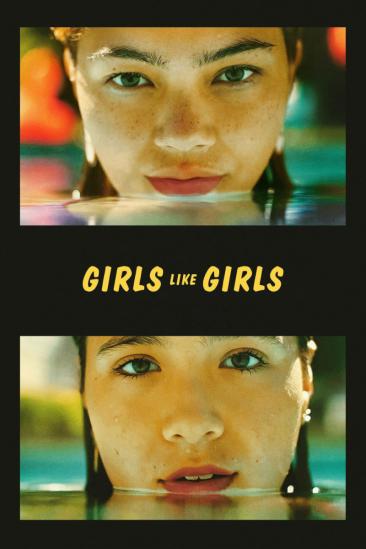
Coley, 17, from rural Oregon, navigates intimacy after her mother's passing. Meeting Sonya sparks new feelings, but self-doubt hinders their connection. Sonya, unfamiliar with dating girls, is unce...
Lemonade Mouth came out over a decade ago, and its cast has not exactly been lying low. Bridget Mendler pivoted to running a satellite data startup, Naomi Scott somehow collected the titles of pop star, Charlie’s Angel, Disney Princess, and Power Ranger without breaking a sweat….and Hayley Kiyoko built a name for herself as a best-selling author and LGBTQ advocate. That last one is why we’re here, because Hayley has now taken her novel “Girls Like Girls” and turned it into a feature film.
Yep, this is definitely appropriate for Pride Month. And its about what I expected.
Hayley Kiyoko isn’t exactly a first-timer here—she already directed the “Girls Like Girls” music video, which makes this feature film less a debut than a long extension of something she’d already started. And I believe it shows: the whole thing has this chill, laid-back, unhurried quality that most first-time directors would struggle to pull off. Now that’s not to say her direction isn't immune to the occasional odd misstep and overreach, but it does feel mostly honest—and more than that, it feels generous.
I wouldn’t put it past you to mistake Morgan Lindsey Price’s production design for strictly bog-standard; the rural-focused setting makes for a fairly accurate time portal back to 2006 but serves as window-dressing otherwise… or so you would think. Ok, it does do its period work dutifully enough, but I do like how many of these settings and locales are deliberately constructed to feel as intimate and inviting as possible. A deliberate softness to the geography and a quiet intentionality to the interior and exterior layouts congeal with that kind of vibe in the mid-2000’s and makes the environment easy to immerse into, the era seeping in through the cracks rather than announcing itself and making the nostalgia more digestible and a little dreamy.
Presentation-wise, it’s aware it takes a lot more than era-accurate details to fully sell a time and place, however, and both Sonja Tyspin and Chris Saul take that assignment in spades. Both of them adopt their cinematography styles eloquently so that the framing of each shot feels like a direct homage to Hayley’s music video while also feeling like a natural extension; between the natural lighting, a mid-range saturation aesthetic with each character having their own distinct color palette and simple but effective staging, the result is actually quite lyrical in shot composition and imagery.
Christine Armstrong and Sabine Hoffman’s combined editing is quiet confident work, mostly clean and unobtrusive and unshowy in the best possible sense.
I’m of two minds regarding the pacing. Clocking in at only 97 minutes, it somehow feels just right and not right enough at the same time. It crams in and throws a lot at you in quick succession that you barely keep track of beyond the first act; that being said, it harbors much better momentum and sharpens its focus once Coley and Sonya’s love story truly finds its rhythm, and it’s that very briskness that kinda starts working in its favor. The few visual effects I was able to find do hold up pretty sturdy, much of the film’s linear focus , the emotional stakes, in hindsight, feel somewhat muted in a film that’s already supposed to be emotionally complex and heavy, and I feel like I can get away with saying this: the tone is ridiculously sapphic. Like, I’ve mainlined enough GL content out of Thailand this year alone to have developed something of a calibrated internal meter for this stuff, so I can tell you with some authority that this film is unapologetically, almost defiantly gay in a way that feels genuinely celebratory rather than performative. It’s still breezy and self-serious in the ways it needs to be.
Appropriately atmospheric, Jessica Rose Weiss’s musical score drifts, draping the film in something warm and wistful in a way in which it makes space for the emotion to truly fester and crystallize rather than just underscoring it. Sound design is competent in its more retro sensibilities, the costumes from Kelli Dunsmore stand out in lieu of matching the Y2K summer aesthetic; Coley’s transformation from timid griever to assured, confident lesbian through her flannel wardrobe and Sonya’s constant flip-flop between vibrancy and masked shadings stand out more, and if you went into this expecting anything other than a PG rating, you clearly haven’t been paying attention to what film you were getting here.
Overall vibe I got from the cast was….very inviting. There’s this generosity to how they share the screen; nobody draws too much attention to each other, existing alongside the other with this easy unforced naturalism that makes the performances surprisingly authentic. Dialogue is TeenNick levels of awkward and stilted, and doesn’t try to hide how unsubtle it is, but there is a faint authenticity to that awkwardness that some of these interactions carry, and they do improve the longer the movie progresses…….and honestly, the same can be said for the characters as well. They are derivative, make no mistake about it, but its in that simplicity that they become malleable clay rather than hollow outlines.
Both Maya da Costa and Myra Molloy bring distinct energies to their roles that help anchor them as the leads; the former bringing a quiet, surprising emotional maturity as Coley and the latter being frustratingly passive, inscrutable and understandably unconvincing in how she presents herself as Sonya. Their chemistry is mostly affectionate and while there are a bit too many scenes where they go out of sync (specifically since Myra doesn’t quite play unconvincing subtlely enough to bely Sonya’s facade), the duo have enough warmth and pull to where I actually buy into their genuine love and longing for one another.
Even if you hadn’t read the book, I reckon most of you were able to catch on to how rudimentary this narrative was likely to be: a young woman maneuvering through adolescence moves to a small town with her remaining parent following the death of the other, and during the summer, starts falling head over heels with the popular girl at school. It’s a tried-and-true template that sticks to a simple formula all the way through but it’s one that the film executes earnestly, taking every cliché as invitation to be kneaded into something quietly lived in; it’s less an actual old-fashioned romance story than that of a coming-of-age drama about two young people with very different psychological needs whose converging moments just happen to curl into the shape of a love story. That distinction matters, because the emotional logic here is less about narrative catharsis than it is about the daily, tedious labor of forging an identity when every institution you know seems invested in erasing yours. The romance is not so much a destination as a byproduct—an emergent property of two people slowly realizing that they see themselves reflected most clearly in the shatter-pattern of the other’s vulnerabilities.
Now, the film doesn’t shy away from the possibility that these two might not last, or that their story might be more a prologue than a happy ending; it just insists, stubbornly, on the truth of the connection while it lasts.
While not immune to the gravitational pull of its own genre conventions, the entire structure has a tenderness that feels quiet enough to avoid the broader, louder, bulging clichés of the genre, and even when it does lean into said clichés, it actually feels like it fits what’s being shown to us rather than just for the sake of it. Ironically, that also makes the screenplay a bit more rewarding when it does lean into that vulnerability and forces Coley and Sonya to confront their own personal issues regarding shame, self-acceptance, and internalized homophobia. That being said, it’s the bare minimum the film executes, and the runtime doesn’t lend itself to sitting inside that discomfort long enough for it to fully breathe or metabolize….but it’s refreshing seeing a coming-of-age rom-com can still make room for that kind of emotional wreckage: the faltering, the backsliding, the feelings that don’t resolve so much as they just eventually get quieter before you can come back stronger and more assured.
But with all that comes some….rather head-scratching dilemmas inherent to the film’s narrative construction. There were a handful of slight but memorably misguided choices—the way the film portrays a particular side character despite her seemingly helping Coley numb the pain and forget, and completely dropping the abuse angle from the book and music video stand out—that set off a few alarms with regard to the intent of the film’s storytelling throughout. Despite this taking place in an era where loving the same sex still possessed implicit social danger, there are certain changes made where you can feel the modern world pulling in and neutering specific elements that could’ve made this feel more authentic. As much as I’m glad that abuse angle from the book didn’t make it into the film—and let’s not get it twisted, I’m ELATED I didn’t have to see that—it just comes off as the story keeping its cards close to its chest and playing it safe.
And that’s just the thing: it hints at larger conflicts and consequences, such as how friends, family members, or romantic partners might react to the relationship, but many of those situations remain implied rather than fully explored.
Sweet without being saccharine, tender without being precious, and unpretentious in a way that actually takes some doing, “Girls Like Girls” is undercooked in places and unabashedly simple in others—but it wears both of those things lightly and without apology, the way a lazy July summer afternoon does. It’s the kind of film that knows precisely what it is and what it isn’t and makes its peace with both, not needing to be anything more than that.