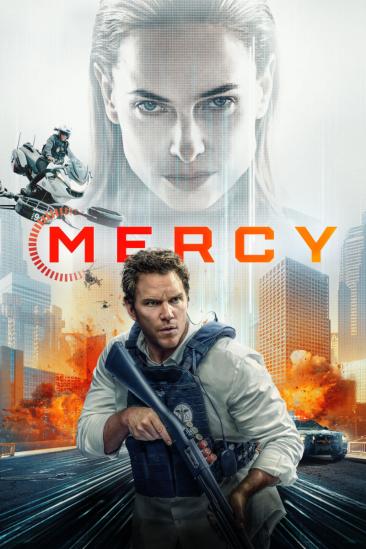
In the near future, a detective stands on trial accused of murdering his wife. He has 90 minutes to prove his innocence to the advanced A.I. Judge he once championed, before it determines his fate.
Some movies, on top of just being confusing, illogical, dated or just plain bad, can also spectacularly implode when they crash-land into our lives at the wrong place at exactly the wrong time. Like a tone-deaf comedian telling airport jokes on September 12th, the timing of “Mercy” couldn’t possibly have been any worse.
I knew I was gonna be in for a field day upon discovering director Timur Bekmambetov here was a leading producer for Ice Cube’s War of the Worlds as well as other screenlife movies like Searching, Missing, and Unfriended. Despite being very much in his comfort zone, he is very haphazard and, dare I say, lazy with a direction that borders on uninspired autopilot. With a shocking carelessness that could border on contempt, its like watching a virtuoso pianist lazily plunk out "Chopsticks" with one finger.
Production design in movies such as this are always difficult to make intriguing or carry a blueprint to stylistically build upon its attention to detail. ‘Searching’ and ‘Missing’ only just managed to pull it off; this film cannot. Alex McDowell’s construction of the not-so-distant future is supposed to feel like a high-tech, clinical minefield but this is an early indiction of the movie’s commitment to half-measures. Its sleek modernism is quite plain and is utilized a lot less sparingly to the detriment of the plot than one might theorize, setting up its parameters with a lot of scotch tape. Everything looks like an iOS update almost designed to nudge the viewer into a state of passive recognition and while small splices of the atmosphere here are equal parts oppressive, squirrelly and uncertain due to the ticking-clock dynamic, the scope and scale of this world are somehow both suffocatingly small and impossibly sprawling. Making the world-building this desultory and inconsistent by refusing to follow its own rules is just the kiss of death.
For being strictly a gimmick movie, the presentation doesn’t embrace the gimmick to its full potential. It’s unable to quite click into what makes the movie work in that format and the circumstances surrounding the world and genre it inhabits don’t allow the same kind of familiarity that makes the medium feel fun or exciting; seeing as the cinematography has to carry the brunt of that burden, it also unfortunately carries some of the blame. I find no joy in criticizing Khalid Mohtaseb's cinematography, yet I must point out how clumsy and amateurish the screenlife camera implementation feels throughout. While the concept of blending traditional film framing with desktop interfaces could have been innovative, the execution here is spotty.
Let’s not overlook the banal editing, the cuts come rapid-fire without ever building momentum, each scene bleeding into the next with the grace of a malfunctioning slideshow—no, scratch that—like someone flippantly flipping through channels.
With the pacing prioritizing speed over substance, its obvious I’m supposed to be immersed but the breakneck velocity with which we careen from setpiece to setpiece leaves no room for genuine tension to build and it certainly doesn’t help that the 100-minute runtime actively has to invent reasons to spin its wheels and stall for time. Visual effects operate on a budget around well-rendered but completely uninspired VFX shots that do little more than provide generic, paint-by-numbers action, whatever action we do end up getting is absolutely pitiful—landing with all the impact of a deflated balloon, and the tone doesn’t know what to do with itself: baffling as a thriller, but unintentionally funny as a satire of tech-paranoia cinema, it’s all built on a haphazard focus that keeps changing and never settles on anything concrete.
Only one of Rabin Djawadi’s score pops off as even vaguely memorable and that’s only because it keeps riffing auditory cues from Annihilation; the rest of his musical score is appropriately minimalist for the material but its so muted that it just fades into forgettable background noise. Thankfully, the sound design only just fares a little better in offering more consistent atmospheric tension, Anthony Franco’s costume design is full of generic contemporary clothing with occasional half-hearted futuristic touches in a dystopian setting that begs for more visual storytelling through attire and honestly, I had to do a double take on which MMPA rating this was because it is so aggressively tame. This is PG-13?
There isn’t a single believable person in this cast that isn’t just phoning it in, stuck in thankless positions with very little to do or even when they are trying, the script is constantly working against them, giving them mostly bare-bones dialogue and rudderless characterization that is dull at best and inconsistent at worst.
Chris Pratt is basically doing a less enthusiastic take on what Ice Cube did with War of the Worlds, just nowhere near as funny or with a believable range to feel genuine. Personal preferences against the man aside, he is overacting his ass off trying to make his bland characterization stick to no avail. Honestly, I could say the same with everyone else including Rebecca Ferguson and she’s the only one here who’s actively up to task.
Yeah, I’m not gonna bother sugarcoating anything here; this script is just insipid with how acrimoniously double-edged and two-faced it is. For how digestible it looks on the surface and how played out the screenlife gimmick has become—a damn shame considering how well the screenlife method of telling stories through laptops and desktops has been put to effective use in the past—every opportunity it has to make even the bare necessities of this basic plot sing, the plot either doesn’t take it or strains credulity at every juncture trying in a bid to stretch the truth. Maybe I would’ve been more receptive to the narrative not strictly adhering itself to the screenlife formula if I wasn’t constantly reminded how conceptually derivative and textbook this was with every avenue it takes.
As we are living in our own dystopian hell, where people are actively being stripped of or blatantly giving away their freedom for the sake of alleged security, so much of this narrative’s moral framing feels backwards and only grows more disjointed as the titular three-act structure becomes more arbitrary and laughably over-the-top. Sure, you could give it brownie points by actively admitting official punishment involves too many grey areas to be adjudicated by a computer, but it immediately loses said points by never once questioning whether or not it’s a violation of the privacy of people living or dead to give Raven this much access to their personal data. The absurd contradiction of the accused still pleading their case through the omniscient access despite that same access finding them guilty is an anemic afterthought, especially when the film never bothers framing it as a dilemma or something to inspire any hesitation, and the lack of any concrete emotional cruxes to anchor the film’s approach to morality makes every attempt at it fall dispiritingly flat.
I think you get the picture by now: putting aside how much this was executed better in Minority Report, this narrative straight up has no balls, not having the temerity to throw out these empty red herrings when it knows damn well it has no real moral or ethical dilemma. Meanwhile, the actual solution to the mystery is both predictable and absurd with how much property and bodies need to be put down to prove it; keep in mind, this is the kind of movie where you can narrow the outcome down to one of two endings and decipher the big twist within minutes so in the grand scheme of things, this flimsy pretext for the concept really shouldn't matter. Except it does, because it’s a testament that reveals the movies true slight-of-hand: where Minority Report warns that even perfect systems break when operated by imperfect people, Mercy suggests the opposite—that human reasoning itself is the contamination, the defect in an otherwise flawless machine; bow before your digital overload. Don't dare interrogate the divine algorithm that's just a fancy desktop background with delusions of godhood while it simultaneously conflates the conditions of homelessness, inequality, and violence like an advertisement, lazily curating a ridiculously naive and infantile viewpoint of criminal justice that is just plain wrong.
That’s not even going into the "bipolar" AI fluctuating between "caring" assistant and cruel emotionless tormentor with zero explanation, windup or telegraph, actively missing or leaving out crucial information that it shouldn’t have, and despite these glaring inconsistencies, is so ridiculously omnipresent that there’s no tension to Chris’ own search.It has access to everything, all this information, all the pieces to the puzzle, but yet can't put it together on its own? You’re actively going out of your way to alienate people with AI-worship and thinly-veiled authoritarian propaganda and you can’t even do the propaganda correctly, let alone search for one half decent excuse to defend AI without putting an giant asterisk next to it? I know I’ve been grasping at straws trying to be realistic about AI usage in the past but like, this was a house of cards that was destined to fall.
A movie so destitute that my computer actively fought to keep me from finishing it, I actually felt dirty for watching “Mercy”. So shameless in its desire to twist itself into grotesque and convoluted knots to defend its pro-AI, quasi-fascist copaganda that it snaps its own spine in the process, making its few brush-ups against competence all the more infuriating. This is corporate ministry levels of self-sabotage.