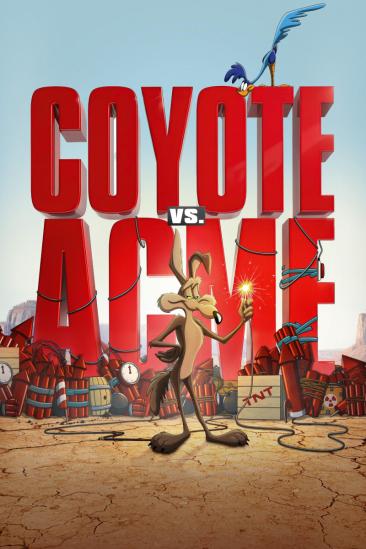
After Acme products fail him one too many times in his dogged pursuit of the Roadrunner, Wile E. Coyote decides to hire a billboard lawyer to sue the Acme Corporation.
Regardless of whether the film does well or not, “Coyote vs. Acme” is destined to go down in history as one of the greatest saves in the history of Hollywood. One of the many movies in 2023 that Warner Bros. canceled and shelved into purgatory to obtain a tax write-off (David Zaslav ain’t shit), the outcry from both fans and the people who made it was loud, immediate and nuclear, so much so that Warner Bros. eventually put the film up for sale before Ketchup Entertainment swept in to save it. So after all the hubbub to get to this point, does the movie actually deserve the fight it inspired?
MEEP-MEEP.
Only serving as Dave Green’s third directorial outing after Earth To Echo and TMNT: Out of the Shadows, he displays a lot more confidence that’s looser and more assured than either of those films suggested he could be—sure, it’s not flashy or overworked, but its energetic enough to match the kinetic nature of Looney Tunes in live action, and he doesn’t even have to do too much. Offset by a precariously soft touch, its warm and cozy enough to feel inviting even if he occasionally dips into that Netflix glazed autopilot register before immediately snapping out of it.
Steve Arnold’s production design had to pull off a very precarious balancing act not just with the iconography but especially with how well it could operate in tandem with the physics of the animated world against the real world. Unlike the Chip’n Dale movie from 2022 that lets its uncanny valley calcify into the production design until it became a liability, the volume-averse, on-location filmmaking here does the opposite—dissolving the boundary between VFX and actual blocking until the toon/human world feels genuinely inhabited rather than assembled. When it’s not contrasting the obvious parallels between the cluttered Everyman reality of the working class and minimalist corporate culture, it clearly wants to feel epic, almost mythic in its scope and scale, and it relishes in the theatrical stagework of the courtroom scene but because there’s a strict horizontal tunnel-vision on the central case however, the broader world never quite coheres the way Who Framed Roger Rabbit does. This kind of worldbuilding gap doesn’t sink the film, but it does leave a faint mark over it.
Speaking of, the live-action/animation blend was always going to be the film’s highest-wire act—and the presentation sticks the landing. What could have collapsed into novelty instead opens outward, the seams between the two worlds feels natural, never gimmicky, adding a shadow layer to their coloring strengthens the visual sense that they are in our world and the film is packed with small homages to support evidence of a world with genuine depth and history behind it. In many ways, it does feel like a true sequel not so much to Who Framed Roger Rabbit itself but to the actual philosophy behind the argument it makes: the animated and the real don’t merely tolerate each other but are, in some essential way, incomplete without each other….which is kind of a shame that most of the technical elements meant to bolster that settle on just doing their job without properly distinguishing themselves. Brandon Trost’s cinematography comes so close so many times to feeling truly cinematic, not that it doesn’t already. For very brief moments, it flirts with grandeur; the compositions are polished and most of the angles and shots compliment the scenes and emotions well but just as it threatens to transcend, it snaps back into the functional, well-lit safety of a standard studio comedy. It’s expansive in its ambition, yet somehow still standardly composed.
Carsten Kurpanek’s editing is also pretty standard, all things considered: every cut the scene is supposed to convey is here and accounted for.
Minus a few brief stints where the pacing either crawls just enough to catch your notice or deflates when the protagonist's motivations end up interfering with the narrative slightly, it is an otherwise smooth running affair that moves with the kind of loose, unforced momentum that never calls attention to itself and covers a remarkable amount of ground without ever feeling like its running. Again, some visual effects do look rough around the edges due to the insistence on the cell-shaded CG; some of its jokes didn’t resonate with me either due to missing context or how they were placed, but the rest are well constructed enough that I didn’t mind; focus again can sometimes be strict with where its placed and barely offers room for flexibility, and the action sequences, sparse as they are, hit their marks without breaking a sweat—each pratfall and explosive mishap timed to the millisecond without ever feeling frantic or overstuffed, unfolding in a series of satisfying, clockwork calamities.
Spirited in the midst of juggling slapstick, dramedy, and quirky silliness with a dash of hopeful skepticism, the self-aware tone never collapses in on itself and persists as one singular entity rather than three separate ones. Even for Looney Tunes, consistency is important, and it has mastered the art of widening its aperture, taking in more and more without losing focus on any of it or curdling into ironic detachment.
Bouncing between the classic cartoon music staples with an otherwise playful score, Steven Price nevertheless packs a wistfulness beneath the zaniness before snapping back to brassy chaos before the sentiment can curdle, and the presence of that emotional dimensionality matters. Impeccable sound design enters in under your skin like a splinter and permeates every pore; Daniela Moore’s costume design reads the three main human characters well enough, telegraphing personality and brief visual language through them, but it rarely ventures beyond that initial read; there’s beauty in having stakes here that are both comically trivial and deeply, recognizably human, and let's not kid ourselves about the MPAA Rating: PG was always the way to go—not as a concession to accessibility or a commercial calculation, but as a philosophical commitment to the full register of what this kind of story demands.
Fully aware of the prospect of being placed in essentially a live-action cartoon, the cast may come off fairly unremarkable—and most of the time, they are—but they also bring just the right amount of comic exaggeration to their roles, and they never try to outdo the cartoon characters, preferring to bow to their lunatic majesty. I was taken aback by how semi-conductive the dialogue ended up being even when the vast majority of it is still mostly basic and while the characters are either painted squarely in black and white or reduced to one core predominant trait or role in the story, each one has a distinct personality to them that it’s easy to pick apart which is which.
Both Will Forte and John Cena are fantastic, the former playing it straight as he digs himself deep into the awkward Everyman role for our point of reference, while the latter fully commits to this valorized alpha caricature to fit in alongside the other caricature roles. Lana Condor brings plenty of enthusiasm, Martha Kelly’s repeated deadpan deliveries grew in me after a while despite me not being big on deadpan, and they even managed to make the general characters of Wile E. Coyote and even the Roadrunner surprisingly captivating.
Based on a 1990 New Yorker Article, the premise isn’t anything short of simple but ingenious; a 1996 legal thriller throwback about a deadbeat lawyer who takes crappy cases to make ends meet finally getting the case of his life while actively trying to make a difference while being built around one of animations greatest running gags, and there’s a communal quality to how timeless this familiar setup proves to be. Juggling the tried-and-true LT shenanigans with classic gag/set-up and payoff structures on top of shuffling everything into a legal thriller template, you’d be hard-pressed to imagine this is a character drama first, conspiracy thriller second….but it’s still about real things happening to real people just through the lens of cartoon characters. Even with the semi-annoying liar revealed arcs and third-act breakups, the screenplay understands that the best Looney Tunes narratives operate on dream logic made flesh—cause and effect bent just enough to recognize the familiar in the absurd, threading the needle between reverence and reinvention with surprising dexterity, and it also works especially well in reshaping Wile E. Coyote from an antagonist into a victim of the machine while not completely absolving his status as a con artist.
Perhaps, the biggest strength for most things regarding the Tunes is something this film pulls off with flying colors: how much it keeps moving without ever being exhausting noise, on top of exploring and picking apart certain tidbits of lore from Toon history to recontextualize them through the legal framework without ever feeling like homework.
Similar to how Who Framed Roger Rabbit used its lens to stand in for censorship and racism, this one is just as prescient in its message on corporate arrogance, monopoly capitalism, legal disenfranchisement, clinical exploitation and the ever-familiar fight of the common man looking to fight against them due to the monopoly they hold and sketchy, unethical practices they indulge in towards their consumers. Constantly abusing whatever loopholes and laws they see fit, they routinely keep getting away with it due to a sheer lack of accountability and/or any shits being given by a willfully ineffectual, litigious government and the characters are so fed up with said corporate poisoning that they’ve largely resigned themselves to either become one with the machine or acquiesce to its will and stop trying. It’s both refreshing and exhausting when the film takes the familiar Acme mythology and goes out of its way to poke fun at working‑class exploitation with righteous fury and then all of a sudden, it finds a strong emotional bond, and the budding slow-burn-to-actualization lends to big emotional swings, shockingly landing beyond the basics of friendship, purpose, rejection, loneliness, and what happens when the thing you’ve spent your entire life pursuing becomes part of your identity.
Look, ultimately, it’s the kind of anti-corporate boilerplate you’d expect from folks who hit the career jackpot, then use studio money to cover up and virtue-signal their way through a cookie-cutter courtroom dramedy…but considering how Warner Bros canceled the film’s release originally for those very reasons, it paradoxically also works as this ode to resilience in light of seemingly impossible odds and a real-life mirror reflecting back at itself. It’s likely one of the most meta-films in Hollywood at this moment as the parallels are so on-the-nose it risks being didactic, and the whole obsessive and hyperactive pedantry of the whole thing can feel a bit overstimulating…..but that’s the whole damn point: this isn’t subtle, it’s vindication as performance art, vindication as a deranged, spastic ballet of cause and effect that suddenly gives that sort of power back to the people because, again, THIS WAS NEVER SUPPOSED TO COME OUT.
Even if the film ended up sucking (which, thank god it doesn’t), this would’ve been an absolute win just based on principle.
At this point, it’s not only appropriate, its fucking poetic that “Coyote vs Acme” persists in being this recursive joke that folds in on itself; a Möbius strip of existential humiliation and defiance that constantly entertains but not without purpose, reckoning with corporate malfeasance with humor and surprisingly heartfelt emotion that matters. History has proven that if Wile E. Coyote can survive being repeatedly crushed, run off, stomped on by all types of reality-defying bullshit, of course the film bearing his name would survive the latest and most insidious form of cartoon violence: the corporate kill anvil.