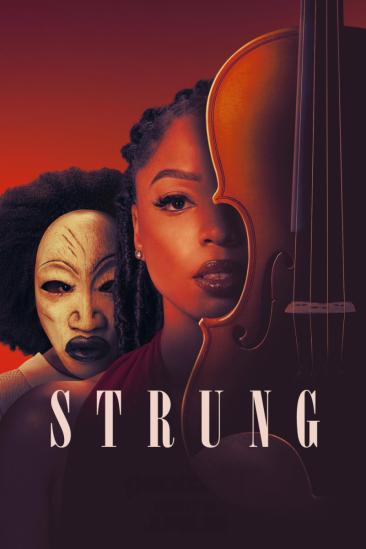
A talented violinist whose prestigious new role as a music tutor for an enigmatic, elite family spirals into a psychological battle for her safety and sanity.
Multiple avenues can be taken in achieving the feat of making a memorable psychological thriller, delving into something primal within a broken mind. But then there are the movies where that ambition outstrips the execution and vice versa—everything you expect it to do, it just flops around like a trout without water, and just when you think it can't get any worse, the few bits that do work are so stuck in isolation that they feel almost accidental.
That’s pretty much “Strung” in a nutshell.
For being a veteran director, Malcolm D. Lee doesn’t seem to swim so well when it comes to translating his usual comedic chops to horror—and to be clear, this is his first time doing something like this, so there’s a version of this where that’s forgivable. What starts off as cautious curiosity through feeling out the edges turns to ransacking as Malcolm appears to catch on to how much this framework isn’t holding, and so he develops something of a scarcity mindset that opts to try and do too much to cover up how little is actually there. In the end, his direction comes off more campy than anything else as a means to retreat back to a style he can comfortably work around and still, what’s left behind is too skeletal to hold the weight of anything it was supposed to carry.
Keith Brian Burns knew exactly what he was doing, crafting his production design around the idea of this glam bubble, this gilded cage; the house being spotless, priceless, almost infested with this minimalist, calculated emptiness to an intimidating degree, and the art department’s team further complement this vision, really drawing out the sterility of this wealthy world. If nothing else, the openness to these locations and sets make the film undeniably pretty to look at, even as that beauty curdles into alienation. Considering that atmosphere is the silent puppeteer that’s normally meant to suffocate or liberate a story’s entire identity, this had the building blocks to actively deliver on that. Unfortunately, said atmosphere here can’t feel anything but artificial to me due to the way it tries harder than necessary to force eeriness in a story that straight-up doesn’t have any upon rewatch, and it fights directly against both the scope and scale of said story.
I will admit the presentation leans a lot toward the well-worn architecture of wealthy Black dysfunction, a genre Tyler Perry helped calcify into shorthand (not to mention he also produced this one), but considering the structure of said presentation matches that of a made-for-TV basic-ass production, it's hard not to feel cheated because the high gloss of it all kinda tricks you a little bit. The same can be said for Greg Gardiner’s cinematography, although it does a much more convincing job. On top of the rather warm and cozy lighting throughout, every once in a while, there’s a poignant medium shot, a captivating wide angle, a striking visual that helps tell a million stories all in one shot; it’s far from jaw-dropping, but there is something deliberate to the framing of everything despite the rhythm of everything else struggling to maintain itself.
On paper and execution, Paul Millspaugh’s editing is competent enough. Not quite by-the-numbers but not quite interminably terrible either despite a few hiccups.
Seriously, if the content of this movie proved anything, its that the film’s bloated two-hour runtime is its own indictment. The pacing lurches between glacial pauses and jarring soap-opera trappings, making every scene—regardless of its intent—feel like it’s being pulled through wet sand. Now, the few special effects that turn up range from passable to downright deplorable especially with CGI blood, all of the humor lands too flat to unsettle or elicit any laughter, the broad focus means moments meant to unnerve defunct every scare to feel focus-grouped and sterile, and speaking of dread, much of the tension and suspense the movie desperately wants to manufacture are like a faulty string of damp firecrackers: a few sharp, startling snaps, crackles, and pops of promise in a few precious isolated moments before long stretches of dead, underwhelming fizzle. It feels constructed in a back room and delivered on a dolly, not something that grows organically from the story’s soil.
Oh boy, how do I describe the tone here? A psychological thriller with twists and turns? Romantic thriller that tries too hard? Elements of spiritual horror so scant they were there more for aesthetic purposes? Like, talk about trying at everything and succeeding at none of them.
Speaking of, Ali Shaheed Muhammad and Adrian Younge’s score moves fluidly between classical strings, cool jazz brushwork, and hip-hop low-end in a way that at least understands the film’s cultural register, but there’s a persistent mismatch between what the music is doing and what the scene needs it to do—this persistent tendency to reach for warmth and melodic reassurance in scenes actively trying to do the opposite—and it undercuts whatever dread the film manages to build because the music ends up being an afterthought anyway despite it serving as a core communication tool and narrative driver. I want to say the sound design complements that weird balancing act but only just, Neil McClean’s costume design is mostly vibrant with its color psychology and intentional contemporary styling with the high-fashion wardrobe, and yeah, this is an easy win: the MPAA rating is Rated R, and although it takes a while to bear its teeth, it's fully deserved.
One thing that’s immediately undeniable, though, and one of the film’s few highlights is the cast. Let’s make one thing clear, though: not everybody here oozes charisma, bleeds with charm, or bounces off the other with just enough chemistry to sell the ridiculousness onscreen, and it leads to many performers overacting or underacting the material. But they all carry a strength so undeniable that clearly illustrates how much they’re giving it their all here, despite getting little in return. And I do mean LITTLE; so much of the dialogue is just meandering and awkward, badly exposing the decent exchanges through bad, obvious uses of ADR, and all the characters are either ancillary at best and regressive at once; not only do they dangerously flirt with being one-dimensional and perpetuating SEVERAL dated stereotypes that should’ve been retired already, all this does is exert and expose all the familiar characteristics and trademarks of a Tyler Perry flick.
Lynn Whitfield is ethereal, giving us a positively delightful showcase with classic, icy matriarch energy, and then there’s Anna Diop, whose zealous performance casually bridges herself as cartoonishly devious as possible while also being a complicated pseudo-red herring to be mindful of. But they’re like the only two out-and-out great performances here. Coco Jones is just there as the token best friend, Lucien Laviscount is supposed to nail this balance between suave and menacing that his performance doesn’t convey, Romy Woods is fairly average despite not fully selling the sheltered trauma of being a stunted child being held back (I’m really sorry, guys), and despite being the main character, the central figure meant to converge all the people around her, Chloe Bailey isn’t so much miscast as she is not yet equipped for the ask. Whatever quasi-earnestness there is to her portrayal immediately gets buried under mountains of persistent stiffness she can’t quite shake, and the register she’s operating in never climbs above the emotional ceiling of a Disney Channel Original Movie.
Pick out the carcass from any classic domestic thriller that features big houses, imperiled women, and heaps of paranoia, modernize it with as many tantalizing, smutty undertones as possible, dap it up with extremities, and you get something that, if put on Tubi or the Lifetime channel, you’d understand exactly why it’s there. This narrative is essentially The Housemaid and The Turn of the Screw, minus the supernatural elements, and it’s executed in the most obvious, placid, by-the-numbers fashion while also equipping the soapiest of soap opera theatrics—so much to give Netflix’s The Polygamist an anal evacuation. I sincerely hope your tolerance for clichés, contrivances, coincidences, and overused/meaninglessness plot devices is as high as Kami’s Lookout because this story is infested with tropes stitched together from better movies than this, played out either as contrived or simplistic with such a straight face that the bloat practically implodes in on itself. Our main character is supposed to be thoughtful and intelligent, yet is constantly making poor decisions so preposterous that much of the movie becomes unintentionally comedic, they don’t exactly dive into the specifics of her trauma well enough to explain why she’s hallucinating, and in trying to keep up with the malarkey after a while, it all gradually gets boring.
It doesn’t happen fast, but when it hits, it hits HARD.
MJ’s mantra from No Way Home about expecting disappointment so you’ll never be disappointed pops into my head because do not expect any bait-and-switch situations here. The screenplay doesn’t have the dexterity or cunning for misdirection—it can’t convincingly lay out one way out, let alone two—and it doesn’t seem to know this about itself. And even with that in mind, it actively telegraphs its central deception so early and so plainly ahead of its reveal that the third act arrives already spent, cooling off with piss on the counter with nowhere left to go. Even when the film inevitably starts eating itself and going crazy, it still ends exactly how you’d expect it to, and there ends up being no real consequences due to the writing’s flagrant inability to commit to placing anyone in ACTUAL jeopardy.
For what’s meant to be an unnerving study of inherited trauma, predatory wealth of the ultrarich and the prey they feed on, early childhood development needs for those exposed to trauma, self-sabotage, paranoia, cabin fever, the rather stubborn insistence on instinct and trusting your gut, and the lack of agency that often comes with working for and living with an employer……NONE of those actually flow together so much as collide, leaving a narrative traffic jam where nothing moves with purpose or rhythm. Only one plot thread here was given proper time to be fleshed out (or at the very least permitted me to care about it), and it was the relationship between Laila and Zuri, the former seeing the young child as a means to atone for not being able to save her sister a long time ago. Outside of that, the film coasts almost on the strength of its premise rather than the discipline of its craft, and similar to something like Fantasy Island, it actively seems determined to circle nothing while chasing its own tail, essentially making room to waste time. Too heavy-handed in its messaging while being too scattered to be coherent and make sense, it barely seems to have any courage in its own conviction and identity when its not endlessly cribbing off other movies.
Perhaps it expects me to make peace with the reality that this wasn’t trying to be the black version of Black Swan, which…..ok, fine. But how exactly am I supposed to retroactively turn my brain off for this when it keeps hyperextending itself to where the show doesn’t match the tell, it fails at every genre hybrid brass ring it reaches for, and leaves so many questions and plot holes unanswered? Keep in mind, I wouldn’t even be asking a good chunk of these questions if the film didn’t waste minutes upon hours trying to build up a world and lore that should be more important than how it’s presented to us. Y’all didn’t make a thriller movie, and trying to bombard us with half-hearted platitudes on the psychological weight of family secrets and the literal and figurative masks people wear to try and pretend that you did otherwise is just sad.
Also, the irony isn’t lost on me that for a movie obsessed with the central thesis of ignoring your gut in favor of playing it safe, this movie more or less spends its entire runtime proving it on itself. Just another industry exercise in suppressing instincts and defaulting to safety–and I guess on that note, if nothing else, it’s consistent.
With busted strings, instruments that are wildly out of tune, and the type of pitch that gets way too far-fetched and awkward even with the few notes it manages to hit right, whatever glimmers of potential shine through the film’s desperate glamour and lamé-clad aspirations, “Strung” is a symphony of errors that lacks the moxie to make it truly engaging or consistent.