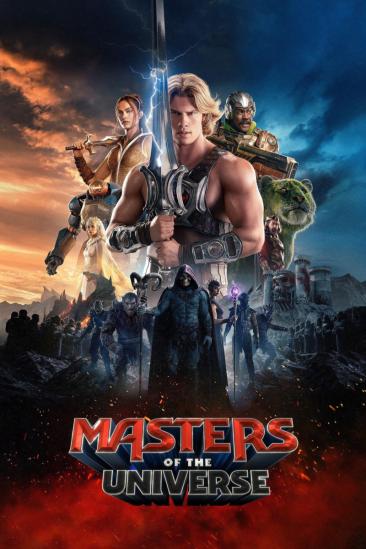
After being separated for 15 years, the Sword of Power leads Prince Adam back to Eternia, where he discovers his home shattered under the fiendish rule of Skeletor. To save his family and his world...
He-Man and “Masters of the Universe” exist in my memory as little more than a logo and a catchphrase—I could pick Skeletor, He-Man and She-Ra out of a lineup, but that’s about where my expertise ends. My mom tells me I was raised on this show; apparently, she sat through enough episodes with me as a toddler that accompanying me to the theater was never up for debate. Honestly, I took my seat knowing essentially nothing.
Color me shocked, I actually had fun with this.
Between Kubo and the Two Strings and Bumblebee, Travis Knight’s direction is one that always makes sure to have a point of view and a central peculiarity to how his weaponizes his focus. Controlling each and every scene with the assiduousness of a stop-motion figure, he treats the frame with the same reverence you’d see in Laika’s puppet-filled worlds; like a diorama under glass, that meticulousness barely grounds the material and inverts what could’ve easily collapsed under its own kitsch into something that feels, against all odds, considered.
Guy Hendrix Dyas had no easy task as production designer, and the degree to which Eternia feels genuinely expansive—a world that flirts with actual weight and geography to it—is a real credit to his efforts. Even with its narrow focus teasing us with a planet composed of the coolest shit from every fantasy story you’ve ever heard, only to pull back to a select few locations, it never quite feels like a shortchanged cheat. That it only just avoids collapsing into the plastic artificiality that so often dooms these kinds of nostalgic resurrections is nothing short of miraculous, and while the worldbuilding isn’t as intricate or complex or pops off the screen as well as, say, Dungeons and Dragons: Honor Among Thieves—despite the vast scope and scale of this world saying otherwise—there’s actual sincerity to the spectacle and how the general look of the film embraces that with defiant pride.
Leaning hard into the excess of '80s hair-metal aesthetics and kitschy expressive amplification, this is a presentation that lives and dies on maximum theatricality and an unflagging embrace of the ridiculous; essentially a Saturday morning cartoon on a blockbuster’s scale. It can feel a bit too pleased with itself, spending a lot of time admiring its own world and mythology instead of maintaining momentum, but it’s hard not to be swept up in the sheer volume and velocity of the thing. And that’s especially the case for the general cinematography of the film; Fabian Wagner’s efforts display a lot of verve, vigor and energy to his camerawork with zooms, whip-pans and prowling galore; all around sturdy sense of immediacy that’s never passive and the vivid color palette between warm and cool remaining faithful to the animated series’ color scheme gives the entire visual identity of the movie just the right combination of heightened cartooniness.
Paul Rubell’s editing does a very good job of keeping up and compounding that.
For a film running over two and a half hours, the pacing stays surprisingly dense and compact—it moves with the restless, forward-lurching energy of a power chord that refuses to resolve. Even the stretches where it loses its footing in the middle don’t bleed the momentum dry; it stumbles without stalling, catching itself before the weight of its own runtime can settle in. Visually, the makeup and CGI hit this weird middle ground: they’re sturdy and passable for the most part but don’t entirely break the immersion when it gets too obvious (it is meant to be a cartoon after all), tension just does not exist in this movie, physical stakes don’t really register while the emotional stakes do take up more room, the humor is either based around faint sexual underpinnings or heavily borrowed from GOTG and the “wink-wink-nudge-nudge,” self-aware camp of 1980’s Flash Gordon (both are barely held together by scotch tape and prayers but they get more chuckles than you’d think), and it goes without saying: the action is interminably fine. Among the CG flurry it subjects us to, they’re all well-staged with plenty of adequate blocking despite being occasionally weightless and tactile.
I had to warm up to the tone a little bit. On one hand, keeping the campy, unserious register of the original is the right template to work from—no argument there. But the film occasionally drifts into Thor: Ragnarok mode, and that’s a tonal Sword of Power that cuts both ways. The moments it fully commits land with genuine, goofy charm, and when it doesn’t, it feels like it’s mugging for the crowd instead of committing to what it actually wants to be. Thankfully, a balance is found to where nothing gets overbearing.
Daniel Pemberton once again kills it—his score a rock-heavy, guitar-synth-and-orchestra hybrid that doesn’t just evoke ‘80s hair metal so much as weaponize it, blasting through the film’s best moments with the kind of maximal, fist-pumping conviction that makes you feel like you should be watching this on a CRT television with the volume knob cranked all the way to the right. Sound design is crispy with the kind of saturated thwack that earns its keep, Richard Sale’s costume design is nothing short of exquisite, breathlessly recreating the characters' signature looks, including colorful body armor and dramatic silhouettes, and lets be real, this was always going to be a PG-13 rating: consequence-free carnage where the stakes, again, feel safely upholstered, which suits the material just fine.
From day one, the casting was always going to prove problematic for many people, so the ensemble needed to prove they could deliver, and credit to them, most of them did. What unifies them isn’t uniformly strong acting so much as a shared willingness to meet the material on its own absurd terms: nobody here is slumming it or holding the campiness at arm’s length, and that collective buy-in goes a long way. I admit the dialogue they’re given isn’t terrible, in isolation or in execution, though how much it lands depends entirely on who’s saying it, and the characters land roughly where you’d expect them to—archetypal enough to honor what they were, with just enough new texture grafted on to keep them distinct from one another.
Nicholas Galitzine nails the lovable clown and noble hero of both He-Man’s alter egos convincingly without sacrificing his wide-eyed sense of wonder or vulnerability, Idris Elba’s bumbling rogue mode was nothing special but he still acts the hell out of it, Alison Brie actually made for a damn-near portrayal of Evil-Lyn, and Lord help me, for as much as I detest the guy, Jared Leto is actually the best part of the movie as Skeletor. He nails the mannerisms, comedic timing, campiness, and high theatricality that jives well with his ’80s conception, purring with this diva-like bitchiness that oozes personality.
If what I recall about the original series is correct, it comes as no surprise to see it be transformed into this narrative molded into the type of paint-by-numbers Hollywood studio product, one where we have seen all of this derivative storytelling before. Relying almost entirely on its recycled blockbuster template to do the heavy lifting, what we get here is the prototypical battle between good and evil and the mindless adventure you’d expect out of this intellectual property. Every space opera/hero’s journey cliché you can think of, it checks that off and telegraphs every beat with clear mechanical efficiency that only just avoids feeling shopworn due to the palpable affection for the textures of this nonsense. On its own, that’s fine; some movies work better when it keeps things simple and this is based on a toyline designed specially to sell fantasy rather than the other way around so of course, this giddy hodgepodge drafting off other things that people already love was destined to feel familiar. There’s comfort to be had in the familiarity, sure, but never genuine surprise.
This is a bizarre cocktail of a movie that constantly battles between genuine nostalgia and modern corporate boardroom box-ticking that somehow doesn’t let one half overshadow the other; it’s actually a pretty firm middle ground that doesn’t need to make complete mincemeat out of the traditional 'Hero's Journey' or the mythos surrounding He-Man for the sake of it.
Surprisingly, the strongest thematic point the film attempts (and somewhat succeeds) in making is in a similar vein to what the Barbie movie tackled. While that film was blatantly smash-the-patriarchy feminist in calling for both genders to not only discover themselves without being pressured by the culture around them but break free of the pressures behind trying to live up to impossible standards, this one is a little bit low-key in its insistence on building self-assurance instead of self-destruction, positivity instead of toxicity, those who can recognize their own feelings and self-worth, and find victory not through brute strength but collaboration and team-building. It’s essentially tackling competing masculinities and how those who possess power tend to use that responsibility; Adam trying to make sense of who he is while uniting everyone through empathy and emotional intelligence as opposed to Skeletor, who constantly berates and physically assaults his henchmen and closest associates while throwing a hissy fit when things don’t go his way. And while the movie doesn’t necessarily commit to that avenue entirely to the end—the final battle between He-Man and Skeletor ultimately conceding that empathy and emotional intelligence have their ceiling, that sometimes the guy on the other side of the sword simply does not care, and that protecting the people you love occasionally demands you meet brutality on its own terms—it still feels like the narrative was consciously scaffolded around that thematic spine from the ground up. By far, the film’s most interesting wrinkle.
But that can just as easily be read as the film hedging its bets, unwilling to plant a flag or draw a line-in-the-sand toward a genuine worldview and pulling back and to that extent, that is true. While that specific theme gets the lions den of time dedicated toward it by default, other themes of heroism, restraint, and responsibility are gestured toward since Adam never truly learns any of those lessons or make the intended payoff between him and his father feel earned. You could also say the film spending considerable effort trying to rationalize the cheesiness of the original cartoon while paradoxically making the mythology more confusing is a point of contention.
A film that tries serving two masters and doesn’t quite harness the power of Grayskull to honor either one but preserves on sheer charm and playfulness, “Masters Of The Universe” carries its kitschy, rock-guitar fever dream further than its derivative bones have any right to go. It doesn’t fully commit, but it commits enough.