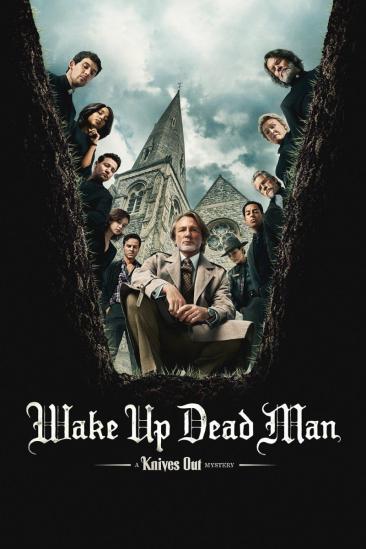
When young priest Jud Duplenticy is sent to assist charismatic firebrand Monsignor Jefferson Wicks, it’s clear that all is not well in the pews. After a sudden and seemingly impossible murder roc...
It goes without saying: I absolutely adore Rian Johnson’s ever-spiraling modern whodunnit Knives Out franchise. Both the first film and its flamboyant little sibling Glass Onion, I found guilty for the crime of being deliciously entertaining; compulsively fun, scornful and playful of the dour faux-gravitas that seeps into most modern mysteries, and masks two seemingly complex webs around a central idea so simplistic, everything plays like a magic trick you don’t mind falling for over and over again. However, if the first film pulls out the rug and the second one shakes out your previous certainties and beats you with it….
….the third film “Wake Up Dead Man” goes one step further.
Third time around, its imperfections still dwell on the surface level but Rian Johnson’s well-rounded direction vibrates with the same showman’s ostentation as before, just with a gaudy religious aftertaste and wavelength more brazenly theatrical then its predecessors. I could just feel the glee behind how he guides his own auteur touch, both lighter and more precise in its own constructiveness to serve both the story and the overarching illusion.
Upon putting all three films under a microscope back to back, I came to realize how the third installment shrinks its canvas deliberately to claustrophobic intimacy. This perfectly warm yet catty small-town setting feels right at home for a mystery—neither small enough to be quaint nor large enough to escape its own secrets—and, ever the master stylist, Rian gave production designer Rick Heinrichs more than enough leeway to manipulate this setting to fully embrace the cinematic nature of Catholicism in all of its byzantine grandeur and razor sharp edges. Narrow and interlocked to stage every scene like the walls are closing in, the effect is almost suffocating in how the town itself acts like a nervous system with the church as its brain stem. If anything, the smaller, more personal scope and scale of the environment intensifies that dour atmosphere, as if the very walls of the church are listening, judging, and perhaps concealing the truth.
It's not easy for many films to get a lot of mileage out of the cinematic nature of Catholicism in all its byzantine grandeur but this presentation actually does mold the church into a silent character with the weight of centuries of both devotion and corruption towering around it while, as per Knives Out tradition, still juxtaposes the time and place with classical motifs to say what needs to be said about the contemporary world. Steve Yeldin’s cinematography stops just shy of fully surrendering to gothic excess, his camera work elevates this entry to visual heights unmatched in the franchise—every frame both tactile, theatrical and dramatically staged with dramatic stark lighting, exquisite shadow play, and the dynamic color palette with rich green forests, mossy cemeteries, and bright red Satanic kitsch helping establish the more heightened reality of events here.
Bob Ducsay’s editing thankfully weaves all that hypnotic rhythm seamlessly enough.
The two-and-a-half hour runtime might drag in places but to me, it never fully severed the invisible thread connecting viewer to narrative, enough momentum is stockpiled with the somber, slower pacing that makes the revelations deliver the same satisfying punch that made its predecessors so memorable, and much of the tone offsets its new moodier, grounded trappings within that familiar dark comedic mordant wit from its predecessors. Jenny Eagan’s costume design visually telegraph the film's thematic, symbolic contrasts while being masterfully curated on their own and there’s tension of a different kind here; not exactly the flashy cat-and-mouse games of the previous films, but something more ecclesiastical—suspense born from the terrible possibility that faith itself might be the most elaborate con of all while still taking the piss out of the more staid or stodgy interpretations of ritual in general.
Nathan Johnson’s score is one symbolic of the struggle between darkness and light, scraping strings that resolve into pure notes and subtly hints at when something is afoot, both the sound design and visual effects maintain a reliable standard without calling attention to themselves nor faltering in their execution and the PG-13 rating…is used as a scalpel rather than a bludgeon, trimming every beat of blood so the violence you don’t glimpse lands harder than the violence you do.
Is anyone surprised when I say the cast is excellent? Not really. All of these actors and actresses in this chamber play bounce off each other wonderfully, the dialogue still crackles with triple-layered ironies and despite originally sympathizing with complaints on how much of an afterthought the ensemble is, looking back on it now with how the story is structured, I think it makes sense. It was important to construct the other characters purely as collateral damage, victims of a terrible situation and not opportunists simultaneously; a crucial distinction that served the moral framework of the story. And even with their limited screen time, all talented individuals extract remarkable nuance from their roles and lend their characters enough impressive depth and authenticity to feel like real people with baggage.
Benoit Blanc is no longer the gravitational force that pulls all these clues and factors into his orbit, but Daniel Craig's molasses-thick southern drawl and undeniable silver-screen magnetism gives him enough yards to both keep his showboat trademark eccentricities intact while allowing glimpses of genuine vulnerability beneath the bespoke suits and confidence. However, as per tradition with these films, his partner—this time Josh O'Connor with his doe-eyed, furrowed-brow sensitivity and monastic restraint—makes him the standout.
So the first film tackled trust-fund dysfunctional white privileged families and the second one was a gleeful takedown of Elon Musk and techbro culture so it only makes sense the third film would go a step further and pick apart the Christian/Catholic religion. Inspired by “locked door mysteries” like The Hollow Man and The Murders in the Rue Morgue, this narrative is the most straightforward out of the three as an overt tribute to the ur-text of “impossible crime”-solving and with more quaintly focus to boot, saving its farcical satirical bits to pop up in restrained spurts while getting to the real heart behind….how and why people do what they do. That curiosity is bubbled and boiled through Johnson’s bait-and-switch-and-back-to-bait plotting to seduce you with a seemingly complex recursion of secrets waiting to be excavated by the right questions, taking on the best of both worlds. Its tricky sleight of hand operates within the realm of recognizable human experience and that very interplay between Jud’s refusal to reduce people to clues contrasting Blanc’s atheism and instance on accountability and moral clarity constantly keeps the themes of the film at the forefront while not sacrificing the scope of the murder mystery. And given that these movies actually play fair with their audiences in letting them think far ahead to deduce for themselves….
…this is where the ambiguity of the motive hits the most traction.
While the first two movies flirt with politics enough in certain personalities to where people will get the resemblance, this one goes full throttle in being scathingly political and critical with its subject matter, throwing subtext out the window for a refreshing halfway perspective on the good, bad and ugly aspects of the religion. In a day and age where most movies tend to glorify or exploit certain parts of it for a specific purpose, these events that this story lays bare doesn't divide the faithful from the heretic but reminds them of their common needs. A lesser movie would’ve actually picked a side but its dialectic omnibus of ideas makes room for contemporary politics, the role of social media in culture, what place religion actually has in our lives, contradictions in the practice of Catholicism, hypocrisy, misogyny, demagoguery, greed, faith, anger, and redemption among other things….all while actually anchoring those themes to each character.
It really does hammer home not just how so many charismatic bad actors have infiltrated the church and brainwashed so many people under narrow, combative circumstances and conditions, not just how the very formation of factions is a detriment to our willingness and ability to fight for someone outside of “your tribe”…..but also how the rather uncomfortable importance behind how grace, love and understanding should be the proper way you combat the evils of the world will be a constant lifelong struggle full of doubts and temptation. Both Jud’s authentic belief and Wicks’s exploitative fearmongering are taken as seriously as the other and even if it doesn’t do much more to expand upon the subject beyond how much a person knows about the subject, it stands out as a genuinely moving work of humanism on its own merits.
Believe me, the task of sticking to compassion and understanding has been pushed to its absolute breaking point this very year alone to where I questioned ‘What the hell is even the point?’ But at the same time, it’s like Jud said ‘You start fighting wolves, and then everyone else around you becomes one”…..and that’s not the way any of us should be living our lives; constantly demonizing each other.
And by the time the film’s final act begins its careful unwinding—by the time the last, ragged threads have been pulled taut, the false bottoms revealed—it becomes self-evident that not only has the Knives Out franchise chosen to question its own tropes, but Wake Up Dead Man has turned inward to interrogate the very reason for its own existence. This third installment opts not to celebrate the final reveal ….but on why such a reveal matters, exploring the hollow ache left behind by knowledge—on examining the cost of truth, not as a prize, but as an open wound while actively taking its time to ponder on the specific aftermath for the gamesmanship and its consequences for all involved, thus making this emotional payoff the most overpowering of the series. Ditching the self-aggrandizing monologue did hurt a little (as it will to other viewers as well), especially since that’s what we came to these movies for but this installment feels the most dedicated towards breaking established patterns to reach a breakthrough, pivoting away from the comfort of resolution and instead burrowing into the quiet, ugly persistence of grief and resentment among the survivors while also picking apart the fallibility of leadership (whether we truly value leadership or we indulge the fantasy/illusion we believe they can give us).
Sure, watching so much of the scheme unfold in real time extends how long Jud and Benoit must passively react to or receive information and denies the detectives a more thorough sense of urgency; all of this points to the plotting once again straining credibility and credulity to be a mostly breezy watch. But if the film knows what it is and doesn’t stray from it, sometimes there isn’t a point of fighting it, whether its your thing or not.
As much as I’ve propagandized myself into believing I am an astute critic, I have found myself once again at the mercy of Rian Johnson’s entertainer’s flair for theatrics and scholar’s devotion to mystery craft. Equal parts a deadpan-absurdist ensemble comedy with a religious undercurrent bolstering the whodunnit, “Wake Up Dead Man” reveals and plays its more meditative hand with irreverent generosity despite its complexity, making this the third donut hole in a donuts hole.