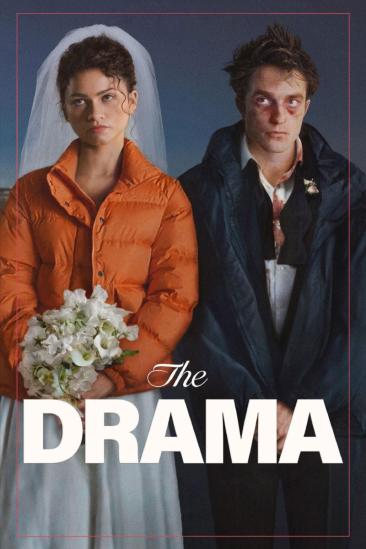
“The Drama” has already cemented its place as one of the most controversial films of the year…..and I VERY NEARLY savored every divisive second of it.
Kristoffer Borgli’s direction might as well be slippery with how trolling it is; a case study of weaponized ambiguity. The way he keeps sliding disconcertingly through conventional sentimentality to expose something trickier, and ultimately more volatile in every scene never allows a clean moral position to settle; it feels engineered to destabilize, especially considering his own controversial public persona pulses with the same reckless, self-canceling energy had just come to light. Ironically, that very dilemma mirrors how he directs and telegraphs the film itself either as meta-textual self-awareness or just a convenient alibi for bad behavior; exactly the kind of question the film refuses to answer for you.
From a first glance, production designer Zosia Mackenzie’s work here doesn’t look or feel all that remarkable; leaning heavily into the Boston backdrop, every location is very classical, very basic, very tactile…..but sit with it. Because Boston has this old-school elegance to it, this cultural and intellectual gravity that manages to be raw and refined, cerebral and emotionally combustible all at once— and that layered, contradictory identity bleeds directly into the film’s own DNA. The city isn’t just a backdrop here; it’s a mood-board, a mirror, a third character. Even setting aside the chilly Northern European vibe - despite being set in Cambridge instead of Boston, Mackenzie leans into a lot of asymmetry with the interiors to subliminally telegraph the simmering dissonance between our leads—high-status refinement pressed up uncomfortably against low-level dread the way old money aesthetics quietly rot at the edges and the atmosphere displays a disquieting undercurrent to the emotional scope and scale of the story, a wrongness you can’t quite name all in the name of exaggerated normalcy. All of it lands before the big reveal even strikes the match.
Presentation-wise, it carries the emotional familiarity of something you feel like you’ve seen before—and you have, almost—but its sanded down just enough from recognizable life that the moral geometry underneath registers as almost Euclidean in its clean, rigid lines, but never so tidy that it loses its pull. Simple enough to be seductive but legible enough that you need to know how it ends and I like how that curdles over to the rest of the technical elements; with the film being shot entirely on-location, there’s an obvious polish and sophisticated edge to Arseni Khachaturan’s cinematography that feels calibrated to both comfort and elicit a fresh recoil. Beyond just the framing, natural lighting, and being shot on 35mm film rather than digitally, it’s the way Khachaturan lingers presenting the shiniest possible vessel for moral rot.
There’s something really delightful about how deliberately abrupt the nonlinear editing by Kristoffer Borgli and Joshua Raymond Lee is, weaponized in service of the absurdist comedy, each cut landing like a punchline that refuses to apologize for itself.
For an hour and 45 minutes, the pacing is measured like a slow drip—never sluggish, never rushed, just a steady, deliberate pressure cooker building that is given ample time to marinate. With how spare and restrained the visual effects are, they’re pretty solid while never overreaching, the black comedy is arid enough to crack, yet it still lands and most of the prickly tension we get out of this branching out between reality and fantasy is actually generated in the negative space between the two. Perhaps the most trickiest aspect to nail here—outside the writing—was how bi-polar the tone is; a rom-com careening at high speed into a psychological drama, thriller and borderline-horror movie territory as everything unravels. Like Uncut Gems, it understands that sometimes the most effective horror is simply watching everything spiral out of control. It occasionally stumbles in reconciling its absurdist comedy with the gravity of its subject matter, especially since its meant to be awkward straight out the gate but once it finds its footing, the foot never comes off the brakes.
Daniel Pemberton once again adjusts his musical composition accordingly. Unlike with Project Hail Mary which called for something extravagant and spellbinding to a gleefully nauseating degree, he sees no need to overindulge here; just a minimalistic score fine-tuned to this constant, precisely calibrated hum of anxiety sitting under everything like a low-grade fever. The sound design being equally precise without ever feeling intrusive is weird in the best way, Katina Danabassis retains her footing for anthropology in her costume design, dousing the rather minimalist Scandi-slash-slouchy Boston dark academia clothing into this incongruent collision of aspirational polish and lived-in unraveling, and there’s only so much I can say about how accurate a film’s R-rating is; this film is very much another case of that.
Once again, I feel like the acting mostly speaks for itself. Most of their dialogue here doesn’t need to be more than it needs to be and the characters? Lets just say while also being aggravating and unlikable in their own special way; every character traverses through these murky grey waters and yet they’re all so spiffy and entertaining in the variety of how they’re handling of the drama reveals the true content of their actual persona’s that you can’t look away from them.
Mamoudzou Athie makes due as the straight man who’s silence and complicity worsens an already fraught situation, Alana Haim chews the scenery as she’s given the most hatable character by default, bringing such snarky, passive aggressiveness into making her look so punchable and as for our leads, I honestly couldn’t tell you who I was more impressed with. Both Zendaya and Robert Pattinson carry a chemistry that feels less performed than discovered, electric in the way only genuinely mismatched energies can be—Zendaya folding everything inward, growing quieter and more opaque as the stakes climb, while Pattinson unravels outward, looser and more unhinged with every turn of the screw.
Every second of this narrative is specifically engineered and designed to be as polarizing an exercise in discomfort as possible, attempting to deconstruct the reality of "happily ever after" with a sharp, cynical blade while being a profound look at the secrets we keep, beyond our primordial desires for connection, destruction, stability and the exacerbated obsession with theatrics that come with it. It boils down to just a bunch of terrible people doing terrible things to each other regardless of intent and Borgli’s outsider curiosity about the American taboo on discussing this most emotive subject leads him to tread nimbly, careful to satirize the culture’s appalled-yet-tight-lipped attitude to the subject, rather than the horror itself. It runs the tightrope of being unsettling or even insensitive all for the sake of complicating the conflicts our characters face or cause for ourselves, using mass shootings as a framing device to challenge the idea of unconditional love…
….and say what you will about the execution, at least nothing ever gets stagnant. At least these integrated character studies actively carry the combustible premise as far as they can take it and the extremity of the situation strengthens the film’s examination of the limits of love.
The film explores empathy and hypocrisy in the same way it's played out in real life: a Black woman is denied empathy and understanding from two-faced white people and complicit Black men and spends the film trying to plead for her humanity when the very people she's pleading to are actively hurting her. Even the person she’s supposed to be marrying is not giving her any grace and as understandable as that is given the nature of what Emma reveals, it only further exposes what the point even is behind having a society with such a heightened need for accountability to protect its citizens better if there’s no room for remorse and forgiveness anyway. Between the burden of secrecy, performative judgement, moral hypocrisy, impulsive self-sabotage and the fragility of romantic commitment, the mirroring of Borgli’s biography with the film’s larger themes is not subtle, nor is it meant to be. If anything, it’s the engine of the entire enterprise, stoking the question of whether a person’s worst, most exploitative instincts—whether they act on them or not—can ever be truly separated from their best work—whether those instincts are, in a grotesque way, the very reason the work exists and whether or not empathy works in the face of finding redemption especially in light of such a horrific circumstance.
Me personally, as an American disgusted by the refusal to do shit to reduce gun violence, I actually think this movie is nuanced and important in discussing how a shooting was prevented by helping an isolated person connect to others. Unfortunately, the U.S being at an all time low for nuanced discussion means I doubt people on the extreme edges of either side of the gun violence issue would be able to receive the message.
Engineered as this hall of mirrors, every reflection warped by self-consciousness and shame, every attempt at catharsis booby-trapped with irony does end up feeling vague and underdeveloped in certain instances, however—and not always in ways that feel purposeful. It does make it difficult to fully get a grip or evaluate anybody’s growth, stagnation, regression or proper defining of where they stand. Because for all its precision elsewhere, the film doesn’t fully commit to the weight of the questions it asks—it more or less omitting and completely ignoring questions of race, and how its tropes would inflect Charlie and Rachel in their views of Emma’s transgression being one such example—and it starts to feel less like restraint given how deliberately the film otherwise engineers its discomforts. That’s also why it’s very difficult for me to determine whether the ending works; on paper, I’m all for that. Emma earned that empathy by going through such a dark mindset and coming out the other end with a better understanding of forgiveness and accountability, knowing that offering empathy, deserved or otherwise, can help someone properly heal; yet its another moment of the film….kinda chickening out?
But “chickening out” is perhaps too clean a verdict for a film that thrives on leaving its moral bruises mostly un-iced.
Trading in discomfort like currency and marinating in the awkwardness to such a degree that Kristoffer Borgli can't always land everything he intends to give a voice, "The Drama" nonetheless succeeds in getting you talking and making you navigate between the emphatic and the psychotic in a situation guaranteed to incite chaos.