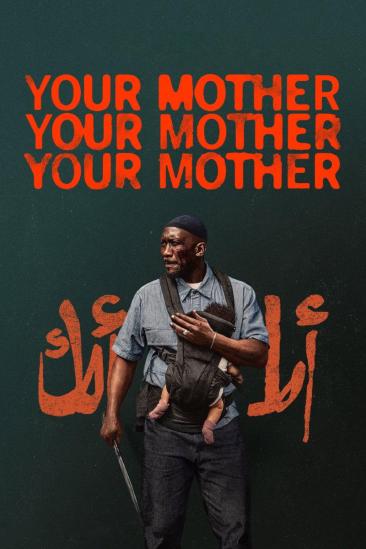
Latif, a devoutly religious hitman, struggles to balance work, faith and fatherhood. When his wife dies, he embarks on a desperate journey across Houston to protect his children, confronting the fo...
Once upon a time, Mahershala Ali and Bassam Tariq were tapped to direct and star in the MCU as the titular character Blade as we moved away from the Infinity Era. Unfortunately, what should’ve been a dirt simple premise—awesome lore, kick-ass fighting, a hard R-rating—languished in development hell for SIX YEARS before essentially everybody stopped giving a fuck and canceled the project. It only further highlighted not only Marvel’s lack of forward-thinking but their broader pattern of sidelining POC-led projects and the general mistreatment of their own diverse characters in the 2020’s. The reason I bring all this up is because both Ali and Tariq inevitably saw the writing on the wall with this thing was never getting out and so decided to move on and collaborate elsewhere….but not without taking their research and training with them.
“Your Mother Your Mother Your Mother” succeeds at being much headier, spiritual, and morally nuanced than a Marvel film could ever be permitted to be, but on its own?
Bassam Tariq’s soulful direction is not without a few uneven splotches and rough patches of his own, but you can actively feel his process as a director painting broadly with his parameters instead of against it, submerging himself within the creative freedom Marvel never would’ve allowed him. Marching to the beat of his own aching, angst-ridden heart, he finds balletic grace in ruthlessly pirouetting around no concrete answer and shared uncertainty.
Akim McKenzie pulls both a tricky balancing act and a cinematic slight-of-hand with his production design at the same time. Despite being set in Houston, filming took place in Atlanta, and it actually makes for a nice facsimile to breathe with a borrowed authenticity, an urban echo so fully realized it transcends mere imitation. His work here carries the same muscular, world-building weight he brought to The Woman King, translating historical grandeur into intimate, lived-in spaces and accumulating quietly in the periphery until the whole world feels textured, specific, and inescapably real. While small in scale, the visual scope is anything but, and the vastness of it is very elusive and slippery in how thoroughly it sneaks up on you.
For an arthouse thriller this dead-set on looking as realistic and grainy as possible, this presentation’s biggest strength is how much it falls back on surrealistic integrity. Even when clinging to the haptic thickness of actual places, every individual environment and scene sort of blurs just out of the reach of certainty, and injects one needle-precise note of myth into the mundanity of it all to feel just that closer to our reality; within only a few seconds of starting, Katelin Arizmendi immediately calls us and every frame to attention with cinematography that harbors such sweaty immediacy and urgency that most modern films lack, but fine-tuned and considerate. On top of the exquisite visual storytelling, candy-coated lighting hinting at a heightened reality and tight framing and blocking, it helps make a nice spiritual homage to Ghost Dog: The Way of the Samurai in the most tasteful way possible.
Cam McLauchlin’s editing has more than just sharp cuts and rhythm to it; they help encapsulate the strength of the visual storytelling.
112 minutes is a fairly average runtime nowadays and despite certain tangential scenes threatening to bloat it out beyond what it can handle, the pacing holds firm. Visual effects and makeup are sparse but they’re applied well and are par for the course; the humor is at its best when it eases its brooding with comic relief through its younger, Gen Z characters; tension is more consistently grounded and upheld with the emotional stakes than the physical ones (I’ll get to that eventually), and while the action sequences are particularly fleeting in this one with a somewhat vague understanding of quality over quantity and the choreography proving Mahershala’s training didn’t go to waste, it feels boilerplate compared to everything else. Overall, it comes out as perhaps the most generic aspect of this production (outside the titular formula being used).
Comedic and playful in brief moments just as it is weighty and profound, the tone doubles down on its sense of ethos with a dexterity that is simultaneously intense and quiet. Bouncing between family drama to pulpy thriller to slow burn religious examination, this hard-to-hood balance is disguised as tonal whiplash almost entirely by design.
One thing I remember about a Son Lux score (specifically the absolute tour-de-force that was Everything Everywhere All At Once) is the insistence on minimalist post-processed orchestral textures and unorthodox percussion…and this one is no different. Syncing Latif's physical actions directly to a repeating, minimalist bass pulse, it pushes a sense of urgency to underscore the emotional stakes with something lean, persistent, almost subliminal. Sound design from Sean Garnhart layers digital and analog elements to give the environment a tangible, physical weight, building the world around the characters; I love how deliberate Deirdra Elizabeth Govan is with the little intricacies of her costume design, reflecting the character’s daily lives, their emotional state, local Texas culture or meticulously sticking to authentic Muslim attire, and allow me to be a sourpuss for a couple of seconds: I was kinda let down by its use of the R-rating. Let’s not get it twisted: it absolutely meets the criteria for gore, violence, explicit content, but it still feels kinda tame? I dunno?
Hands down, the cast is the best aspect of the entire movie and somehow, with very few exceptions, everyone is operating either at two levels: a somber yet mediative stillness or a barely-governable, ice-under-the-feet intensity. Much of the dialogue they’re given is very purposeful and penciled in with enough aplomb to not carry the stink from any cliché platitudes, and it is stuffed to the brim with characters that have enough complicated depth to them to shine through….even if most of them aren’t in the movie for long or are left trapped in the film’s more exaggerated half, playing characters who feel more like genre caricatures than real people.
Despite the notion of a devout man of faith also being a cut-throat hitman seeming too incongruous to be believed, Mahershala Ali somehow manages to make that combination of traits work while continuing to allude this foreboding yet quietly immense screen presence of stoicism and fried vulnerability. John Cho chews up the scenery in spades while actually succeeding at being a warped mirror to the protagonist, and Adia’s performance is perhaps one of the most convincing teen portrayals I’ve seen this decade and that is no small feat.
Too many crime thrillers have been tweaked, swapped, poked, prodded, shaken up, revamped, and retuned to such a nauseating degree over the years and the sad reality is most of them are still fairly formulaic in their attributes and narratives; if you’ve seen enough of them, you could readily swap sequences from one movie to another and not really notice much of a difference. Unfortunately, there isn’t enough here to take away how simple this text still is on its face—Latif going on a redemptive journey to reconnect with his family and his faith—but it’s deceptively dense in how it much it DOES do differently. Enough of the story’s structure meets the requirements of a revisionist Western that its more unorthodox elements stand out in bolder relief; it somehow works in its odd placement, never losing sight of what the constant anchor that roots the story represents and with a rhythm that knows when to advance and when to hold still, at times extended, to let the characters’ interiority shine. Considering how incendiary the film’s premise is and how weighted down his imagery is with societal anxieties about Muslim men, it’s a miracle it doesn’t spiral out of control.
Realistically, we’re looking at two movies trapped in one narrative: a character study and an action film and if we’re going off of Guillermo del Toro’s definition of plot equals rhythm and story equals melody, both certainly favors the character study aspect more. It might not be overwhelmingly artsy enough for those intrigued by the heady promise of violence and theosophy but there’s still an intelligent undercurrent of inventive depth to how Latif interacts with everyone and vice versa. In contrast, the action aspects come across more conventionally and the criminal element isn’t even at the story's forefront (and, in fact, isn't always as well developed as it might have been, especially in terms of clarifying the connections among characters and how those relationships impact the overall flow of the narrative). But I suppose that’s another way the story delights itself in outrageous juxtapositions without compromising the momentum.
Perhaps the main reason why I look at this movie fondly is what it dissects thematically: violence having value in protecting victims despite its corrosive effects, forgiveness and mercy being the true paths forward, the deconstruction behind the idea of a “perfect Islam”, making peace with the quiet inconveniences of everyday life, how pitting individual moral codes against the dogma of organized religion can easily give away to more violence and fanaticism, and it manages to beautifully crowd all of those in without pigeonholing Muslim identity into one pious image. The entire runtime is spent highlighting the crucial importance behind a strong community being built on the ability to forgive, to understand the circumstances of others, to be there in times of need, and to allow people’s faith to fluctuate; Latif and Hwan among others have different visions of faith and are willing to kill in defense of it and with that comes the often-too-wide gulf between what we teach our children and what it is we actually believe.
Similar to Is God Is’s title being an incomplete truth, a question and statement simultaneously regarding uncertainty and fragmented identity, this film’s title—coming from an Islamic hadith—isn’t just a reference to that Hadith about cherishing mothers above all, or a nod to the newly torn void in Latif’s world….but the uneasy translation to and away from religion into violence, faith into what it takes to protect that belief and it knows there’s no point in just interrogating faith….not without embracing and coming to terms with the jarring and poetic contradictions that come with the territory. You can actively feel how earnest it is and how sincerely it interrogates what it means to actually walk a righteous path. And as much as it might not resonate well with people, I love how much that’s reflected and paid off in the ending; a big swing that puts the rug out from underneath you and allowing its protagonist an almost magical moment of change, of rebirth – a literal representation of Latif’s acceptance. Maybe, God was not in the killing, not in the violence. Maybe, God was at home the whole time.
All of that being said, I can understand how someone can look at this and see how the commentaries misfire, especially since, again, most of them get lost in the chaos as the emphasis shifts to the over-the-top side characters and bloody set pieces. Then of course, there’s framing the death of Latif’s wife as the catalyst for his personal struggle, playing into tired tropes about the virtues of women; issues of sex and gender (specifically Latif’s children clearly navigating their own sexual identities while he deals with this deadly feud that directly involves porn) isn’t reflected upon or interrogated that much despite being integral to the story, and the general reality that this is still a rather predictable formula carried out that’s bound to end either one of two ways.
Intertwining enough of its themes and characters in a manner that draws from ancient parables of faith and the modern crisis of belief across the centuries, while also feeling fresh enough in its study of a man trying desperately to do what’s right, it can’t quite congeal and harmonize its many ambitions to make up for every big swing it gradually misses. Thankfully, “Your Mother Your Mother Your Mother” emerges from the ashes of the abandoned Blade project and remains one of the more unique character studies and dramas in recent memory.