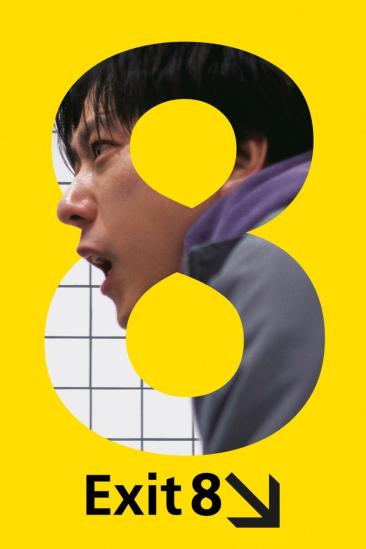
A man trapped in an endless sterile subway passageway sets out to find Exit 8. The rules of his quest are simple: do not overlook anything out of the ordinary. If you discover an anomaly, turn back...
When you come across a movie like “Exit 8” that takes you back by surprise like this, you do have to step back and wonder if such a surprise was due to the expectations you set for yourself. Did it meet or surpass expectations? Did it succeed in spite of other frustrating elements that were added? Does it live up to the source material while standing out as its own thing?
Short answer: yes.
Genki Kawamura is well-versed enough in restraint and practicality to where the need to call attention to himself simply isn’ t necessary; all his direction is is punctilious and quietly confident, the kind that reveals itself only in retrospect—you don’t notice the hand guiding you until you’re already somewhere you didn’t expect to be. Drawing comparisons with Vincenzo Natali's 1997 minimalist horror, Cube feels inevitable and earned; the difference is Kawamura balances the geometry while prioritizing emotional depth alongside visceral horror.
In constructing a near-sublime replica of these minimalist subway stations and underground corridor that constantly loops around, Ryo Sugimoto’s production design dips into the type of limited spacial restraints of storytelling I’ve grown fond of. Thanks to clever shifts in perspective making the most out of the sterile, liminal environments, it all pulses with this sense of unreality that helps the film generate a real sense for the surreal, the monotonous and the hellish; the relentless symmetry leverages its own recognition to create the type of uneasy structure that psychological horror relishes in—this paradoxical expansion where claustrophobia births infinity—even going so far as to exploit the uncanny valley to blend the interior and exterior worlds together to reflect the protagonists inner turmoil and struggles. The more confined the space becomes, the larger the psychological scope and scale breathes and with its meticulously built atmosphere barely wavering, this inverse relationship between physical restraint and mental vastness is guaranteed to be the film’s most prominent achievement.
A really precarious balancing act is at play with this presentation: leaning into the idea of purgatory that focuses less on punishment and more of constant attention to detail and self-improvement and it pulls it off to where the courtesy of my suspension of disbelief was never taken for granted. It just goes to show how technically proficient every individual facet of this project works separately of each other as well as in tandem; Keisuke Imamura weaponizes every single of his cinematography to the highest immersion and then some; it’s actually pretty nerve-racking how physically imposing he makes every shot look here. Employing long, unbroken takes is one thing but add stark color grading and florescent lighting highlighting those feelings of isolation and existential dread—not to mention the spare blocking further enriching the negative space as its own separate character—and just like the game its adapting, the end results are utterly hypnotic.
Sakura Seya’s editing beautifully complicates that dichotomy.
For a game that on average should take 30 to 45 minutes to beat depending on how careful or reckless you want to be, expanding that compact experience to only a 95 minute runtime on screen felt like exactly like the right call; the pacing is deliberate in every beat, every loop, every recalibration—knowing when to move and when to linger, honoring the source material’s economy of design without being beholden to it. Visual effects—both with the environment and the anomalies—are just the right amount of off-putting, tension surprisingly holds up well, maintaining a gradual escalation of physical and emotional stakes that’s very tight and the focus refuses to compromise your sense of imagination in visualizing the extent of its own spiral awareness. Also, the tone is one that I fell in love with almost immediately, riding a unicycle over a tightrope between existential absurdity, psychological mindfuckery and a tight focus on claustrophobia with nary a pit stop. Even when it threatens to dip into saccharine, it wasn’t enough to wane my engagement.
Simple but effective, the bulk of Yasutaka Nakata’s musical composition can be confused for and classified as minimalist and a wee bit repetitive; however what it lacks in variety it more than compensates for in cumulative weight—each sparse, recurring motif quietly expanding in the listener’s chest until it’s taken up far more room than it has any right to. Couple that with an ambient sound design that stretches the silence between sounds into something cavernous, and the score becomes less of an accompaniment and more of a second architecture. I’d say the simplicity in Daisuke Ina’s costume design helps it stand out, the litany of jump scares were actually pretty effective for once even if the lack of variety with them is startling and I admit to being taken aback by its MPAA rating; it being strictly PG-13 gave me pause but once I recalibrated my expectations around the film’s clear disinterest in violence as spectacle, it stopped mattering and I warmed up to it eventually.
Okay, so on paper, I wouldn’t put it past you for thinking the acting doesn’t particularly stand out; there is only so much they could wrestle out of material this purposely thin. However, I’d like to make the argument they’re doing exactly what the film requires as they sell the liminality in their own way. The dialogue isn’t anything too flashy or too remedial either, hitting an unremarkable middle ground that at least moves to story forward and character-wise, there’s not a whole lot to them. They’re all strictly two dimensional in the context of the situation they’re stuck in; they end up feeling somewhat interchangeable and its difficult to form an emotional attachment as a result but it’s not a deal breaker. Again, if anything, the simplicity is why they work.
Yamato Koti’s portrayal as the Walking Man is brief but is guaranteed to send shivers down your spine for how convincing he sells the turmoil….but Kazunari Ninomiya, as our lead, holds down the fort from frame one and refuses to let up. For such a physically demanding role as an asthmatic man pushed to the brink of exhaustion, panic and anxiety, Ninomiya never once lets the seams show—every labored breath, every flinch, every recalibration of his bearings across yet another identical corridor feels less like performance and more like genuine deterioration, and it’s that slow, compounding physical authenticity that helps sell the disquieting nature of the film’s psychological architecture from the inside out.
Based on the 2023 indie horror game of the same name, the premise is as simple as it can be: a walking simulator where The Lost Man is trapped in never-ending subway halls and he has to follow a certain set of rules and be observant to make it to Exit 8 and escape the loop. For a narrative like this centered around so much environmental storytelling and attention to detail, I believe this makes for a great realization, proof-of-concept and expansion of the original concept, steadfastly loyal to the logic of its source by refusing to rely on narrative shortcuts or lazy, prefab explanations for what’s happening. Neither overstaying its welcome nor cutting corners, the story remains as this one constant battle of attrition where every mistake sends you back to square one and it gets so addicting so fast to the point where the plot meandering lies entirely at the feet of our protagonist (and to an extension, us) rather than insipid or lazy writing.
Effectively turning the passive experience of watching a movie into a participatory task—similar to the game—it can’t escape the reality that it is an impenetrable gimmick, and I won’t pretend otherwise. But there’s a crucial distinction worth drawing out: unlike Skinamarink or Undertone, which deploy their tedium as though opacity were a virtue in itself, this film is entirely self-aware of the transaction it’s asking you to enter into. It doesn’t hide behind its own abstraction. It looks you dead in the eye, acknowledges the terms, and then proceeds to weaponize your reluctant buy-in against you—turning the gimmick itself into the mechanism of dread; the outright refusal to rely on the more cliched, annoying familiar tropes of horror films is a bonus. So even when the story starts nudging itself towards a denouement more emotional and conventional than that of the game, it still succeeds at weaponizing your own hindsight. The loop isn’t just asking “What would you do differently?”— it’s asking “What did you already fail to notice?” Each anomaly you spot in real time retroactively rewrites the last clean corridor you walked, the same way realizing you’ve hurt someone rewrites the memory with isolation and dissatisfaction, the final guilt you carry being proportional to how long you remained asleep at the wheel and by the time it ends, you don’t really feel relief as you feel….subpoenaed.
Rooting for the Lost Man feels like an inevitability not because he’s well-rounded, but because every increment of progress feels like a shared victory against an indifferent universe, especially as the shifting environment further delves into his fear of responsibility, the personal accountability he’s trying to avoid and the guilt that comes with it. And the few snippets of backstory we get for the Walking Man and the Child is just enough to let us in that this regurgitating loop is meant to feed on their individual culpability and regrets regarding the roles they play in current society. Now for a concept ripe with possibilities to further expand on that psychedelic horror, it doesn’t exactly go as far as I would’ve liked—the very transition from game to film proved challenging enough already and most of it’s themes regarding minutia, routine, and how the times when life interrupts our stasis are when we get the most lost isn’t anything new—but none of it comes at the cost of your enjoyment. And even with all that, the script refuses to overpack its allegories.
Hell, I even ended up coming across some Buddhist influences sprinkled throughout that were hidden in plain sight here; choosing Exit EIGHT as in the Eightfold Path (a list of actions one must complete in order to escape the cycle of suffering and rebirth), the entire liminal hallway resembling Naraka where people go to deal with their negative karma, the Anomalies themselves being woven into the game as a reminder/living embodiment of what could be, etc
“Exit 8” proves to be quite the controlled cinematic experience: an disquieting psychological exercise in memorization, the banality of modern life’s repetition and a parable for expectant-parent anxiety all deftly bridged out without sacrificing the existential dread that ties them together….even at its most repetitive.