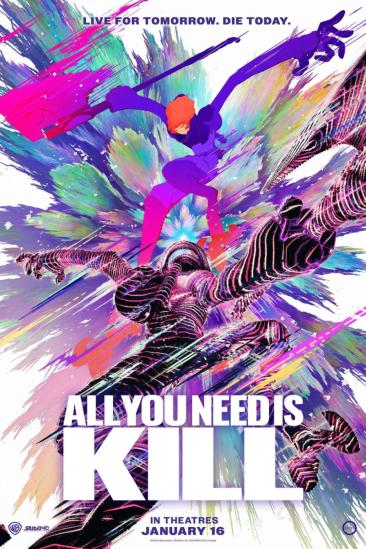
When a massive alien flower known as "Darol" unexpectedly erupts in a deadly event, unleashing monstrous creatures that decimate the population of Japan, Rita is caught in the destruction—and kil...
This question is to all the people who’ve watched Edge of Tomorrow at nausea: are you familiar with the novel that inspired it? “All I Need is Kill”, a Japanese sci-fi light novel about a solider who dies multiple times during an alien invasion and gets resurrected until he learns to fight more effectively to survive, has now hit only its three iteration….and I was weirdly excited upon discovering the connection to EoT.
Consider my curiosity and satisfaction met…..mostly.
As his first directorial outing, Ken’ichirô Akimoto only just shoulders the weight of a story he’s aware requires a lot of patience and restraint as well as acceleration to almost a self-flagellating degree; he doesn’t immediately pander to the easy rhythms of escalation and turns it into something free-flowing and contemplative. With Yukinori Nakamura’s help, much of this shrewd gambit is marinated to balance spectacle with restraint and he constantly leverages that to try and make the immersion feel as intimate as possible. It doesn’t always play ball though, as that discipline can curdle into inertia and often stalls the momentum.
Forgive me for stating the blatantly obvious, but I am a sucker for good animation and this film has that in unobtrusive, eye-popping, gargantuan supplies. Every microsecond of every split-frame is a sumptuous combination of hand-drawn animation, computer graphical composition, well-synthesized 3D and psychedelic color palette all mixed together and cooked into an idiosyncratic exoskeleton that harmonizes these diverse visual elements rather than letting them clash. Exaggerated with sketchy linework contrasting pop stylings while implying spatial depth or substantive heft behind the colors and characters as a marked contrast from conventional anime design, its a purposeful ugliness that screams experimental while making it easy to get immersed into the world. Despite a rough-hewn sort of cutesy aesthetic and the occasional choppy frame-rates that can prove distracting, the ceremonial precision of the production design merges seamlessly with its semi-brooding atmospheric elements.
Even with a somewhat schematic execution, the presentation doesn’t completely undermine the excitement to come and builds anticipation effectively, gradually both inflating and condensing the scope and scale of its visual ambitions. Take both the cinematography and editing for instance; between constant whipping and weaving or picturesque stability with decent lighting, they compliment each other with how deliberate the other’s role is and how each specific shot has to correspond to every dramatic angle the other makes, helping anchor the film’s inimitable visual identity.
Relentless is the only proper way to coin the pacing for this film, matching the protagonists’ urgent dilemma but borders on impatient when micromanaging everything around them, while the concise 85 minute runtime that supports it is both brisk to not overstay its welcome yet reluctant to drag things out for some needed tweaking. Not all the tension is fully extracted to sell the impending doom of both situations, the varied tone whipping between reserved and panic without one overshadowing the other is remarkable considering how exhausting this normally can be, and nearly all the action sequences are hyperkinetic and incredibly stimulating; they may take place in a vacuum where not one can occur that doesn’t serve the immediate logical demands of the plot but they’re well-choreographed, spaced apart so each one serves a distinct purpose and are never boring.
Yet another synth-heavy score dominates the soundscape, but Yasuhiro Maeda's compositions oscillate between pulsing, anxiety-inducing rhythms and more contemplative, almost mournful electronic passages while all the while, Kôji Kasamatsu’s layered sound design juxtaposes different voices and sounds on different tracks if you pay attention and it adds extra value. Emotional and physical stakes feel rather muted despite growing less abstract with each repetition, the costume design is broadly fine outside of a few exceptions and as per usual, the R-rating is utilized to its full potential.
I swear I keep running out of ways to say the acting as a whole is exquisite. Despite being confined mostly to just two people, the voice performances here achieve a remarkable emotional bandwidth from manic frustration to resigned fatalism to hard-won intimacy that develops between our protagonists. And that’s thanks in part again to the exaggerated character design and complete dedication to seeing their arcs all the way through despite how brief and traditional they are; unfortunately, neither Rita or Kenji get the proper time to develop as characters or be given any kind of emotional catharsis that sticks….but narrative necessity aside, the bare minimum was put out and they still rolled with it.
As Rita, Ai Mikami fully embodies this isolated grit that makes her both observant and battle-hardened while Natsuki Hanae’s take on Kenji Nojima contrasts her spikiness with nerdy optimism that gradually evolves alongside his partner. Much of the dialogue they’ve been given though is excessively expository so that could've been tweaked a little bit.
Taking the basic riffs of Groundhog Day and sticking close to the fundamental core of the original book while altering its own DNA to find its own tenor, this very lean yet thin take on the rather tired time-loop idea was always going to run into some familiar, recyclable wallpaper and the narrative flaunts that for all its worth with a lot of dark absurdism. I believe this is one of the few times I can recall seeing a movie embrace the rather frustrating madness of a rougelike situation that Edge of Tomorrow only winked at, while reprising both the action and the monotony of this hellish loop without ever dulling its own premise. Believe it or not, it’s a crucial step up from the original’s execution, which can be viewed as tedious, one-note, and relentlessly steeped with lurid grimdark details that invoke darkness endured audience apathy. Here though, it takes the more interesting deuteragonist from previous tellings and upon thrusting her into the spotlight, makes more of an effort to center their growth away from being built around becoming the ultimate warrior and channel it toward something more internal. And since this story is all but reliant on repetition to get its point across, the imagery and structure meant to succinctly capture these moods, pasts, and worldviews, ensures it lands as best as it can.
Perhaps what I enjoy most about time-loop stories like this is how much most of them devolve to character examinations and AYNIK’s intentions are all but earnest in hoping to convey the weighty existential despair of a cyclical existence, the world-expanding upheaval of discovering a kindred spirit, and transcendent uplift at the cycle’s overcoming. Tying loneliness, ennui, and the fatalism of this scenario to the zeitgeisty concerns of socially isolated youth and impending climate disaster does give more milage to a story that isn’t entirely deep to begin with and more or less, justifies the weaponizing of the repetition as a form of emotional erosion; yes, it is more about overcoming this feeling of “stuckness” as it is about overcoming some external threat again but progress for our protagonists are detailed just enough for us wanting to see the film tie together both characters’ journeys.
One can make the argument that this film straying too far from the actual manga works against it but me personally, it keeps enough of the core fundamentals of the original story for it to be classified as part of that same umbrella and most importantly, at least to me, sticking close to the source material doesn’t always create the best product. Let me put it like this: just like how quality control is an optional extra/bonus for video game developers, the same applies to directors and writers branching too close to or away from the source material for inspiration and/or guidance. Keeping it true to the text is fine and all but you need to make certain concessions when necessary because making a good film takes priority. And given how quickly and confidently this iteration opts to ride the wave of its high concept premise with how tight the scope is, , that universal feeling in its implications about human connection in the face of cosmic futility that is omnipresent in the light-novel is still rife and prevalent here.
With all that being said, maybe anchoring itself to strictly a video game-esque structure might’ve worked a little too well, for a rigid functionalism and temporal weightlessness dampen over everything like a drab mushroom cloud. Between not spending much time walking us through the background of what’s going on and taking 3/4 of the film to finally get a picture of what the hell Rita and Kenji are dealing with, it’s a very action-mechanical heavy focus that is very narrow and betrays the limitations these types of stories have always struggled to overcome. Every idea here, no matter how strong, arrives already panting and the hierarchy behind them don’t graduate or evolve beyond what their relevance to the actual plot is or what they’re physically meant to represent in the present sense.
Also, let’s be honest: even if you catch on to everything the movie puts out before you, I call slight B.S on that ending. Is it a vast improvement over Edge of Tomorrow? Probably, yeah…..and a part of me wants to believe it doesn’t completely rip away the emotional overture layered underneath….but at the end of the day, it’s still a fake-out as well as abrupt. Like, its sound on paper as it echoes shades of Casablanca but the end result feels shallow.
With only its fourth iteration, in both a vacuum and holding a mirror against its other adaptations, the end result is a visually enticing yet mildly pyrrhic tale that won’t offer you even nearly as much adrenaline as Edge of Tomorrow but still carries itself as a fine bit of entertainment.