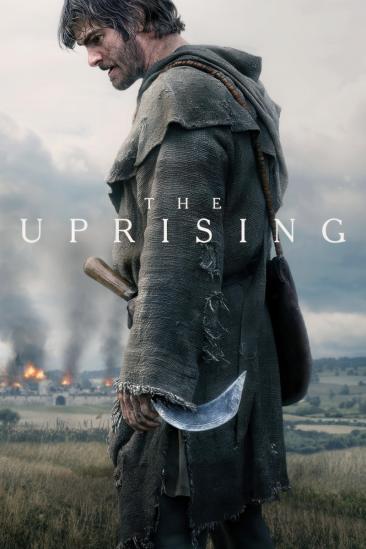
As war and plague devastate 14th-century England, a humble peasant ignites a rebellion, uniting an army of commoners to defy the King’s might in a desperate fight for justice and survival.
Admittedly, when I first saw the trailer for “The Uprising” many months ago, I found myself being weirdly optimistic about it; I’ve always been a history junkie for as long as I can remember, so this just felt like another case of “Yay, more stuff for me to learn”. That being said….. I don’t think I felt the same when I finished this.
If anything, I’d say it’s cinematic gruel: full of intent, flavorless on the tongue, and only filling out of obligation to finish what’s been ladled on your plate.
Can’t say much about Paul Greengrass, considering this is the first film of his I’ve seen….but his direction? Oh boy. It’s apparent that he prefers the smash of history to the slow accretion of it, and he is very much in his element here; giving the revolt a raw, almost documentary-like immediacy, verisimilitude is key to his work, and it bears fruit more in isolation than he thinks it does. It serves the moment more than the meaning and while I think his direction doesn’t suffer entirely from trying to make the moment THE meaning, the sheer weight of that ambition feels like it was pressed flat.
Being set in the 14th century, it could’ve been so easy simply present this historical setting as a backdrop…and it doesn’t completely escape that distinction. Still, the work Nikolaj Danielsen put into the production design is nothing short of remarkable…at first. Initially, his work is staggering in its scope and scale—the Bavarian and Franconian forests, fields, castles and sanctums standing in for London stretch out under a bruised, low-hanging sky, every puddle of mud looks freshly churned by hooves or desperate feet, and the very air seems thick with wood, smoke and damp wool. This is a world built not for beauty but for burden, and the sheer scale of it immerses you completely in the grime and grandeur of medieval hardship. But as we inevitably scour and alternate from one beige-looking set to the next, that very ambition gradually narrows into the type of repetition and sameness that makes the world feel less expansive and more like a series of closed-off soundstages.
One thing that immediately stood out amongst this film’s presentation is how it feels incapable of standing completely still. Similar to the oppressed or the oppressors, it constantly presses up against itself, while simultaneously trying to find room inside a world where even existing seems to require permission. It so casually treats itself in the way oppression becomes accumulation, thus making the historical pageant of it all somewhat handsome to a degree, and maintaining the decency not to prettify it for the sake of modernity (even if that streak doesn’t last). I could say the same for the other technical elements involved that support it, but they all have some caveat attached to them; whether it be in movement or simply making space for the rest of the frame, Pal Ulvik Rokseth’s cinematography is nothing short of restless, both as a detriment and semi-annoying benefit. Complete with drone shots galore, and a muted color palette endemic to some historical dramas of this type, it’s a pure style-over-substance approach that wants to feel like an antique but can’t help getting in its own way. While I can appreciate the dexterity behind the handheld camera movements—a Greengrass staple that does occasionally snaps, crackles and pops in brief moments—that nervous electricity never dissipates when it needs to take a breather.
William Goldenberg’s editing carries over that same restless mentality.
Nothing about this pacing feels even remotely natural if you stop to think about it; it’s somehow overstuffed while still starving for more scraps, and for over two hours and eight minutes, it writes like it's in a hurry to get to the inevitable clash while practically crawling on all fours and with little traction. It does feel more palatable past the one-hour mark, but by then, the exhaustion becomes evident. Makeup and visual effects remain consistently serviceable, if not necessarily revolutionary; focus is sporadic with how simultaneously loose and tight the structure tends to fluctuate; tension is a double-edged sword that often trips over itself multiple times between long stretches of nothing and being shoved into the deep end of a riot, and the action sequences do the bare minimum of placing the audience directly in the middle of chaos to give the revolt an overwhelming sense of urgency. Nothing overly choreographed or polished about it; they’re not the balletic nonsense of most period pictures; it is ugly, sudden, and properly expensive in human terms, and it’s a better use for the handheld.
At least the tone is appropriate: grim, deplorable, and disheveled in its commitment to bleakness and being this sprawling, oppressive force suffocating everything and everyone…even if it annoyingly gives in to restraint and holds back just enough from what the subject demands.
Amongst every aspect of this movie I have some criticism of, Volker Bertelmann’s score is one of the few lone exceptions; experimental in merging distorted cello sounds with heavy analog synthesizers, industrial brasses, electronic drones, and modern bagpipe-like elements to create a tribal atmosphere befitting of a revolution breaking out, it’s the most memorable part of the movie by default, even if many of the tracks sound eerily similar to other movies or eventually blend into each other. Much of the sound design from Aran Clifford is in line with what the time period demands, with some weird audio mixing; Tóth András Dániel and Godena-Juhász Attila’s combined costume design LOOKS the part with everyone looking filthy and/or unglamorous, and as per expected with the MPAA rating, its true to its R-rating: stab wounds visible and multiple beheadings afoot, it does not flinch at all.
I can say with full confidence, no one falters in this ensemble; every performance in this sprawling ensemble feels lived-in and fiercely committed, giving 110% whether in service to the material or in spite of it and there is not a single dull or boring performance in sight. Dialogue has a few standout exchanges and electric monologues amongst the otherwise hokey lines and deliveries, but the characters are a vastly different story….mainly because most of them are painted in the broadest of strokes, and the film treats character as a luxury the fourteenth century couldn’t afford. It NEVER lingers long enough for any of them to feel more like a human living through dire circumstances and less like a basic function to move the plot forward; annoyingly, the teenage King is the only one with an actual character arc here, constantly playing second fiddle to his counsel who actually make the laws before finally stepping into his own to make decisions for himself…only to quickly spiral into megalomania.
Andrew Garfield as the leading man delivers what the film needs—and more than its script earns. He carries the pinched vigilance of a man done arguing with heaven, now just waiting for the taxman and trying to make peace with his purpose. The supporting cast is capable: Jamie Bell’s John Ball smolders with righteous fervor; Cosmo Jarvis’s Wat Tyler wears a soldier’s blunt coarseness.
Right off the bat, this narrative feels contrived and confusing. It is mostly centered around the real-life Peasants’ Revolt of 1381, aka, events that occurred two centuries AFTER the setting of the Robin Hood legends… and yet they try to shoehorn this into being a Robin Hood origin story since the earliest ballads of the character were in the 14th century during the reigns of the three Edwards. Putting all that to one side, we’ve all seen this narrative before, and it can’t help but feel like the kind of history attached to a boring lecture but at the bare minimum, the story presents itself with an intentionally rough and direct approach that makes events feel like they're happening in front of you rather than being carefully staged, and that is the type of history I like to see play out. And yet, there’s just one teensy-weensy-but-ever-so-crucial-little-tiny-problem with it all: It legit feels like every other factor involved in putting this movie together was constructed with something adjacent to an old-and-timey mindset…except for whatever remained of the actual story. There’s a pattern that continually repeats with the same set-up until its climax: characters shout at one another, shaky camerawork, music bludgeoning our ears to remind us of what’s supposed to happen, quiet moment of reprieve and repeat. Repetition isn’t the problem more so than the strange, atonal, gluey aftertaste it leaves once all the trimmings fall away and how much momentum its monotony butchers.
Two straight hours of this very excessive approach seriously damages the story and renders the important moments null and void, because this film couldn’t decide what it wanted to be. Ok, that's an exaggeration: it doesn’t know how to truly sit with the emotions and complex congruities of the time period it clearly wants to engross us in. Certain narrative threads feel underdeveloped, other transitions between the personal and political aspects of the story can feel abrupt, and for as desperately as it wants to be this anti-epic, they undercut or outright avoid emotional storytelling like the plague because God forbid we feel something about a revolution. By keeping its humanity at arm’s length, it becomes a parade of suffering and anger with little to hang onto; you can only attach yourself to rage for so long before desensitizing the viewer. If the characters aren’t fighting, the film doesn’t know what to do with them, and that’s really fucking damaging if you can’t get us to give a shit about why this revolution matters while basing your story on a real-life revolt in which revolting felt like the only feasible option.
Thematically, it somehow has plenty to say about systemic oppression, political violence, generational anger, the desire for justice, and how far is too far to achieve it; the line between justice and revenge blurs considerably when you’ve been wronged and everything around you has been withering away. Comparing this to the power one possesses with a golden spoon shoved up your ass is both palpable and a nice mirroring to ride the coattails of our modern political fears and anxieties; that juxtaposition is one of a few narrative choices that adds some timeless, cyclical weight to the tale—the grim certainty and inevitability that this story is doomed to repeat itself across the course of human history….but the narrative can’t engage with the context meaningfully. What’s more, that’s not even going into the blundering deluge of historical inaccuracies, small and large: how the tax law they protested was enacted four years earlier in 1377 during the Hundred Years’ War; the taxes themselves not even being the reason why the revolt happens at all (especially considering how horrendous the 14th-century tax laws were, increasing four pence to one whole shilling and how the common folk couldn’t make that many shillings per year); condensing the timeline and increasing the death toll of the Black Death despite this happening thirty years AFTER that, and because it goes light on spelling out some of the more detailed beats of this historical context, the more it strays from reality, the more artificial it feels. Yes, I am fully aware of how often movies and documentaries play fast and loose with historical facts and details for the sake of convenience and telling a compelling story. I wouldn’t be so up in arms about it if this movie actively went out of its way to present itself as a very loose form of alternate historical revisionism… or if it stayed true to the spirit and emotions of what happened. I get what Greengrass is doing here: it’s about the mass, the facelessness of revolt, the weight of a mob both literally and symbolically. But after two hours, even the best-executed anonymity begins to feel like a cop-out, an excuse for not trying harder to make sense inside the noise.
And for the cherry on top, there’s a coda scene at the very end revealing our Ploughman transforming into the titular Robin Hood. Now I was spoiled about this ahead of time, so I knew this was coming, but fuck me, was that scene tacked on for the hell of it. This revelation simply does not work; nothing is built up to justify that drastic change, and said drastic change and “revelation” doesn’t even change the meaning of what we’ve already seen or reshape our understanding of the famous character. I don’t know if I’d call this ending tonally or thematically inconsistent with what was shown before (even though it feels like it is)….
… but it is unapologetically Hollywood in a film that, despite its litany of annoyances, actually tried to shoulder some semblance of authenticity despite god knows how many liberties taken.
For as necessary as the very existence of this movie is, I really, REALLY wanted to like “The Uprising”. It’s a muddled clump of noble ideas and occasionally gripping drama jammed through the same blockbuster extruder that has squeezed the soul out of I-don’t-know-how-many-biopics and revisionist downers that dare you to care, then hides every chance to do so under a guardsman’s boot heel. Maybe it’s my own fault for wanting a film that reimagines the peasants’ revolt with some measure of pathos, or perhaps it’s just the malaise of being a person who consumes “historical drama” like a food group, but in a year where we’re barrel-rolling down the lens of fascism faster than ever and they’re actively cheating in plain sight now, pathos is very important.