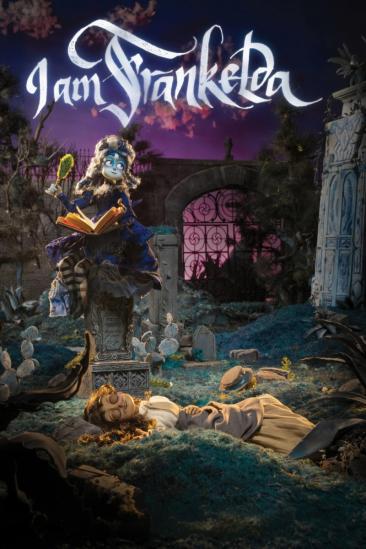
Ladies and gentlemen, peeps of all ages, step right up: tucked somewhere between a fever dream and a folk tale, painted in the colors of marigolds and midnight, here is “I Am Frankelda”—the first stop-motion animated feature ever to crawl, stitch by stitch, out of Mexico and onto your screen. This isn’t quite the “Drop everything and see this when you get the chance” type of event…
....but it feels like it is.
Roy and Arturo Ambriz make their directorial debut here with this feature and talk about burning bright on the first try; it is literally an everything-and-the-talavera-sink delight that doesn’t so much synthesize magic and the macabre as throw both into a cauldron alongside the entire accumulated visual inheritance of Mexican craft tradition. Dense, playful, overstuffed in the best possible way and crackling with the type of energy that comes from someone with a lifetime of ideas, this dual direction from the brothers is one where the ambition remains consistent.
From the exquisite puppetry to oil-basted paintery to the innovative craftwork and distinctiveness put into the ethereal character designs, this stop-motion animation is a sight for sore eyes, especially in a day and age where a medium like this demands an almost biblical amount of patience, poise and practicality to help it stick. Using paintings like La creación de las aves or El árbol de la vida among many other Spanish surrealist artwork as the framework and inspiration for this, there’s a morbid charm to how much extra emphasis it places on materialistic/environmental tactility that feels at once deeply handmade and genuinely haunted; ranging from cotton balls and doilies to fleshy goop and plastic toys, that echoes the ghost of Tim Burton while bleeding phantasmagoria out of every pore. Imaginative, slightly exaggerated, and completely fitting for this twisted dreamworld, the production design bolsters those visuals wonderfully in its baroque, twisted Gothic architecture; Ana Coronilla and Bruce Zick’s combined work is surprising both in scope and scale, fully fleshing out the world of Topus Terrentus and making it feel lived in, despite not spending much time there.
Stop-motion earns its prestige almost entirely by existing, where the sheer labor of it collapses the distance between roof and ceiling so thoroughly that the craft alone is half the achievement; movies like this are either very big or loose on presentation to where they either lean into or fully disappear into it. Drifting between gorgeous and grotesque imagery on a dime, this full-throated celebration of Latin American horror culture squirms through scrambled chronology like a cracked metate grinding gothic copal into daylight while refusing to hide its seams, and both Fernanda G. Manzur and Irene Melis’s combined cinematography doubles down on that idiosyncrasy. Sweeping, intentional movements from the camera make the miniature puppet sets feel grand in scale rather than cramped or limited and the dramatic shadowplay and vivid contrasts in color grading fully encompass the dreamy/haunting equilibrium of a world created entirely through extraordinary means.
Gabriel Acuña’s editing compliments that beautifully, holding its own against all of that.
For every solitary second of its 104-minute runtime, the pacing is tight—perhaps a little too tight. Scenes rush past in a rhythm better suited to a 22-minute episode than a feature several times its length, and you never stop noticing the persistent, almost anxious forward momentum to everything; like, the film had trouble trusting itself to breathe. And yet the fact it never buckles it doesn’t completely deter from how immaculate it is to cram this much in and make it all work without ballooning it past two hours. Much of its focus teeters between linear and sporadic at once due to its structure (although thankfully its never catastrophic), I can’t say I distinctly remember a specific moment where the tension ever fully bubbles and boils over and that’s kind of a problem when the stakes are this well-defined, legible and laid out. Surprisingly, the tone took me the most by surprise, due to, again, how much of it echos and absorbs Tim Burton. The morbid charm, gothic whimsy, the gleeful cohabitation of the tender and terrifying, except the darkness here is communal and worn with pride like an heirloom.
I must give out a round of applause to Kevin Smither’s music composition because ay dios mio, the music is astonishing. Appropriately gothic with a more pronounced operatic mood, it threads itself through every scene with the kind of confident, unhurried sweep that makes you forget you’re watching puppets and given that it’s also a musical, it essentially has to pull double duty; neither variable suffers. The songs aren’t that half bad either; El Principe de los Sustos in particular did take a while to grow on me but once it did, it lodged itself somewhere behind my sternum and hasn’t left. Every facet of the sound design is immaculately dense and gripping, the overarching costume design blending 19th century gothic fashion, Victorian Mexican inspired clothing, and textual imperfections is a visual treat for the eyes thanks to the combined efforts of everyone involved, and yes, the MPAA rating here is a PG rating. But don’t be fooled: there’s a lot you can get away with with a PG rating in an animated film.
There’re only so many times I can say the same thing about an ensemble like this; if I could give out a bouquet of flowers to every member of this voice cast, I would. Vivacious and extravagant as its nervous system breathing life into the project, the range of everyone here is exceptional. The specifically colloquial quality of the dialogue further helps preserve the film’s Mexican identity, even as it hurtles past at the same breakneck speed that plagues the pacing throughout, and it’s been a while since I’ve seen a movie with a character roster this colorful and memorable excluding the main character of course, popping off the screen in a way that helps give truth to their designs.
Mireya Mendoza excels as the central lead for Frankelda, nailing all the passive, withdrawn, fiery aspects that drive her character while Luis Leonardo Suarez coats every syllable of Procustes in such a thick, self-satisfied grease that you want to reach through the screen and wring his little puppet neck with your bare hands. Everyone else holds their own just as well.
Believe it or not, despite the vast intricacy that went into developing everything, the story that ties it all together is both excessive and almost disarmingly simple at the same time. As a tribute to the endless power of imagination, creativity and the long-standing ode to storytelling in general, this had every chance to turn cynical regarding its meta-narrative of the compulsion to make art that moves you, the people who twist that passion into a prison, the edges of imposter syndrome, self-doubt, struggles to be original in a world that barely has any of that left, being a woman in male-dominated field of high importance, and that classic cultural clash between the younger and older generations. But I’m of the opinion of this being the good kind of bewilderment; maximalist to a fault, it’s done in a way that underscores the story’s own passion, intent and purpose to where even when the narrative plods along and it announces the connection between reality and imagination rather than letting the images speak for themselves, the thing still hums.
That being said, this is essentially a prequel to a TV series called Frankelda’s Book of Spooks so once you pick that out, the predictability for this feature is likely to skyrocket.
I wouldn’t put it past you for thinking the general narrative at play is awfully generic, either….because it kinda is. Strip away the visual delirium and the tale beneath is one you’ve seen echoed throughout generations: the creative spirit suffocated by oppression and haunted artists coming to terms with the legacy they want to create. The beats are classical and archetypal, and it wears all its influences on its sleeve as a homage, reinforcement and gentle mockery of the very conventions it employs. Making an act out of retelling its own argument, it also makes the very condition of being “too much” into a virtue, converting how sprawling and dense it is from liabilities into the thesis itself. After all, what are dreams and nightmares if not the mind telling itself stories—stories that carry our communities, our histories, the full weight of who we actually are; storytelling is the very heart of art itself and reality is only bearable because our fantasies weaponize our very fears to swallow it whole. If anything, that’s the most quietly radical thing this film argues: horror isn’t something to survive so much as something to inherit. Fear doesn’t diminish you; it’s the very condition under which growth becomes possible at all and where the door opens up for you to transmute that pain into beauty. You can’t make a home out of the dark if you were never afraid of it to begin with; either you adapt to it or you’re born in it, molded by it.
What it’s got working against it is something I briefly touched upon earlier: the emotional core that doesn’t quite establish itself. Because of how tight the pacing is, and how much the dialogue packs into every frame, the characters barely get a chance to really leave more of an impact than they actually do. Like, there’s like these Seven clans that each control a separate fear, and while they get just enough characterization to hone in on their personalities and overall vibes, they don’t stick around long enough to feel that much more fleshed out. Also, the overarching relationship between both worlds is overexplained in some places and underexplained in others and then there’s the romance itself between Frankelda and Hernival. Very sudden, kinda abrupt, and underdeveloped at once, I kinda struggled to emotionally attach myself.
For being Mexico’s first big venture into the realm of stop-motion, “I Am Frankelda” comes mere pixels, brushstrokes and fingerprints away from landing just shy of a national statement, the defiant artistic bravura of the entire country’s artisans—a declaration of creative sovereignty stitched together frame by painstaking frame. Similar to Ne Zha 2, this film feels less like a debut and more like an arrival, the culmination of an entire culture’s visual mythology finally landing on the exact medium it needs to bite down on.