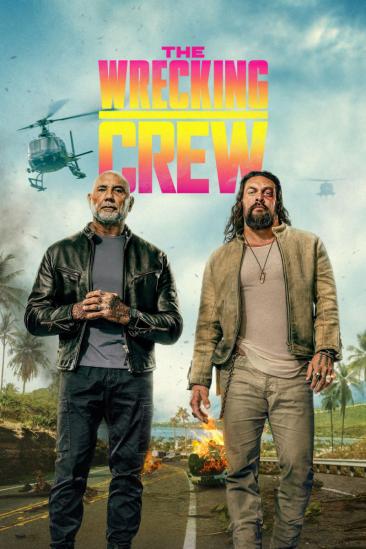
Estranged half-brothers Jonny and James reunite after their father's mysterious death. As they search for the truth, buried secrets reveal a conspiracy threatening to tear their family apart.
Color me surprised: “The Wrecking Crew” isn’t half-bad.
That being said, the narrative at play here isn’t much to write home about. You know exactly how it’s going to play out: two estranged siblings (or random partners with various lifestyles because the formula is basically the same) are brought together following their father’s tragic passing (or a random case that just so happens to require both their skills) to uncover a conspiracy regarding his last case while patching up years of misunderstandings and genuine gripes with each other. Essentially, it plays entirely within familiar territory, relying on well-known tropes and a very predictable story structure where everything is algorithmically placed as it cycles between meathead romp, goofy Hawaiian romp and family trauma drama with all the manufactured enthusiasm and stilted posturing of a GameStop manager. It harkens back to its Lethal Weapon-inspired B-Movie roots well enough through its simple set-up, but a sharper script and bolder identity would've benefited the story much better. Confrontations are repeated at nausea, discoveries blur together instead of building clean momentum toward the finale, it signals every telegraphed “twist” you could see coming a mile away if you’ve seen enough of these movies, and the general cluttering of its plot structure speaks to ambition aiming for a lot but achieving very little.
Easily digestible as a guilty pleasure, it narrowly avoids being boring, and it knows precisely what it is, but the plot is still just a hollow, meandering gumbo pot of loud, boisterous, empty calories where the emotional storytelling and training-wheels-drunken plotting just never gel together.
Thematically, it doesn’t fare much better. It most certainly flirts with forgiveness, unchecked grief, and culturally respectful novelty regarding Hawaiian culture, acknowledging the corruption in paradise and criticizing whites-vs-natives exploitative power plays and gentrification with various gangster groups and corrupt figures keen to exploit the islands’ beauty for their own interests…but that all harkens back to the murder mystery that peels back all of these layers. And the actual murder mystery here is the least interesting aspect of this screenplay by 4,539 mile, like it was pulled from a discarded episode of Hawaii Five-0, but even that show would’ve approached the topic with some class. Again, it keeps gesturing toward something richer—ancestral land rights, the commodification of indigenous suffering, the way trauma replicates itself across generations—but every time it gets close to actual insight, someone gets thrown through a plate-glass window, and we’re back to the buddy-cop shorthand.
You know how they say imitation is the sincerest form of flattery? I can see why Ángel Manuel Soto would take that phrase to heart a little bit; he’s fully aware of how much this project screams 80’s throwback, and his directing clearly shows how much homework he’s done with this cheeky self-awareness, and attempt at an overall halcyon vibe to the proceedings. Parts of it are semi-clever in the brief bursts of energy it exudes, but it’s just plainly competent at the end of the day. It’s more or less the same instincts running on a slightly shorter leash, meaning the otherwise scrappy, idiosyncratic charge that he helped buoy through Blue Beetle’s crowd-pleasing doesn’t hit the same way this time.
I wish I could say more about the general setting, locales and Andrew Menzies’ production design because on its own, it deserves better than what the film actually does with it. There’s a picturesque quality to the locations that at minimum keeps things easy on the eyes—which, after sitting through the infuriating brochure-shoot laziness of the recent Lilo and Stitch remake, feels like faint but genuine praise. But visually unremarkable is still visually unremarkable, even with a nice backdrop; it can’t stop the set-pieces from feeling derivative and tragically underwhelming even if the contrast between sandy beaches and murky underground is highlighted well enough. Not to mention, the rather cynical atmosphere it’s aiming for doesn’t permeate the premises as it does…hover awkwardly above it, waiting for permission to bare its teeth only for the scope and scale of the environments to keep pulling back…..and often times, vice versa.
Really, we’re dealing with a movie where, on one hand, its presentation would’ve been more memorable had it arguably leaned into its worst impulses as a genre. But on the other hand, it’s brainless enough as is that you wouldn’t win on either side. The Spike TV-esque nostalgic novelty of it all means there’s a strain quietly bubbling under every scene, where whatever depth and intrigue are there immediately gets sanded down, and one of the biggest drawbacks as a result of that is the cinematography from Matt Flannery; dammit, I really wanted to give his camerawork some flowers here because there’s a lot of playfulness here. Alternating between sweeping wide shots and semi-immersive tracking shots, it’s appropriately stylized with a decent color palette and vast enough to feel expansive…..but there’s a difference between hypnotic and merely busy, and the digital sheen of it all can occasionally flatten the framework to where everything looks focus-tested into submission.
Michael McCusker’s editing is rather archetypal in how it holds up the weight of alternating from scene to scene. It’s decent enough.
Pacing-wise, the overall tempo and speed is actually pretty respectable; I was mentally preparing myself for the movie to drag itself out just a bit too long, and it does teeter on the edge of overstaying its welcome here and there, but never quite tips over into dead weight where it feels like it actively wastes time. Practical effects are a genuine bright spot here—so when the CGI eventually muscles its way in, the contrast is almost offensive, and whatever immersive grip the film had on you loosens immediately, the linear focus has so little of it that it frays not long upon being pulled, humor is embarrassingly two-faced between not eliciting any laughs and bubbling them up from the surface by complete accident, the stakes are both clear yet fleeting with how little the larger criminal web actually matters as a gripping central conflict, and admittedly, the action sequences flirted between rudimentary and actually kinda decent. However, I distinctly remember the very first one and the one on the highway being absolutely ludicrous, but they’re both modestly scaled, help set the tone, and among the other action sequences here, actually stand out the most.
Speaking of tone, it borders a lot between alternatively jokey and sentimental at the drop of a hat, and the balance between the two is a lumpy blend that stops short of satire with how much it threatens to derail the entire experience. It’s honestly a miracle that it doesn’t, but that goes to show that the only thing clear about the tone is its aggression and where to target it.
Bobby Krlic’s butt-rock score at least fits the proceedings in the manner that it grinds through the speakers like a rental Mustang with cheap subwoofers; its a score so interminably generic and by-the-numbers I can’t actively remember a single note, melody or individual track. And yet, it still fits the shabby affair being told. Sound design is competent and unobtrusive with how functional its layers elevate or detract from the on-screen shenanigans, I can’t recall the significance of Jane Holland’s costume design outside of being a visual roll call of who does what job and a few floral prints thrown in for local color, and outside a few graphic moments in brief spurts near the beginning and end and the violence displayed, the full extent of the R-rating boils down to how many curses are strung along in rapid succession.
It feels superfluous trying to pick apart the acting here; most of the performances meet the dictionary definition of ‘Fine, yet unremarkable’; this comfortable, unmemorable middle ground where everyone hits their marks but leave no actual fingerprints on the role like beige wallpaper on a furnished rental. Between the occasional exposition dump and many of the jokes just not landing, the dialogue is just very coarse, and even the occasional zingers that do raise a chuckle do only that. Character-wise, it’s frustrating because they were so close to nailing it. Most of them feel written and performed in a way that makes them feel recognizably human to a fault, but those are the key words here: TO A FAULT. Fictional characters have at least some responsibility to mean something, to be memorable, and the moment I clocked that none of these people were going to be, the air just got sucked out.
Both Batista and Jason Momoa handle the material with gusto, exuding their natural charm and charisma, although the former comes across as a little stiff and the latter feels like he’s trying a bit too hard. Morena Baccarin is the only one who comes close to matching their energy among the sea of other supporting cast members here, who mostly play it straight.
Neither sardonic enough to be interesting nor sincere or fun enough to be disarming, you’re not gonna lose any sleep whether you miss this one or not. It’s so bang-average that it’s not worth keeping up the conversation about it.