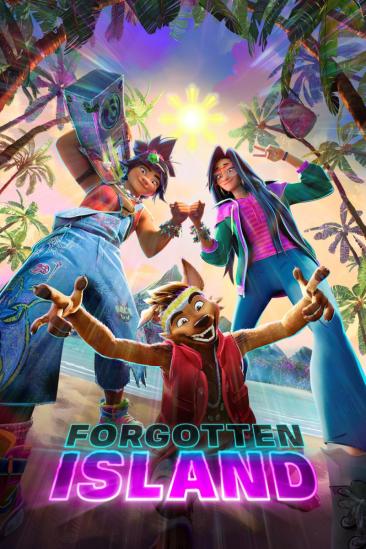
While celebrating their last night together, high school graduates and best friends Jo and Raissa stumble upon a mysterious portal that transports them to the fantastical island of Nakali. When the...
DreamWorks, I maintain this point, is a studio I have slightly more tolerance for than the likes of Disney. Even with them falling into the live-action gravy train now, they still seem open to trying new things and staying experimental; that creative restlessness leaves room for surprising comebacks and gives them more openings to recover and win back audiences. Honestly, I think that very reputation for being hit-or-miss enables them to have an easier time maintaining goodwill compared to Pixar, Sony, Illumination, etc.
“Forgotten Island” demonstrates why that DreamWorks reservoir of goodwill often gets rewarded….and why it so frequently comes under strain.
With these two being longtime BFF’s, Joel Crawford and Januel P. Mercado punched above their weight and proved they were able to shoulder it well on Puss In Boots: The Last Wish. The directing duo continues to branch out that flexibility and sense of ownership, albeit deliberately choppier, weirder and more messy than their previous outing together. Making the most of DreamWorks’ tolerance for boundary-skirting, their direction carrying the aura and vibe of someone who always works like its their last day alive, like they’ve been given one shot at this and refuse to leave anything in the tank….even if they occasionally get a little too lost within their story.
Looking at this movie is somehow too easy to manage and too enticing to look away from; this might as well be a visual mixtape of lush, impressionistic backdrops clashing with kinetic, anime-inspired movements and expressions of the characters, renditions of the hand-drawn 2D look of old Disney movies, even a three-color printing process used for comic books—so much digital precision and detail and nods to Studio Ghibli, Ralph Bakshi, Genndy Tartakovsky that read beautifully on the screen with this animation. Think the Troll's movie if they experimented with the Spider-Verse style first. And on top of that, Ryan L. Carlson’s production design makes the world breathe with both the Forgotten Island and back home during its Manila-set first act, giving it a distinct identity that only JUST separates it from the countless other fantasy worlds seen in animated films; it’s variety within variety—every frame crowded with something new to look at with a broad sense of discovery, which is excessive, yes, but equally impressive for its scope, scale, and light touch.
Inspired by and taken from Filipino culture, mythology and folklore, the very density of this presentation thankfully never feels like a school lecture; I appreciated how the culture was represented without making it overly explicit or relying on stereotypical clothing, customs, or mannerisms, and it gives the maximalism an ardent purpose to feel lived-in rather than exhibited. Even when it’s constantly going BAM BAM BAM in your face, it’s never paraded around to as something cosmetic….something the rest of the technical features can attest to; the cinematography in particular felt like it was working overtime. Between the repeated uses of wide angle lens, dutch angles and purposeful lighting on top of a neon color palette ripped straight out of a techno dance concert, it's a dynamic composition so Dragon Ball Z and Street Fighter-coded it almost hurt how badly I wanted to smile.
Part of me is surprised at how well James Ryan’s editing catches up with and keeps pace with everything; rapid fast cuts galore but all with a purpose.
Here’s the funny thing about the pacing: a good chunk of this movie might as well be hyperventilating from a sugar rush—constantly moving about with such breathless verve and noise that I can see someone getting mentally exhausted by it….BUT the high would eventually wear off and slow down just enough to let the emotions pour, proving that it isn’t rushing around in circles. And all of this for a runtime that’s an hour and forty-nine minutes; fourteen minutes longer than KPop Demon Hunters and seven minutes longer than Puss In Boots: The Last Wish. Focus-wise, it flirts between loose and firm many times, but a balance is found; the sugar rush pertains to the zany humor too, and it gets some getting used to; it retains the cynical charm and heart of most DreamWorks features; emotional stakes are rarely undermined in spite of all the crowdedness, and for how brisk everything here seems to be operating, the tone is determined to be everything: wild, chaotic and loud while grounding itself in emotional sincerity.
The fact that it only JUST gets away with having its cake and eating it too—managing both breakneck spectacle and genuine heart without one canceling the other out—is perhaps its greatest magic trick.
It’s gotten to a point nowadays where you can feel the Last Wish/Spiderverse influences even in the music compositions. For every OST score that feels like a retooled track with a Filipino edge to it, the rest of the work from Nathan Matthew David incorporating traditional Filipino and Indigenous instruments feels like a cathedral being built that’s both ancient and hyper-contemporary. Even the way they utilized the licensed music too has shades of Arcane to it, each pop song not just a backdrop but a narrative heartbeat, chosen to elevate a moment rather than simply occupy it. Every facet of David Thorm’s sound design is fined-tuned specifically to amplify as well as enhance; the costume design is a vibrant collision of traditional Filipino textiles and silhouettes with the oversized, neon-drenched aesthetics of 80s and 90s streetwear, and much like The Wild Robot, this movie’s MPAA rating is another swift reminder of how much PG animated films could get away with—only borrows from more mature sources for inspiration but is unafraid to be a little bit rude.
Ok, this whole cast is pulling in the same direction, and it shows; everyone frequently injects the movie with bursts of absurdity without completely overwhelming its more serious emotional storytelling. The dialogue doesn’t overcomplicate itself—it’s plainspoken, with a cynical bite to give it some spark ‘cause that’s all it ever needed to be, and for how deep and extensive the character roster here is, a decent job is done giving everyone just enough personality and characterization for it to stick….even if it did feel a tad compressed with the various characters it included, such as the tree people's short appearance and the Manananggal not having enough interactions with the lead duo.
For this being H.E.R’s official film debut, she knocked it out of the damn park as Jo, whose line deliveries ping-pong between all big gestures, bigger voice, and a whirlwind of optimism that keeps bumping into everybody’s walls to contrast wonderfully against Liza Soberano’s Raissa—being the straight woman to everyone else’s chaos, and she plays it with a low-key naturalism that never asks for attention. Their back-and-forth carries the whole movie; you believe they’ve been best friends since second grade, and you believe exactly why they’re about to wreck that friendship. I could gush about Dave Franco’s gruff, spiffy energy, Jenny Slate’s perfected anxious comfortability or Lea Salonga (the singing voice for Jasmine and Mulan btw) trading in her usual warmth for menace as the famous Manananggal, but I’d be beating a dead horse.
So remixing Superbad, Eternal Sunshine of the Spotless Mind, The Hangover and Dude, Where’s My Car into a rave-like children's adventure was definitely not on my bingo card. That being said, the narrative from the outside looking in…..and the inside looking out is one we’ve seen a thousand times already: two best friends who are polar opposites inevitably have to part ways, and it causes a rift, but they get whisked away on one last adventure to clear the air, make more memories and potentially save a mystical group of people through the power of friendship and growing up. It has been the scaffolding for enough cutesy road movies and after-school specials to induce contact hives, and yet, what makes the difference, what keeps it from feeling like a tourist’s carousel through the same emotional scenery, is how often it uses that outline as a trampoline, instead of a treadmill. More than happy to skip the foundational table setting, the story keeps enough of its chaos straight to capitalize on its biggest strength aside from the animation: the chemistry and believability of our main leads as friends. Without that, most of the story would understandably crumble.
And because the movie is so hyperactively layered in its plotting, there are visual analogs for every emotional beat, every step of the girl’s journey, every gnarly beast and hilarious mythological figure encountered, that even when the story pauses to contemplate the slow-motion loss of innocence or the weird, emotional pangs of growing older, you’re quickly swept along to the next set piece before you can settle into cliché.
Once again, as per tradition in most kids movies, this one is thematically very poignant in its teaching of the younger generation about the inevitable realities of sacrifice, death, mourning something you eventually outgrow, and how life’s twists and turns affect relationships we once thought were permanent. We’ve seen these themes and motifs dramatized so often you hardly even get any credit for calling it out anymore, but the framing device not only recontextualizes “found family” clichés to fit the characters’ narrative backgrounds but manages to weaponize it as an argument—a debate, almost—about whether it’s okay to let go of a friendship that has long outlived its purpose. There’s a harder edge to this story than at first appears: Jo and Raissa’s relationship, and the manner in which it fractures, is depicted with a depth of pain and anxiety that is less “let’s all stay friends forever” and more “maybe it’s okay, even necessary, to outgrow the people we once thought would be constants. Even the most tightknit of friendships have a lifespan, and while they might not actually end, they inevitably evolve or regress just as slowly or rapidly as we humans do. Jo and Raissa’s “rift” isn’t just a sleepy falling-out, but a full-throttle psychic demolition derby, mediated by gods and monsters—and the patched-up friendship at the end isn’t cheap, but sweaty, earned, full of melancholy for what has to be left behind……even if the ending is pretty clear within its first 30 minutes, and its magically dubious third act relies heavily on viewers’ buy–in to a largely unexplained power wielded.
On top of that, it stumbles during its second act; not enough to derail it but enough to remind you “Oh yeah, this is kids movie syndrome.” The opening is focused and emotionally compelling, and the final stretch eventually brings the story back around full-circle to its strongest themes, but the middle portion feels noticeably meandering; with the deluge of new characters, references, conflicts, revelations and spiritual resemblances, again, being fired off at you in rapid succession, it stifles the momentum. Problems solve themselves, arguments are settled in minutes, Manang—aside from one sequence—is hardly ever given the antagonistic gravitas she deserves despite there not really being an actual villain in this and while none of this is at all forgettable, you can’t deny it is rushed.
I don’t want to harp on the hard work being done here and say “There’s too much imagination” because that’s a total fabrication…..but that very mentality of “Throw everything and see if it sticks” adds a bit to the overstimulation.
Tayo Na and WAPOOSHES all around, “Forgotten Island” is how you take a simplistic premise and inject it with the sort of baroque, frenzied life that makes the entire 109 minutes seem almost allergic to boredom and makes said madcap barrage another DreamWorks special: fun, inviting, and nakedly heart-forward. It’s like the culinary muscle of an upper-echelon kitchen—lots of wild flavor, maybe some uneven notes, but unforgettable in the way it engages all the taste buds.