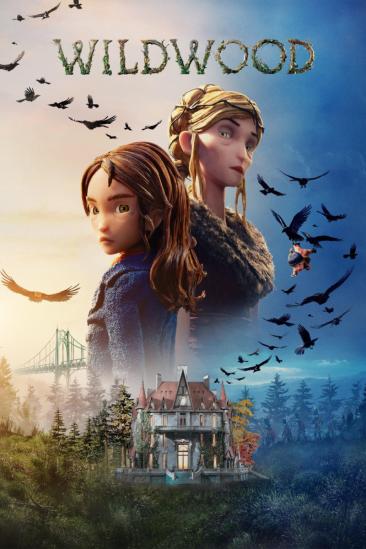
Prue and her classmate Curtis are drawn into a magical forest filled with enchanted creatures, loyal allies, and formidable adversaries as they embark on a desperate quest to rescue Prue's abducted...
After a seven-year drought, following fifteen years of meticulous, painstaking work in the shadowed animation bays and under the hum of god knows how many 3D printers and melted computers, LAIKA’s long-awaited new film has finally emerged into the light. As tempting as it is to be the contrarian again…
….I know better than that. Even for LAIKA’s standards, “Wildwood” is a near-generational triumph.
If I recall, this is Travis Knight’s first directorial outing with the company in over a decade since Kubo and the Two Strings, and it makes sense why he had to be the one to direct this at the end of the day. There’s an ambiguous sincerity to his own direction that he instills, anchoring much of the familiarity with a soulful pulse without having to constantly wink at the audience; refusing to play that game, he plays a lot with the light and dark with surreality and an off-kilter flavor that always seems to bolster this edge that perfectly reflects his nuanced storytelling.
Charming mixture between Brian Jacques’ “Redwall” and a full-fledged epic odyssey, I have no words to describe how exquisite, how euphoric, how…satisfying this animation is. 231 weeks of production, 2,804 shots, 233 handcrafted puppets, 132 practical sets, more than 142,000 replacement faces, and 49 animators later, and the end result is so breathtaking, I actually forgot I was watching stop-motion. Between the usual striking attention to detail and and this almost feverish kinetic fluidity of movement with a tactile sense of weight and velocity, there's a robust and pleasing directness to it that somehow gives it a more organic character and physical immediacy than Pixar's latest looks as of late (even putting I Am Frankelda to shame) and it drip-feeds into Nelson Lowry’s production design. With this being essentially a love letter to Portland, Oregon—which just so happens to be the home of LAIKA—there’s a distinct cozy, warm feel to the city’s distinct quirks, while blossoming the forests’s already enchanting illustrations from Carson Ellis with its own bustling identity across multiple burrows. On top of carefully carving it with the scope, scale and spectacle of a David Lean film, it helps make the worldbuilding digestible without drowning it in too much exposition.
With this being another coming of age story cloaked as a sci-fi/fantasy story, where the high stakes of the fantastical plot and environment reflect the foibles and frustrations of growing up, this presentation is remarkably dense. Sincere in its importance of showing genuine wonder in fantasy storytelling, but also the willingness to show the darker sides of that world and the people inhabiting it, it absolutely plays to LAIKA’s strengths; iit’s probably the most courageous and self-assured one compared to their recent outings, letting ambiguity and visual subtext do the heavy lifting whenever possible. It most certainly helps that every other major technical component is firing on all cylinders here; Caleb Deschanel being behind the camera immediately buoys the cinematography with such mobility, grace and fearless accuracy that helps push the medium forward and experiment further with the bold art direction.
Christopher Murrie-Green editing is quick to not only catch up but carve rhythm into that grandeur.
Clocking in at over two hours and ten minutes, it’s the longest stop-motion animated film yet, so imagine my surprise when I realized how much this feature insists on this go-go-go pacing that does thankfully indulge/let you sit with its obviously impressive handiwork….but only just. It does gradually take its time to expand, explain and broaden out what it needs to. Much of the humor isn’t gut-burstingly funny or groundbreaking but it makes sure to feel like a natural extension to each character’s personalities; tension is surprisingly multifaceted and straightforward at once; both the physical and emotional stakes line up and coalesce into each other beautifully, and the action sequences are the “lock-your-eyes-to-the-screen-and-don’t-let-go” type, where even the small chases to the big bombast battles are outlined with a thrilling, authentic rush of adrenaline….and a real chance of actual death.
One point of praise that’ll probably be more pointed than others is how well the tone straddles comedy, grief, depression, death, etc without sugarcoating its subject matter, allowing its story to explore genuinely unsettling ideas without being pigeonholed.
Ethereal and everlasting, much of Dario Marianelli’s musical composition isn’t that far off from what we’re used to hearing in animated films these days….but GODDAMN, is it still thrilling. It’s a simple throwback-y old-school fantasy score that knows what moment to sell the switch and sweep the layered soundscape with the full force of an impassable sprawling vista. Sound design does a fantastic job grounding the fantastical, dark, and sprawling world in a tactile, physical reality (especially considering every foley effect and sound has to be emulated from scratch); Deborah Cook’s costume design is nothing short of intricate in its simplicity and subliminal communication, and for this being Laika’s first PG-13 rated film (which may I remind you is RARE for a stop-motion feature), it ABSOLUTELY lives up to it. Being explicitly merciless and graphic in its violence but pulling back just enough to make a point and not needlessly drown us in every few seconds, that classification is nothing to scoff at.
Naturalistic and nuanced, these voice-acting performances rival live-action work, with characters put through the wringer; I rarely say this, but everyone is cast almost perfectly and captures a complete understanding of the material, so their worst vices don't dictate their performance. Even with the dialogue being occasionally on-the-nose and basic, there’s such emphatic conviction in how they’re delivered that makes you believe every word being said, and despite the fact that the characters here aren’t all that fresh, they’re given just enough dimensions to feel fully realized in this world. Everyone (humans and animals alike) fits into a clear archetype but there’s a calming mixture of layers to keep you engaged throughout.
Mahershala Ali and Amanda Stenberg do well with imbuing their simple characters with enough gusto to feel like their own; Charlie Day actually gets enough mileage as this turncoat coyote; Awkwafina leverages her comedic and dramatic chops sparingly without becoming overbearing (which will be a miracle to some people), and Carey Mulligan does an excellent job at making the Dowager Governess come the closest to becoming three dimensional, rounding out her heartbreak and menace to feel equal parts tragic, horrifying and distinctly real. However, it’s Peyton Elizabeth Lee and Jacob Trembley as the leads that prove just as formidable: the former being equal parts snobby, fierce, witty, compassionate and willing to be a little unlikable and the latter nailing an earnest, timid, nebbish and nerdy young boy act that helps sell an impactful, satisfying and tragic character arc….despite seemingly having this recorded before his voice dropped.
A carefully threaded ball of yarn mixing elements and echoing shades of Labyrinth, Chronicles of Narnia, Lord Of The Rings, Return to Oz, Over The Garden Wall, Princess Monoke and the late ‘80’s to ‘90’s collection of Renaissance Disney, this is a very old-fashioned type of narrative with many elements we can pick out from any fantasy story. What starts as a simple rescue mission is destined to spiral into something much more complex as most of these stories are; it’s basically a magic trick that ask us to buy into the act without holding our hands. For as familiar the story ends up becoming, there’s nothing generally frictionless about it.
Every individual scene floats a piece of the puzzle into place even when it bloats in the middle (because of course it does) with the expository storytelling; no matter how small, it ensures everyone has a role and fulfills it to the highest potential and even when it does telegraph plenty of beats, said pieces are not rolled into a gelatinous mass, indistinguishable from ripoffs and claptrap. They are handpicked and assembled with love, forming a rich mosaic of interesting decisions and intentional callbacks, assembled into a fascinating configuration where the film immediately establishes its setting and stakes really well without ever falling into the trap of over-explaining or relying on exposition. For a story about old bones, unsacred pacts, broken hearts, minds and bodies, it can occasionally be too focused on trotting the characters out from one situation to the next but you do get the sense that most characters circumstances add to the conflict as a nice mirror or contrast to each other.
It does such a stellar job retaining its own distinct identity in light of its inspirations that by the time we arrived at the third act, I was already so sucked in and riding this high all the way to the end that I didn’t care how prototypical and familiar many of these beats are.
For being a timeless fantasy, of course it would thematically touch up on issues of our time: conservation, displacement, bureaucracy, environmentalism and the geopolitical tension that comes with it and then we have the more bargain-based themes we’re used to seeing in kids films: maturing doesn’t mean you abandon your imagination and wonder, heroism isn’t limited to just swords and stones—Curtis essentially witnesses much of the suffering and darkness that plagues the land while Prue is forced to accept its wonder and majesty—and the more cautionary message about the dangers of unprocessed grief. All of which tie back into the biggest thematic fabric of this feature: adversity—more specifically, how the wilderness is only impassable if you let it be. We, as children, often are dumped onto this mudball of a planet with only a fractured piece of what we believe to be the truth about where we are, what we do and what our place is supposed to be; after all, the world’s full of possibilities. As we get older, as we feel more increasingly jaded to the atrocities we create and especially as we inevitably sleepwalk into the dour hopelessness of a tech-heavy fascist future, the world…breaks us either quietly or loudly. While the possibilities of making it slightly more sustainable remain, it’s that painful transition from adolescence to adulthood where we have to decide whether the pain and love we experience is something worth consuming us and worsening our environment or channeling to make something better for ourselves and everyone around us.
To parents wondering if this is safe viewing to take your kids to, I’d say absolutely….because it only increases the likelhood that them growing up on this will inspire them to indulge in the strenuous hours of creating something so stunningly beautiful.
Unfortunately, because I gotta be that guy, if there is ONE THING I absolutely HAVE to nitpick, its that because sheer density of how much it has to juggle in its 2-hour-plus runtime, it can feel a bit overwhelming. There’s enough narrative meat to fatten and fuel a full streaming season stretched out to twenty hours (more specifically the old streaming seasons which are 20 episodes apiece), which does reward multiple rewatches, but also left me a bit adrift on first viewing at this….this whirlwind of invention. And as sturdy as the emotional depth here is, it’s still a far cry from what they’ve achieved previously.
On top of that, with the source material being over 500 pages long and the story being condensed thoroughly to fit into the two hour window of this film, a lot of the characters, again, feel extremely two dimensional including the protagonist.
What might as well be the peak of human ingenuity and craftsmanship in the world of stop motion, “Wildwood” is the complete amalgamation of the truth that Travis Knight believes brings the world together: ordinary people doing ridiculous things with unreasonable conviction. Not just a celebration of stop-motion animation in the modern era, it weaponizes the old-fashioned fairytale archetypes of yesteryear to give us a masterpiece and a mesmerizing technical achievement in film; it was worth every. Damn. Minute.