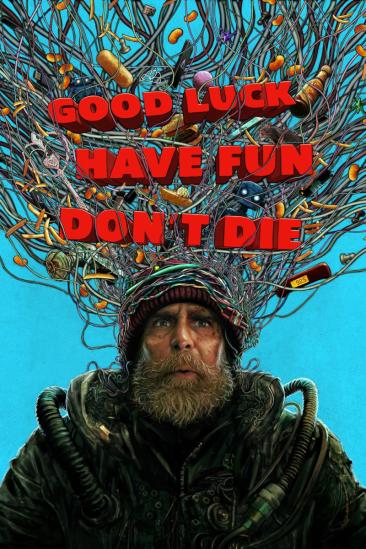
A man from the future arrives at a diner in Los Angeles where he must recruit the precise combination of disgruntled patrons to join him on a one-night-six-block quest to save the world from the te...
While "Good Luck, Have Fun, Don't Die" isn't breaking new ground as this year's first standout film, at least it handily outclasses "Mercy" in the increasingly crowded "AI-turns-nightmarish" subgenre.
There’s something very Looney Tunes about the way Gore Verbinski traverses something this manic and silly while still treating it with the serious gravitas such a sensitive topic deserves. His direction is very blunt, very manic and very angry and yet the way he orchestrates the chaos with the precision of a conductor who knows exactly when to let the cymbals crash and when to let the violins whisper? It’s basically a funhouse mirror that distorts reality just enough to make us see it more clearly and even at its most caustic, Verbinski never loses his playful spirit.
What looks like probably the most generic end times ever staged has an intentional parsimoniousness to it; there’s nothing opulent in how David Brisbane approaches and maps his production design given the low budget here but there’s something of an uncanny cognitive dissonance to the decompression that makes it almost work. The sets are spare to the point of austerity and are so functionally drab that the shift from the diner to more unstable environments to lock in the escalating tension feels like intentional gaslighting, like it wants us to suspect our own spatial awareness; reality being gamified and every location being a potential glitch. You could get away with saying there’s not much you could do with the environments to showcase said terror given what we get is very similar to our current events but the end result is still a somewhat incohesive world with a rather faint atmosphere and several other elements feeling entirely nonsensical….even if the final twist of the movie proves the lack of visual unity was meant to be intentional.
Normally, having to deal with a presentation this scattershot can feel like a detriment to the overall quality but with each layer pulled back, the video game-esque structure here at least flirts like it wants to reward more attentive viewing with the way it touches on the replayability of certain actions, tropes and sequences to reconsider different approaches. Jim Whitaker's cinematography opts for a heightened nocturnal reality that doesn't quite align with the film's structure. While his staging, blocking, and creative use of color and shadow show clear intention, there's an ironic disconnect at play that bolsters the overall visual aesthetic —the imagery being so enamored with the world's surface-level beauty that they fail to acknowledge its underlying ugliness of the world it depicts is a brilliant dichotomy.
Editing has enough rhyme and reason behind its momentum to make it stick but even then, it can feel sluggish.
The film's visual polish stretches every dollar and belies its modest $20 million price tag to impressive effect, the humor will often vary a lot (most of the absurdist gallows-tinged nihilism can feel a bit mean at times) but at least it doesn’t feel like its actively chasing for shock value and its honestly a miracle that the overall tone doesn’t immediately fall apart. Ricocheting between genres like Wile E. Coyote chasing the Road Runner off a cliff, it could’ve easily torpedoed into leaden doomscrolling, or having the zany dry wit constantly undercut it feel very Marvel-esque and stupid…..but it actually respects that balance. If anything, the real issue with the tone is half-measured timidity: the madcap absurdism isn't quite silly or all-encompassing enough to work as no-rules surrealism, yet isn't restrained or specific enough to act as anything that makes any kind of sense.
Off-kilter to the point of being fun, Geoff Zanelli digs up a lot of personality out of this techno musical score—ominous electronica sliding into fun orchestral bombast with a tinge of warped paranoia burrowing underneath, the sound design is equally exceptional in its ability to transform mundane spaces into pressure chambers to heighten one’s unease, costume design is bland yet kitschy in a weirdly farcical fashion, and looking back at it now, the R-rating felt rather faint, like it wanted to go harder with the violence but the hesitation on fitting it into that wheelbarrow tone to be funny or fully commit to something more brutal holds it back a bit.
All of the acting is competent enough with what they’re given as they grasp the film’s peculiar wavelength within the constraints of the material, nothing less, dialogue often crosses the line between authentic, exposition-y and somewhat banal and while the characterization isn’t anything new, it meets the base terms of ‘simple but effective’. You don’t really care about any of them outside of Ingrid but on top of giving most characters a thematically effective backstory to tie into the current conflict and give them a role to play, they’re given just enough of a gravitational pull to where you can squint and say ‘I can see why this group somewhat matters’.
Sam Rockwell holds the fort as the disheveled futuristic hero with a chip on his shoulder, chewing up most of the scenery and demanding your attention and once the specifics around her get cleared up, Haley Lu Richardson comes to match and pay back Rockwell’s intensity in full. It takes the others a while to get on either of their wavelengths but you can make the argument even that feels intentional. This isn't a movie chasing emotional depth so much as it is throwing characters into absurd situations and seeing how they survive them.
While not quite the Rashomon-style narrative structure that benefited Weapons, this episodic Black Mirror sketch takes its high-concept through a similar tactic that could’ve worked. Despite its derivative nature riffing off films such as Edge of Tomorrow, Groundhog Day, 12 Monkeys and Terminator, it maintains its aim on a necessarily messy video survival game setup without completely losing it when all the chips are down….yet the piecemealing of all its influences together never evolves to become something of its own, unable to completely live up to the sardonic promise of its title. What we get is mostly just lumbering about from one deserted building to the next while being chased by unknown arbitrary minions while the most interesting dynamics of the story are displayed in the background, exposition-dumped onto us or get shown in brief flashes.
Keep in mind, mixing social satires with time travel movies almost always stumble somewhere along the path and this one stumbles a lot. It teases us with the idea of more intertwined character narratives only to drop it halfway through, there’s a school shooting subplot fused with a teens clone angle ripped from Stepford Wives that does thematically have a point but the film isn’t tight enough to push it farther, the final act has a hum-drum reveal I should’ve seen coming hampered by how pedestrian the entire buildup ended up being with the exasperating clichés; there’s this walking through a thick swamp feeling that stinks up the whole joint and while it doesn’t rip all the fun away, you can’t help but feel cheated.
Lets get one obvious bit out of the way regarding the themes here: yes, they are very haphazard and in your face about our current obsession with smart phones and technology, while also acknowledging the overwhelming emotions of the political landscape. Doom-scrolling, video game addiction, people becoming more and more numb to violence and bloodshed to the point that they’d cause it just to feel something, corporations monetizing grief, communities outsourcing decision-making to machines—all of these tendencies are exaggerated just enough to expose how disturbingly close they already are to reality but the film doesn’t really add anything new to say about these otherwise; its pretty much tame video game-esque plotting without the sharp teeth to anchor it down. But there’s one major change in how it approaches said messaging that only just benefits the story being told here: the specifics of the points it makes are actually rather inspired, effectively holding up a broken mirror to the way we’ve voluntarily outsourced societal functions to technology because having to deal with those real issues would require effort, empathy, and other things we’ve collectively misplaced, and we either convinced ourselves we don’t want to or can’t afford to revolt against it due to the way capitalism has literally rooted the very meaning of living around the world. The overall destructive conformity to break something down and replace it with a computer to either lighten the load or do all the work for us in a bid to stay complicit, comfortable or wrangle back some control over a constantly evolving landscape does give the film some legitimacy over something well-worn; it definitely beats out Mercy which literally had to bend over backwards to try and defend something that barely has any positives to it.
And as far as that ending, it’s a perplexing contradiction—basically a narrative cop-out and an earned payoff wrapped in the shroud of nihilistic despair. I could feel the shift was coming in the third act in general due to being telegraphed half an hour in advance. While its well aware that no one major fix is going to permanently hold off the AI threat and that people being aware of it is a good enough start to combat it, it also gives off ‘we’re all rats in a glided cage and we’re not really gonna get out because we’re hooked on the false promises of instant fixes and a happy ending’. Not to mention, it also leaning a little too close to the whole “technology equals bad” route, especially when such a black-and-white approach doesn’t even hint towards the broader systems and structures that make it so harmful (or, at least, profit off that harm).