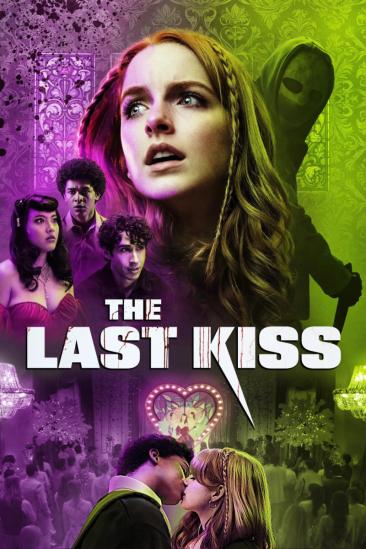
Laurel always imagined her first kiss would be a fairy tale. Instead, that fantasy turns frightening when she's cursed with an ability to see the death of anyone she kisses. After a vision reveals...
Ahhh, true loves kiss; the famous motif immortalized through Shakespeare, Brothers Grimm tales and classic Disney movies recognizing the magical capabilities in fiction and fantasy to break curses or awaken someone from deep sleep or mind control. It’s so prevalent and deeply embedded into pop culture that while it’s not openly called out as much anymore, it’s still being used. But what were to happen if true loves kiss…..became “The Last Kiss”?
No, this is not a remake of the 2006 rom-com by Tony Goldwyn; this is another horror/slasher from Blumhouse…..and if their track record is anything to go by, don’t expect much outta this one.
Three years after her directorial debut with Unseen back in 2023, it’s nice to see Yoko Okumura again….and all the flourishes that come with her directing. Whilst her debut was coked up on barely-restrained frustration and anger, this one is a lot more playful and atmospheric, to where you can almost feel her relaxing into the material. It gets the job done, though less through patience than through her sanding down the rough edges to fit the material—which is a shame, since little of her own personality manages to push through the seams.
Retro without calling attention to itself, Danielle Sahota’s production design does a decent enough job in simulating the type of charm that small-town horror requires for both irony and intimacy. That being said, it doesn’t take long for it to blend in among the deluge of other horror settings; not much variety stands out with the sets (the garden dance is the only noticeable exception), and it's hard to really decipher a real sense of place or to let the town breathe and bustle with personality. Maybe that’s down to how small and compact the scope and scale ends up being for a project of this stature, so while all this probably didn’t need to be so extravagant to stand out, it probably would’ve benefited a little from it. And while we’re on the topic of standing out, the whole attempt at the Valentine’s Day branding came off rather flimsy to me. “Love Hurts” did much better tying the Valentine’s Day aesthetic into the environmental storytelling, and that was much more tacky than this.
Retooling Stephen King’s novel, “The Dead Zone” by giving it a loopier, more lightweight spin, there’s something uncomfortably snug and cozy about how comfortably this presentation leans into and commits to its own weirdness decently enough; it legit feels like a supernatural mystery TV pilot or even a Disney Channel Original Movie but with a modest budget upgrade—all the downstream edges of something cheaply, indifferently assembled, but deposited with surprising and unintentionally endearing earnestness. And you can apply that sentiment to the other technical elements involved: Michael Fimognari’s cinematography is perfectly workmanlike and seems to have taken some tips and tricks from the 70’s and 80’s, relying on muted painterly aesthetics, longer takes, wider frames, and a floridly queasy color palette to boot that makes for some ardent visuals. It’s not as stark with its visual compartmentalization as opposed to something like Cabaret, but did it need to with material like this?
Editing-wise, it’s about the same deal.
Well aware of itself to know better than to waste our time, much of the pacing moves at a clip that never lets the casual viewer stop and ask the obvious questions (it didn’t stop me, though), and for a runtime of only an hour and a half, that method was probably for the best. It’s tight, compact, and is stuffed with almost no filler. I couldn’t find any major discrepancies with the visual effects used; barely any suspense or tension is built up to fully engross me in the fates of these characters despite so many missed opportunities to take advantage of that; none of the kill scenes are anywhere close to inventive (but maybe that’s on me for expecting more), and while the gore is there, it’s gore with good manners—shows up on schedule, does its job, and doesn’t leave a mess. Even the scares are polite; they might as well announce themselves with a door creak two seconds before anything happens.
Some of the best, or should I say digestible, tonal tightropes in film are those with this genteel veneer of self-awareness—the kind that doesn’t announce its cleverness so much as wear it lightly. This one, I can admire for embracing the oddity of a story and for slight fragments; there’s this harmony between dark comedy, teen slasher, and supernatural mystery without veering into parody or satire, but the horror comes off almost like an afterthought. Now, it’s not as winkingly meta and sincerely heartfelt as it may think, but there’s nothing wrong with having a little fun with itself.
Most of Tangelene Bolton’s musical compositions are standard fare for the horror genre, and even the few that are slightly different when it transitions to an awkward associative synth score don’t offer much in terms of variety; the focus is on the eclectic soundtrack and needle drops, and they’re the main highlight. Sound design from Scott Hitchon is the audio equivalent of a well-stocked but utterly generic hardware store where you can find every standard tool but nothing that surprises you; much of Charlene Akuamoah’s costume design bleeds into the visuals and psuedo-color psychology, although it doesn’t quite go all the way with it as I thought she was going to, and for what feels like the third time this year, I had to do a double take on the MPAA rating either due to me mistaking the rating or being so discontent that it should’ve been something else. If anything, the few hard-R flourishes it has feel more surface-level than truly unsettling.
What I most certainly did not expect was for the cast to be as earnest as they were. Nobody here is coasting, nobody is collecting a paycheck with their eyes half-closed; objectively, everybody is putting their best foot forward here, treating even the dumbest expository line like it’s the last page of a stage play, and you can feel the effort behind that kind of commitment. It is nice that everyone gets better-than-average dialogue, but many of the characters they’re stuck with are still your typical slasher-horror movie characters—all of whom seem assembled from a teenage horror manual—and have either very little personality or not much screen presence to make an impact.
Speaking up on McKenna Grace’s performance feels redundant because what’s the point? You know she’s gonna do great regardless of the material, and she carries the film on her shoulders with innocence, charisma, and an impeccable elegance that balances grief, terror, and the right amount of teenage awkwardness; the problem is it’s not really enough to salvage the entire project she’s single-handedly hoisting on her shoulders. The only one who really bounces off her and matches her dedication, energy, and chemistry is Arkira Chantaratananond, bringing a welcome warmth, charm, and ambiguity to her role.
The second I read the synopsis of this movie, I kept telling myself “this narrative should not be taking itself seriously at all,” and I swear on the life of me, I must’ve jinxed it. It’s basically Scream meets Final Destination meets I Know What You Did Last Summer meets Happy Death Day in one giant melting pot to make a high-concept horror, and here’s the thing about high-concept movies: coming up with the concept is usually the easy part. Not tripping over it for 90 minutes is where the illusion breaks, and the bubbles start popping. As is, really, this is a fairly by-the-numbers teenage slasher that builds for the better part of 90 minutes toward a finale that lands and disappears in about ten minutes. The whole film exists to get you to that final sequence (that’s how most mysteries are constructed, though), and it’s well aware how often its running the gamut for familiarity; for every scene that plays with storybook conventions, skewers and dissects the tropes, it plays the rest completely straight, and the urge to subvert yields quietly to a more comforting urge to let the tropes run amok: parental concern, climactic dances, unnecessary escalations that disappear as soon as they appear, minimal lack of long-term consequences, etc.
Honestly, this was where I started getting flashbacks to Totally Killer; got a ridiculous gimmick with a low-fi aesthetic on top of a masked killer running around that almost feels completely immaterial to what’s actually happening despite the importance placed on them. It doesn’t really care about coherence—it’s in pursuit purely of vibes and delivers that with some relish, plus some coherence creeps its way in as an optional extra. Everything is fairly safe here.
And yet, I found myself caring more about Laurel’s dilemma than expected despite seeing it coming a mile away: obsessing over safety only to receive visions that force her to violate everyone else as complicated means to save them from a grim fate. Putting aside the risqué visuals of her literally kissing her way through suspects and being three apples tall, the way they try to pass up her objectives as her mind making up these extreme situations to create scenarios she could predict and control is easily the strongest thematic current the film has going for it; how our own traumas can sometimes be even more terrifying than the actual physical impending threat. There are more pressing mature themes it touches upon to play into the natural anxieties, vulnerability, and fear tied to intimacy—the psychological weight of carrying secrets, trying to change a fixed fate, racing against time to protect loved ones—but those are squarely done from surface-level viewing.
Alas, this is also where I gotta hold this film somewhat accountable here: I wasn’t expecting the mystery to be ironclad—it is a trashy teen slasher after all—but I quickly clocked the killer after some process of elimination… and it didn’t take away from how illiterate, dumb, and stupid his motive is. Say what you will about the killer’s motive from Scream 7, at least it’s more interesting than this. Not only that, but the very concept of the visions kept throwing me for a loop. Putting aside how the rules start getting fuzzy almost immediately once other outside favors start getting roped in, it isn’t even used all that interestingly. The skill becomes almost a script tool—she sees something, investigates, finds a clue, something else happens, and we move on. Just a repetitive gilded cage that quickly turns both the visions and supposed deaths into mechanisms to push the story to the next scene rather than as events that really affect the character….or finds a balance for both.
And just to be a petty asswipe, there is a somewhat innocuous detail that the protagonist knows and studied Krav Maga and her best friend thinks its “sick”. Look it up to see why it’s problematic; I feel like it speaks for itself.
Maybe I’m being a bit merciful here, but I really wanted to meet “The Last Kiss” on its level just enough to get a few sugar-high thrills from the splattered remnants of its premise and not feel completely short-changed….and to some extent, I did. That being said, this is still a shoddy script that fails to turn its interesting premise into something great, but at least it knows what it wants? Barely….