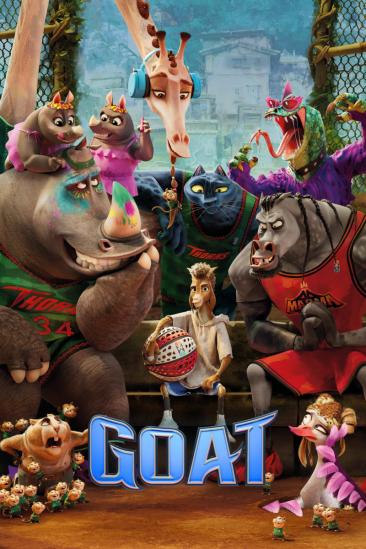
Will, a small goat with big dreams, gets a once-in-a-lifetime shot to join the pros and play roarball – a high-intensity, co-ed, full-contact sport dominated by the fastest, fiercest animals in t...
As a basketball tribute movie, “GOAT” is just sort of ….there.
OK, so stop me if you’ve heard this one before: a young goat named Will gets the chance of a lifetime to join the pros and play roarball, a high-intensity, full-contact sport dominated by the fastest and fiercest animals in the world. Yeah, the plot really is that simple; from the underdog struggling to stand out in a world of giants, an ailing superstar wrestling with her legacy, a fractured team in need of reconciliation, the big-shot bully who’s always the winner; every structural, emotional or developmental beat you can think of, this routine story checks all those boxes with passable flair and execution. It’s as if a sports movie template was downloaded and merely filled in the blanks with how proud it is of its formula but it is hard to knock against it since it was made from a place of adoration.
Just like the Cars franchise, this was made entirely as a love letter for the game of basketball.
Not to mention, it does unveil some like bench warming, media spotlight, player egos, internal team issues, coaches getting ignored, front office decision-making being primarily money centered and our own appetite for digital fame through visibility, all of which is molded around personal ambition, resilience and overcoming adversity to achieve greatness. As tired as some of these themes often are, they are timeless for a reason—we've all felt like outsiders desperate to belong, being dismissed based on appearance or background. The story's central conflict about gatekeeping extends beyond professional sports and it carries enough metaphorical weight to support the entire narrative structure, creating ripple effects that naturally flow into explorations of class division, prejudice, and the commodification of athletic prowess. These aren't just sports movie clichés; they're reflections of barriers that exist throughout society, barriers that resonate regardless of whether you've ever picked up a basketball.
Yet it’s a damn shame that, even with all that ambition, the story doesn’t carry that boldness with the same amount of weight. I don’t care how many times we’ve seen this story before: find some way to make the formula feel fresh or utilize it to its full potential…..and it doesn’t quite get there. The classic hero's journey never truly takes shape because the outcome feels predetermined from the very beginning. There's no real doubt, no meaningful obstacles that shake the trajectory. You always know he - and the team - will succeed, which removes emotional investment. There’s also some counterintuitive messaging in how the team even succeeds because of said specific method being pointed out as sketchy from the offset, its attempts to be timely with references to crypto ads and viral memes feel misplaced and when the plot does open up and leave ample room for genuine character growth, it blows past it too quickly.
Sometimes, very rarely but sometimes, it’s easy to tell when a director actively wants to bend the path to reshape the project into something more satiable instead of just phoning it in because the derivative shape of formula makes it easy for them and while Tyree Dillihay and Adam Rosette don’t succeed at the former, they still made sure to put their best foot forward. It’s a dual direction working in tandem that places its trust firmly in the visual language and environmental storytelling.
Similar to Zootopia, there’s something novel and inviting about the lush, laidback dystopia bolstering the painterly gouache/impasto animation; bordering on impressionistic without veering all the way through, the artisanal look has a visual push-and-pull that plays the grit of urban decay against the thickness of reclaimed wilderness, which I am a sucker for, and extends that effective visual language to the character designs. It actively feels like it’s properly rendering the scope and scale beyond the characters to make size actually matter here and Jang Lee’s production design boarders on specific design choices that embrace the constraints of its environmental storytelling with fluid exaggeration and tactile attention to detail (something the 3D did help enhance). Probably my biggest test with the animation was seeing whether or not it going to be a TMNT: Out of the Shadows scenario where the stellar animation either enhances the narrative or acted as a delicate veil to hide its simplicity; I’d say it harbors a competent middle ground.
Looking at the overall presentation, from the first frame onward, I appreciate the delicate balance between technical precision and playful dynamism, never sacrificing its manic energy while maintaining the stylistic integrity established in the film's unique aesthetic approach. John Clark’s camerawork plays out like an illusive memory-tape, warping its specific cadence to emphasize a particular feel; either beautiful comic book stillness or an instantaneous roller-coaster mimicking the chaos of a live broadcast. Thankfully, Clare Knight’s editing is quick to pick up the slack.
Pacing here isn’t a complete turnoff but it did leave me scratching my head on more than one occasion; everything feels pitched at lightning speed in its haste to speed-run through each quarter to get to the next predetermined plot beat, even when staying within the film’s 100 minute runtime. Said runtime simultaneously feels too short and not long enough for a movie self-evidently unembarrassed to admit that it’s for kids, whatever snippets of tension the film tries to build up gets negated or aborted from miles away and the tone was about what I expected: competent balance between inspirational sports drama and somewhat deflating kiddie humor without one overtaking the other.
If you told me Kris Bowers, the same person who did the score for The Wild Robot, was doing this one, I would’ve had a hard time believing you because I could not latch onto a single memorable composition piece; they all feel interchangeable. Few needle-drops from the soundtrack aside, it isn’t as propulsive as what I expected. Overall sound design thankfully makes up for that upon matching both the physical specificity of the characters and the environmental effects, Dominique Dawson’s costume design is inspired as far as keeping the character designs grounded in animal biology but they’re otherwise pretty bog-standard and with the MMPA rating being a comfortably PG, that’s more or less a slam dunk.
Boiled down to one word, I’d call the acting comfortable; everyone understands the assignment and is having fun with their roles no matter how awkward and fairly basic the dialogue exchanges are; most of the humor didn’t feel too immature to the point where it turned me off (some of them are pretty decent). But the characters themselves? They feel stifled.
Superficially, they do change and grow and evolve but because it never feels earned, everyone feels stuck in stasis. Both the protagonist and antagonist are meant to come off as intense but instead feel strictly one-dimensional, and supporting characters feel like background props rather than real people. The only exception to the rule is Jett, having the only ‘complex’ character arc out of the roster and even she’s not given the chance to truly grapple with that growth.
A sports movie as routine and traditional as its litany of inspirations with only its bold aesthetic ambition to invigorate such a formula, GOAT’s storytelling probably never was going to be anywhere near as daring or adventurous, yet it barely passes on virtue of having its heart in the right place.