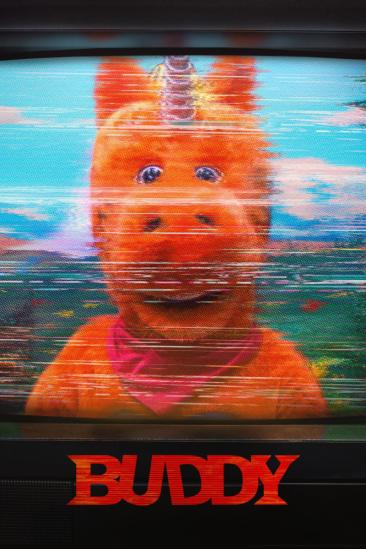
Remember BUDDY—the bright orange unicorn and star of that classic childrens' television show who brought joy and life lessons into your living room? Inside the colorful world of "It's Buddy!", a...
Even if you haven’t been entirely born, raised and molded by the zeitgeist of the 90’s and 2000’s, there was no escaping the shadows of those oppressively happy children’s TV programs with plush animals, various cheery side characters, and a group of kids harmonizing and doing daily chores with a smile; Sesame Street and Barney in particular come to mind. As someone who grew up on such shows, not all of them were immediate after-school staples in my house, and yet I can respect the intentions behind them. But I also have come to expect them to be riddled with and plagued by dark or shocking occurrences behind the scenes.
“Buddy” plays on those realities as a surreal send-up to said nostalgia and for the most part, it’s a fairly entertaining ride.
Casper King’s direction immediately slices through the uncanny, inorganic happy sheen lurking underneath the many genres and moods he juxtaposes like a razor that’s not too sharp but not too dull either. There’s something of a restrained fluidity and energy he exerts in the way he dives headfirst into the kookiness of the idea in a way that's increasingly rare in the landscape of Hollywood today (so much so you could debate his head’s a little up his ass about it). For all its chaotic invention, though, the film’s trajectory remains disappointingly conventional, a well-signaled retreat into safe horror beats…..and yet, King’s commitment is absolute like the unhinged faith of a true believer that has no shame.
Nothing short of deliberate and immaculate, Anna Kathleen’s production design recreates the prototypical late-'90s educational kids' program with an almost eerie precision and some genuinely respectable abstract, surreal imagery woven through the film's more unhinged stretches. Fusing Barney meets Videodrome meets Death of a Unicorn meets Wizard of Oz meets Peewee's Playhouse, the candid artifice of the sets and the expansion of it to show what you’d see if you ever made it beyond the confines of a soundstage shows an extreme dedication to masking the true horror behind forced positivity and the cracking of a seemingly cheerful exterior. It establishes a clear visual identity and a genuine affection for the children's television aesthetic it wants to subvert and for a while because of that authenticity, we buy into the show….and some aspects of the worldbuilding.
I do love the late twentieth-century sheen of the presentation, committing to its stylistic framing device via both retro and practical sensibilities, parodying so many children's television shows until it actually feels like one. Recreating that aggressively cheerful world with candy-colored sets, awkward songs, and the kind of forced positivity that starts feeling weird before anything explicitly horrible happens already gives the feature a bustling personality and a certain ontological framework that barely paints over the technical elements in enough smoke and mirrors to mask the more docile factors creeping in. But even that depends on which factors in particular; Zach Kuperstein’s camerawork juggles a tightly controlled color palette, an accurate aspect ratio for the era and the general 1.33 shot-cheaply-on-video aesthetic of a bygone era that plays with lighting and flat composition; it’s the premiere definition of simple but effective that doesn’t call attention to or overexert itself for the sake of buying into the bonkers circumstances that already exist.
Josh Ethier’s editing follows that same mentality; ; even when it does curtail the momentum a little bit, the structure it follows is still mostly acceptable.
For a movie that’s only an hour and 35 minutes long, it doesn’t leave a lot of room for error, and the pacing harbors a respectable balance for that contract; even when it slows to a crawl during the middle (why is it always halfway through), the overall shape of the thing is trim enough that it never becomes a genuine grievance, and it gets to the points it's trying to make relatively promptly. Visual effects are B-movie-coded intentionally low budget and over the top to emulate cheap 90s/00s television; the adds to the low-budget slasher nature of the movie; enough focus is placed on the illusion to add to the low-budget slasher nature of the movie; we do get decent stakes and a prevalent sense of danger eerily familiar to those who’ve been through such extraneous situations, but the way its filtered can give you pause, and let’s be practical, guys: the film’s more unsettling than it is legitimately scary. There are hints of disturbing moments to come in the first act, but it settles for boilerplate gore and thrills that never take full advantage of its premise or the medium's power for ambiguity. Even the kill scenes themselves, while not tame, are largely uninventive.
The tone threads a genuinely tricky needle: blending surrealist horror while being disarmingly funny for most of its runtime, while keeping this darker, unnerving undercurrent slowly bleeding through the lighthearted premise and nailing that queasy mix of saccharine children's-show sincerity and creeping menace. It's a tough balance to pull off, and for the most part, the film manages it well.
Now the soundtrack homages much of the overbearing, repetitive songs about nominal moral messages while remaining plot-relevant; the score itself from Michael Yezerski is an issue. Even with the corny orchestral thumps expected after a jump scare and the melodies pushing and bending childhood jingles into distorted, uneasy variants, the score comes off really forgettable the more I reflect on it, and it just screams a lack of confidence in the suspense and atmosphere. Mac Smith’s sound design borders on decent and frustrating simultaneously; Shawna-Nova Foley’s costume design fits right in with the cultural zeitgeist of the late 90’s—excavating the era’s particular brand of synthetic cheerfulness with an almost anthropological thoroughness, and by god, they weren’t fucking around with the MPAA rating. Despite the actual nature of the kills themselves being weirdly muted, this is still an unabashedly hard R rating, one that isn’t concerned with pushing the insensitivity envelope a bit too much, or offending anyone with the mounting dose of gore on the screen (of which there is plenty of both to go around).
Genuinely, there is not a single weak link in this cast; everybody leans hard and heavy into that uncanny energy while also playing it deathly straight in such a manner that surprisingly doesn’t backfire….which makes it a shame that the dialogue they’re given is this routinely remedial and vanilla and the characters aren’t that much better. Ok, I’m exaggerating a little bit; they’re all functional for the roles they need to play in the story (concerned mother, observant child, overbearing adult figure with malicious intent) but that’s about the extent of it.
All of the child actors in this are astonishing (lampooning the overly-sweet-natured child actors from decades past) but it’s Delaney Quinn who harbors the most emotional weight and carries it all the way to the finish line; Cristin Milioti is more or less in her element blending the cheesy alongside raw intensity; and then there’s Keegan Michael-Key, practically a damn-near perfect fit for the role, completely encapsulating the fake-nice attitude and secret evil nature of Buddy with his natural charisma…even if he can’t maintain for long stretches at a time.
You look at everything this mindfuck of a narrative picks apart and unravels into, and it just feels ripe for the picking in the horror genre; it just feels like it belongs here. It’s a set-up guaranteed to raise eyebrows and secure attention, and despite the dark cloud of actual real-life events and tragedies hanging over the premise here, the proceedings are never crassly exploitative. The narrative capitalizes on those morbid echoes just enough to leave residue beneath the crust of….what’s essentially an old Barney joke. Occasionally inspired as another high-concept horror on a supposed grand scale,, its plot structure is respectable for not being purely linear, starting with separate A and B plots that gradually converge into one, fulfilling the three-act structure criteria. However, it suffers from dragging and stretching time with unnecessarily long scenes. Plus, it is painfully predictable; said transition from the meta world to the real world doesn’t completely deflate much of the film's fun but the fact that everything both inside and outside the show is conventional, half-baked, and sometimes downright tedious as it is kinda clips its wings. And of course, there’s centering itself around a twist that you can decipher within literal seconds once you pick up the hints.
Snipping, pillaging and borrowing some thematic DNA from The Matrix in the sense of "which reality is real?", vintage Brothers Grimm stories about trolls and other creatures that openly preyed on children, the skewering of algorithm-fueled distractions, and the self-isolation of modern American life in an era where mutual conversation goes to die the more TV’s or computer screens show up in every room in the house, it perhaps crystallizes its strongest thematic connection with the underlying subtext being childhood innocence and lack of guile making them easy victims of a malevolent predator. Nearly all its focus is the depressing reality of child stars being mistreated and forgotten by the entertainment industry, failed and broken or disposed of by the institutions and left to fend for themselves against the cult-like setup and secrecy these shows tend to breed (Dan Schneider’s reign of terror at Nickelodeon and comes to mind). When that hyper-fixated perfection facade starts crumbling, there isn’t so much shock behind it as there is perverse recognition; of course the people in the big orange suits are hiding something, of course there are thing behind the painted doors they’d prefer you didn’t see….and you have no idea how much people will pay to keep control of the power they possess, the narrative they paint.
Beyond this, the film functions as a potent metaphor for the prison of childhood media itself: Freddy and her co-stars are performers ensnared in perpetual nostalgia, immobilized by a system designed to stunt their growth. Their struggle for freedom resonates with the fundamental human urge to shed outgrown platitudes and the simplistic moral frameworks they were paid to perform.
For such a dense premise and cautionary tale, it makes for a better short film than an actual full-length story…..and the story itself seems to agree because by the time the third act rolls around and all the masks (figuratively and literally) have been torn off, the central premise has long since exhausted itself—it’s limitations growing more obvious and consequently feeling overextended with a degree of repetition. Any faint signs of a protagonist arc or more deconstructed pop-culture spoofs go out the window alarmingly fast, and the constant randomness of introducing then abandoning various characters and ideas along the way becomes more noticeable, making the mystery-box setup feel even more slight. Wearing out its welcome as the emotional anchor the film is banking on sort of trips over itself when we reach the climax, it’s like the narrative acknowledges and leans into how much it’s banking on us to sit with the emotions it's trying to convey….but it doesn’t know how. Even the gimmick of Buddy, who stabs and decapitates with sunny disposition intact and whose skin color is a not-so-subtle dig at the president, is a basic joke that wears off far too quickly than it should’ve.
With all that being said, I do admit to liking the idea behind the ending. Sure, the way the premise was executed assured us that it would be impossible to conclude this in a way that was satisfying (and let’s be real: that was never going to happen), but there’s something both dour and more horrifying watching it end on an abstract existential riddle that denies tidy closure. Like, no matter what, this is going to follow you and getting the truth, breaking out of that gilded cage comes with its own share of consequences.
Mischievous and kooky in a way that much of its potential is equal parts fulfilled , and as it is also grasping at straws, I can’t deny “Buddy” has an unquestionable brazen identity, and is at its best when translating all its childhood safety-net fantasies into theatrical cruelty that feels inevitable and downright morbid given certain real-life contextual events. It doesn’t quite sustain its own joke and it runs out of steam long after we get its point, but it knows how much we thrive on watching something this cheerful slowly reveal how wrong it is.