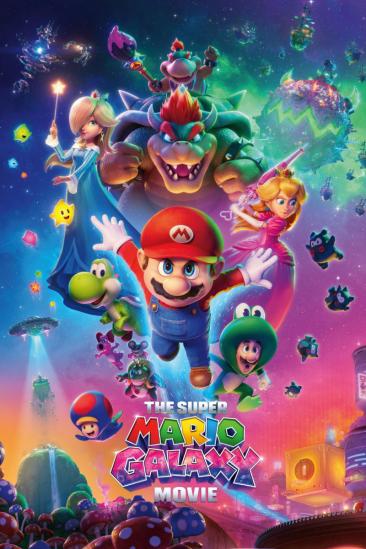
Having thwarted Bowser's previous plot to marry Princess Peach, Mario and Luigi now face a fresh threat in Bowser Jr., who is determined to liberate his father from captivity and restore the family...
Looking back at how well Sonic’s been holding up with his movies and games as of recently, it felt criminal to not give the same sentiment to his Nintendo “rival”, Mario. The Super Mario Bros Movie of 2023 was an exclusive ‘by-the-fans, for-the-fans’ experience that I had to play constant tug-of-war with in order to properly walk away satiated, caught between appreciating its reverence for the source material and recognizing its fundamental shortcomings as cinema. In the end, I bit the bullet and recommended the first film.
I can’t do the same for the “Super Mario Galaxy” film. I’m sorry; I know I played Devil’s Advocate with the first film but I’m not gonna give this one the same luxury cause this really tested my patience.
So this is somehow a four person job now; Pierre Leduc and Fabien Polack help co-direct this alongside returning directors Aaron Horvath and Michael Jelenic…..and my hand to God, it’s impossible to understand why they needed this directorial hydra when the result feels as manufactured as a plastic mushroom kingdom souvenir. Yes, they are well aware this isn’t supposed to be deep and fine-tuned everything around that mentality but it still doesn’t come off as something natural and with such narrow focus with the attention span of a ferret, the innovation from before is fleeting.
Let’s get the obvious out of the way: yes, the animation here is absolutely gorgeous; if anything, it’s somehow even more extravagant than before. Every color of every frame seems to be competing for focus and with every scene overloaded like a child's sticker book, the visual language expands outward in all directions—cosmic vistas stretch to infinity, microscopic details reveal themselves in the tiniest corners, and the sheer scale of imagination on display makes the first film look positively restrained by comparison. But it also expands beyond the hyper-stylized Illumination animation style between 8-bit homages and other diverse illustrated stylings. It really could’ve been something but it doesn’t latch onto any one atmosphere; the wonder and melancholy of outer space, sheer horror of being swallowed by a black hole, firm solitude of landing on a small planet? The production design feels explicitly like window dressing, never exactly invoking that sense of galactic grandeur of the stretches of the universe Mario or any of the characters are supposedly exploring.
Look, if you’ve seen any Illumination movie, this presentation fits smack-dab along the rest of them: it’s very easily distracted by its own excess, gorging itself on its own maximalist tendencies with visual information that somehow doesn’t overwhelm or enhance despite the beautiful animation. The universe of Mario Galaxy should feel vast and limitless, but paradoxically, the more they show, the smaller it all feels and it carries over to how the film looks. Both the general cinematography and Eric Osmond’s editing keep the fluidity of the film going, playing out similar to the way it would be done in a modern video game, but not much else truly bubbles over into something remarkable.
Pacing has ADHD written all over it; despite the modest 1hr 38 minute runtime, the franticness of it means nothing really gets properly developed and it rarely pauses to collect itself, constantly holding its breath as it pinballs against everything in its vicinity. Tension is almost nigh-nonexistent—every attempt to create suspense falling flatter than a Goomba after being stomped on Mario’s boot, the stakes are both too vague and don’t hit as hard as the scope and scale suggests and on paper and execution, the tone is about what I expected: a hyperactive confection of synthetic joy, corporate-mandated wonder, and algorithmically determined “fun” that merely exists.
Brian Tyler’s musical composition remains immaculate as it was the first time around and thankfully without the forced inclusion of random pop songs, the music has more of a chance to spread its wings. Sound design flip-flops on fully crystalizng the iconic audio palette of the Mario universe or merely lean on it as a safety net, though it at least maintains a coherent approach throughout the film, costumes are at the very least visually enticing, matching the attires of the characters with aplomb, the action sequences remain competently crafted with the occasional splash of visual flair and maneuverability even if they have much lower energy to them this time and if you were expecting anything more or less than a PG rating, I don’t know what else to tell you.
Can I be honest? The voice acting isn’t as memorable as before; nobody’s outright terrible but there’s a palpable sense that the recording booth sessions lacked direction, with performances ranging from merely serviceable to occasionally inspired. Almost every piece of dialogue they’re given is as basic and perfunctory as room temperature water and the characters they’re stuck with barely qualify as such. They STILL get little to no character development or agency in how they progress and the few character beats they do set up get shoved off to one-off gags, or little two-line check-ins every twenty minutes; Bowser is still the only one who has the closest thing to an actual personality and arc.
Charlie Day and Jack Black remain the most vocally energetic of the bunch and neither Brie Larson or Glen Powell are half bad either. Everyone else though feels like they’re phoning it in.
Here’s the thing about the game: Super Mario Galaxy is a more atmospheric experience where, similar to prior Mario games, vibes are the main takeaway. There’s a real majesty to that audiovisual empirical that catches you off guard—not just with its gravity-defying mechanics, but with the sheer scale of its universe and the loneliness that creeps in at the edges of those bright, impossible landscapes; its a game about awe and the vibes do help linger long after the end credits roll. This movie is a very, VERY loose adaptation of the game that does practically glow with affection for its source material with this relentless barrage of fan service creating an almost manic sense of fun, and despite my critical faculties that I will scream in protest soon, I found the corners of my mouth betraying me with an involuntary smile every once in a while.
With all that being said, it runs into the exact issues I had with its predecessor, only magnified because it pushes its already commercialized albatross of a vessel to the breaking point and is only a movie in the flimsiest, most meager sense of the word. In its eagerness to please, the film occasionally trips over its own enthusiasm and the narrative never reaches the tiny threads of emotional or structural finesse the first film had, lacking a certain spirit that once gave the journey more cohesion. It has the skeleton of something interesting revolving around family dynamics, considering its centered around both Peach and Bowser reconnecting with their significant others and coming to grips with the time they’ve spent apart and a basic story does no disservice to a Mario movie, but it being a compilation of overly caffeinated sequences hardly distinguishes it from the games it draws from. The episodic structure reeks of a toddler unable to decide which shiny object to grab next, bouncing from set-piece to set-piece with the attention span of a goldfish on espresso and it can’t even be bothered to teach even the basics of emotional literacy, something the first film at least feigned toward.
Careening through the broadest possible strokes of the game’s plot and iconography, flattening every moment into either a punchline or a rapid-fire spectacle was probably an inevitability but it once again reinforces how what works in one medium won’t exactly fit in another.
There is still technically a rising action, climax, falling action and resolution but in the most cliffs-note version imaginable and since the film never confesses any higher ambition, the end result is exactly the meandering, annoying, boring, unfunny, baby-spleening blandness I worried the first film was going to be; Illumination’s specialty. Look, as overly basic the first Mario movie was, at least it felt like we were heading in a certain direction. A better job was done tuning itself to the spirit and atmosphere of the games, the simplicity of it fed into the imagination without feeling overbearing and it presented itself like a hero’s journey, occasionally flicking its fingers toward something real.
I’ve mentioned this multiple times in the past: you can have your fluff and your junk food but even junk food has to taste good. This has this weird metallic aftertaste like something that reflects the content that kids and even some young adults get when they scroll online: flashy, triggering, addictive but without any of the substance.
So this is yet another kaleidoscopic sensory assault that mistakes bombardment for enjoyment, references for substance, and corporate-approved childhood memories for authentic passion and fun; it borders on simplicity, knowing its lane and staying in it religiously. But understanding the game doesn’t mean I have to enjoy playing it; try as I might, I can’t bring myself to savor what “Super Mario Galaxy” is serving.