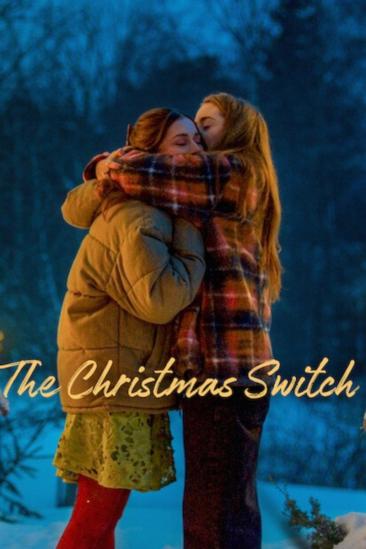
Craving a change of pace, work-hard-play-hard city girl Freddie swaps lives with her homebody sister Mattie at Christmas time, only to unwrap a whole new kind of mess.
So recent events in my life have me feeling slightly more optimistic than usual; I think it’s time for some early Christmas flicks to get me into the spirits….from Sweden, no less. Enter “The Christmas Switch”, not to be confused with the 2016 film of the same name, about two sisters switching lives for a day.
Yeah, this was about what I expected.
You wanna check out a movie direction that obviously isn’t autopilot but feels just manufactured enough to feel like it is? Look at what Adam Pälsson managed to cook up. Ok, ok, I’m spearheading a bit—this is his directorial debut after all—but I genuinely could not pick out anything of interest regarding the way he directs and alternates proceedings from scene to scene; that being said, it’s competent and unremarkable in the sense he understands that this isn’t supposed to be a mind-boggling endeavor and thus focuses on the warmth and entertainment factor rather than getting into complicated territory.
Teresa Beale’s production design is a weird one, from a personal preference at least. I’m used to these Christmas movies screeching the importance of the holiday from the rooftops and completely taking over the storyline, so it’s kinda a small relief to not have many of these locations constantly call attention to each other; it’s simply around Christmastime and its more of a backdrop that at least provides a pleasant seasonal atmosphere.
When you look at the setup and how the presentation molds that into this framework, it doesn’t get off to the best of starts and doesn’t really get much better; almost speed-running the inciting incident and giving arise to conflicts that are a bit too silly for my tastes despite its light hand. The one consistent thing keeping this presentation from splintering apart like a broken snow globe is how it all looks. Ari Willey’s cinematography doesn’t immediately back this up but gradually eases you onto that wavelength. Much of the shot composition, framework and general visual imagery is simple yet effective, while the cozy lighting helps alternate the color palette between warm, inviting spaces and cooler tones; it refreshingly never borders close to the typical over-the-top Netflix sheen either.
Sofia Lindgren’s editing follows a somewhat similar approach; although because it jumps back and forth between both sisters and lives so frequently and without a clear passage of time, the whole package can feel a little pole-vaulty with erratic visual rhythm. Still, on its own, it’s passable.
Occasional stumps aside, the pacing is brisk (sometimes too brisk), and there’s a steady, if unremarkable, hum of narrative propulsion if you squint hard enough. At best, it never stalls out long enough to let the audience fixate on the narrative bottlenecks and at worst, it risks making everything feel like a begrudgingly cashed check. Much of its dramatic developments aren’t taken seriously (that isn’t an immediate turnoff, but it’s very evident how little conflict matters here); focus is semi-sporadic in how convenient some of these dips are, and for all intents and purposes, there isn’t a dull moment to be found here. This could just be down to the way I’ve gotten accustomed to watching stuff, but it was impossible for me to get bored here. Everything about the tone points to this being your typical light-hearted romp perfect for a comfy night on the sofa; gentle enough with its unruffled mood not to feel artificial and to pretend it’s giving its conflicts proper cadence. At least said tone is consistent throughout.
Christian Olsson’s music composition carries out that usual festive holiday splendor with just a little bit of Swedish flair to dutifully ticks the boxes for festive warmth and give it a sense of place. Sound design doesn’t offer much beyond what’s expected of it, but being functional and unobtrusive is exactly what a film of this gentle ambition requires; Cilla Rörby keeps the costume design comfortable but true to their characters’ personalities as best as she can, and as far as the MPAA rating is concerned, the TV-MA rating only goes as far as the explicit language being used and very brief shots of nudity.
There’s a quiet, lived-in domesticity that resonated with me upon watching this cast perform; everyone is extremely comfortable either playing up to the bit or simply having fun with their incredibly simple roles. Dialogue-wise, there’s enough bounce in the snappy banter to elicit the faintest of smirks now and then, although it mostly boils down to how they deliver their lines, and I wasn’t kidding when I said incredibly simple roles; even with our main duo being a semi-exception, our entire foray of characters are strictly two-dimensional.
Felice Jankell takes her characters’ doe-eyed wonder and molds it into an innocence that isn’t naive and it’s a miracle that her character remains palatable at all following a major blunder she makes; Happy Jankell sells her restlessness without ever turning it into a punchline, and the sisterly bond between them is the movie at its most comfortable, made even better since the actresses in real life are actual sisters. The rest of the supporting cast, again, are wonderfully solid, more so rounding things out rather than jumping out, with Celie Sparre being a noticeable standout.
Christmas movies always seem to center themselves around three central narrative throughlines: comfy coziness to celebrate the holidays, quarter-life crisis journey of self-discovery and realization, or a sneaky little subversion of the holiday’s sentimentality. For a narrative this straightforward, it opts to go for all three but streamline the pressure points of each just enough to deliver exactly what the film understands people usually expect out of Christmas films. Very cut-and-dry formula and blueprint that toggles familiar settings and motifs like a well-traveled tram making stops at every expected station, yet it does so with enough local flavor and sincerity that you find yourself smiling at it despite the evident predestination. That being said, it still runs on the typical romantic cues meant to keep surprises scarce and mildly uneventful. Not only that—and this is further compounded by the pacing—it moves through all of its conflicts way too quickly. Problems that deserve a few scenes get one, a couple of the romantic threads feel hurried, and a few late developments ask for more suspension of belief than the story has earned. Several moments pop up that call for more pathos only for it to be skimmed through, never letting a moment linger long enough for anything to settle.
Forgive me for repeating myself for the third time, but again, if we’re going back to the basic idea of plot equals rhythm and story equals melody, it plays all of its key changes as safe and familiar as possible. But is any of this really a surprise? It’s platonic seasonal evening filler, and there’s admittedly a spry, curious comfort in how endearingly blunt it cuts where it hurts, never straining under the weight of its own concept.
Not much to really dissect here as far as messages and thematic resonance is concerned. With both sisters going through an adjustment period, buckling the routine and trying something different is the main thematic component the narrative aims to explore, challenging not just the characters’ perceptions of whether their routines are aiding or harming them, but also the necessity and futility of such changes in domestic perfection, rambling independence, and the perks/cost of honesty.Undemanding yet nonjudgmental as hollow genre comfort goes, no attempts are made to transcend such limitations as it does reaffirm why we return to these quiet dramas around this time of year; of the two sisters, Freddie’s journey and romance is the stronger storyline (at least in the context of what the movie presents) while Matilda’s is the more immediately damning because it falls back on Hollywood’s eye-rolling decades-long tendency of romanticizing cheating. Alas, these minor transgressions are what pass for narrative spice in a genre that has, over the years, managed to bleach the concept of holiday drama down to a faint tincture of conflict and a lukewarm draft of resolution.
Still, it was hard not to occasionally smile and chuckle along—maybe in spite of myself, maybe not.
How to best describe “The Christmas Switch”? It’s practically a sugar cookie of a film, crumbly and over-sweet and meant to dissolve on your tongue with alarming efficiency, washed down with the cider of sincerity even in its paint-by-numbers moments and with just enough character work and fuzzy warmth to get you through the door. Sometimes movies are allowed to just be….okay, and this is one of those exceptions that prove the rule.