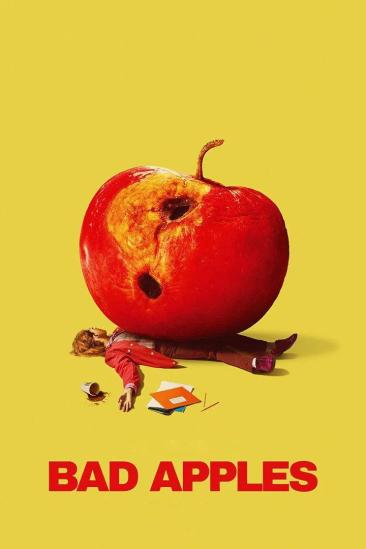
For as much as I have tried to remain a steadfast, virtuous example of halfway-decent goodness and uphold my responsibility to put good out into the world and receive some back (and the recent blue wave has definitely helped prove my point), the terrifying shades of gray that cloud our world have unfortunately left me very…very jaded and cynical. And now I got another movie to remind me why humanity might genuinely be cooked…..and I didn’t even know this movie existed until I stumbled across YouTuber Zaffy’s video about it.
“Bad Apples” is another reason why I genuinely fear the direction the human race is going.
Sticky subjects like this don’t really benefit from being told in broad strokes, and given the nature of this premise, thank god Jonatan Eztler’s direction doesn’t descend to that level. Directing with a surprisingly deft hand and an unrestrained breadth of confidence, there’s this incremental strangulation in both his eye for comedic timing and gruesome escalation that turns the whole ordeal into a macabre circus: the further it rolls, the less you can look away, and the more you realize you’re watching a funhouse mirror pointed directly at the most stubbornly backwards corners of dysfunction. You personally feel like he’s cherrypicking the worst memories of your life.
When I dissect production designs in movies, I can often make the mistake of misinterpreting simplicity for plain window dressing that doesn’t really add to the story or simply not going far enough with the setting when they might be holding their breath and making space; Jacqueline Abraham's production design has no such issues. If anything, the way she creates this convincing sense of place with each location without ever becoming overblown, or oversold is downright surgical. Following through on the same scalpel-precise sadism as the script (which I’ll get to later), it doesn’t reflect the narrative more than it colludes with it, acting as an accomplice to its moral chemistry.
Admittedly, there’s something almost too manufactured about how the presentation is stylized, but that’s taking into account how sly and controlled it is. Clean, almost cheerful imagery sits against a growing sense of rot underneath as a few inspired visual touches quietly reinforce the central metaphor, and because the film’s sense of moral ambiguity grows naturally from this environment, it helps lean into this genuine sense of unpredictability while simultaneously painting each scene as awkward, and claustrophobic, and obvious as possible (but not in a way that dulls them). Nea Asphäll's cinematography is passively hostile in fortifying that visual identity: tight intimate framework, striking shots and a color palette deliberate in its usage; slowly creeping in more warm and cool colors to balance against the desaturation and draw on that uncanny normalcy amongst the unhinged.
Robert Krantz's editing is similarly assured, maintaining a strong sense of rhythm and pacing that keeps things moving briskly.
Speaking of pacing, no such issues arise at the top of my head. Not too brisk at the possibility of risking snapping the structure apart but nothing overly elongated to sap the momentum it immediately picks up on; for a runtime of an hour and forty-six minutes, it ensures that every scene is employed wisely. Both emotional and dramatic tension is always at a fever pitch for completely different reasons that thankfully coalesce with one another; the black comedy is at its best when its played completely straight; its focus and satire is pointed enough to sting without becoming preachy, and there’s a certain thrill to watching how long the tone can keep its balance; a pitch-black comedy that walks a tightrope between satire, thriller, and sheer absurdity, it is unapologetically twisted in how it dares you to laugh at things you probably shouldn't. I don’t know how I was able to tune into its warped wavelength even when it got too cynical.
Chris Roe’s musical score was surprising to me, to the extent of how atmospheric it ends up being—brassy, swollen, almost obnoxious, yet perfectly pitched to push the satire right up to the edge of melodrama without spilling over. The sound design from Andreas Franck is perhaps the most uniformly basic thing about this production but it still does its job well; Sarah Blenkinsop’s costumes begin muted, then slowly unravel, mirroring the production design’s rigid geometry in sharp collars and structured silhouettes and while the MPAA rating is accurate—content like this was only ever going to make sense with the R-rating—it mostly extends to profanities and foul language. It only gets real bloody at the very beginning of the movie.
You stumble across projects like this as frequently as I do, and sooner or later, you’re going to say, “This movie wouldn’t work nearly as well without this cast.” And this feature is Exhibit 772 as to why: everyone delivers sharp, fearless, and often hilarious performances that more than hold their own, and the dynamic between the child actors and the lead gives the film its most memorable and unpredictable moments. Not to mention, the dialogue is sharp with lots of bite, and surprisingly, the characterization is much more nuanced in a manner that actually works in the story’s favor. Unlike Disney or Marvel’s efforts with humanizing their villains as of late, this confident, multi-faceted writing beautifully threads and wields each character like jagged glass, unafraid to make them assholes, opportunists and victims of circumstance all at once; it ain’t easy to make every character in your movie so evil while also being this pitiful.
Saoirse Ronan may be the lifeline, the heart and soul of this whole thing; capturing her characters' decency, anxiety and desperation without ever letting any one quality overwhelm the other in a true multilayered performance, but it’s young Eddie Waller whose given the hardest role in this feature—being this detestable, destructive obnoxious little twerp you want to throttle while subtly never losing sight of the fundamentally vulnerable child underneath—and he knocks it out of the damn park. Nia Parker however proves to be equally formidable, creating in her a teacher's pet who is convincingly just as annoying and utterly hateable, if not more, than the rest of the cast.
Based on the debut novel by Swedish author Rasmus Lindgren, much of this story reminds me of The Drama, centering itself around a plethora of scenarios and subject matter guaranteed to alienate the audience for the sake of asking an important, if not somewhat implausible, question. On its own, the set-up is pretty painful, and the internal logic has its fair share of gaps to overlook. But again, if we’re going back to Guillermo del Toro’s definition of plot as rhythm and story as melody, both work because its ideas aren’t merely draped over a thriller; they’re woven into its fabric. Every character’s choice and decision carries meaning and consequence, and the thriller structure turns that abstract systemic tension into something immediate while giving the characters direction and not sapping momentum. You can easily chart the three-act structure behind it all, but that's more a sign of its sturdy construction than any kind of predictability on its part. It feels fresh, distinct, and entirely unconcerned with conforming to expectation or tying things in neat little bows. I'm not convinced it quite comes together as satisfyingly as I would have liked it to, but I'm also not convinced it actually needs to be satisfying. The story is messy, satirical and sincere by design through a myriad of dark Swedish cinema tropes and perhaps its best quality—and most daring—is how it doesn’t beg you to agree with any of its players.
Not to mention, it also cleverly avoids spelling everything out, allowing certain things to be inferred and trusting the audience to connect the dots themselves.
Safe to say that every facet of this narrative is specifically engineered to make you feel like a piece of shit, and leave you with a bad taste in your mouth. Every thematic residue it leaves behind regarding empathy and circumstances, pressure and complexities surrounding the schooling system, parental neglect, the indictment of the bystander effect, modern struggles of teaching, and the constant need to be in control plays directly into the idyllic hell contrast, and eventually, you realize the affair isn't as obviously interested in making a specific point as you may expect it to be. Instead, it's more than content to imbue the actions of its protagonist with the nuance they deserve, refusing to provide any answers - let alone easy ones - to the central questions at its core. It ends up being not so much about 'right' or 'wrong' and more about how pretty much every single link in the structural and societal chain that raises young people into young adults has failed at a fundamental level. And what truly stuck with me was how long that veil of unpredictability lingered until that eerie sense of familiarity washed over me: the realization that nothing about this movie actually surprised me. This is how people are.
Literally every main character (and I do mean EVERY DAMN CHARACTER) is given a platform and position where they can actively do the right thing and MULTIPLE TIMES, they actively refuse to do so, either because they’re clearly not right in the head, they get a lot out of just pretending nothing is wrong, or this inciting riot invades their peace, and they just want it to stop, damned whether justice gets served or not. And this is something both the children AND parents exhibit here. Everybody in every community lives in their own damn bubble, and not many are willing to sacrifice their comfort to inconvenience themselves, to actively call out an injustice and do something good, to stop turning a blind eye to the most outrageous events to preserve harmony and their sense of safety. When that happens, we get situations like this where both Danny's behavior and Maria's increasingly desperate actions reflect the pressure placed on parents and teachers to deal with problems they’re either ill-equipped to solve or just need to be present for to lighten the load. Yes, there is something slightly comedic about the entire ordeal, but really….the joke has long since stopped being funny; we’re actively living in the very reality this film is portraying.
One might argue the tonal inconsistency reveals an uncertainty in how to deliver its moral, a problem compounded by several factors: the dubious premise that society is better off without its Dannys, the irony of a studio like Paramount delivering this twisted civics lesson, the puzzling delay of its release for a full year after its Toronto premiere, and having the complete misfortune to release the same week as a tragic manhunt for a missing child in the UK—but despite all that, nothing in these throttles back the film’s feverish commitment to the bit let alone how defiantly it refuses to offer the catharsis of a teachable moment. This title is a deliberate poke at that quote: “one bad apple can spoil the barrel”. To me, there are quiet bad apples, loud bad apples….and then there are the rotten ones so thorough and contagious it not only damages everything adjacent but also compels the rest to rot while pretending nothing’s wrong.
If I had to pick apart anything, the more outrageous turns of this narrative require more generous suspensions of disbelief since plausibility was always guaranteed to pole vault out the window, and me personally, for how insane and dark this story commits to being on its own, it actually could’ve benefitted from being A LOT DARKER. You can also make the argument that it actually doesn’t find its satirical footing until the final act, right in time for the final twist, and that it’s too little too late when it does pull that trigger….but I can make peace with that, alongside its more heavy-handed symbolism and visual metaphorical underpinnings.
In contrast to what the Charli XCX song says, “Bad Apples” is ripe for the picking specifically because of how rotten to the core it is. A pointed critique of schools and families offloading responsibility and creating morally grey zones where ordinary people make extraordinary mistakes, the commitment to total nihilism and the lack of catharsis made me want to bleach my soul and brush my teeth for a week….and yet, because everyone is in on the bit, you find it hard to resist too.