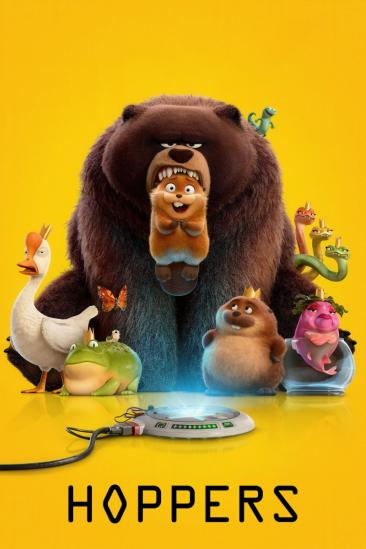
Scientists have discovered how to "hop" human consciousness into lifelike robotic animals, allowing people to communicate with animals as animals. Animal lover Mabel seizes an opportunity to use th...
“Hoppers” is the equivalent of the A+ student of the class having his scores simmer down to a B or B-: its still a good effort and indistinguishable that it’s their work but you expect better from them. And that’s been Pixar’s reality for a while now….
Descending from We Bare Bears fame, Daniel Chong’s direction is centered around two philosophies: attention to density and a fierce commitment to emotional authenticity in manufactured close quarters via playful intimacy. His voice remains hyperfixated on the omnipresent meme-ry of pop culture, lending the material a speed and spikiness that feels distinctly mid-2010s, yet never forced. But these twin impulses—the urge to crowd every frame with life and the need to carve out moments of quiet sincerity—often pull against each other, creating a friction that both energizes and unsettles.
It always feels redundant to talk about how much Pixar’s animation has reached such a breathtaking, staggering level of technical and artistic maturity because it practically speaks for itself. Lively, colorful, and peppered with this anime-inspired flair that will differ based on perspective, the animation and art direction borrows just enough from the modern canon of cutesy, hyper-saturated indie comics to feel candy-shell vibrant. With an impossible elasticity of movement and polished confidence, it wields its pixels like confetti cannons, while honing in this fabulously tactile sense of plant and water textures, and it even enhances the creatures’ faces with expression and anthropomorphic emotion when one inhabits an animal body, only for them to lose expressiveness when trying to interact with them in human form. Even taking into account how Bryn Imagire’s production design only favors a few select locations over others and how the scope and scale of the animal glade and human world only just coalesces, a lot of fun mileage is had out of interaction between them both.
Knowing full well how similar it is to Avatar while also drawing on the surreality cues that reminds me of Monty Python’s Flying Circus, it’s a presentation that’s nothing short on theatricality and a compulsive need to be attentive at all times. Even in the rare instances where’s no depth or layering and it comes off somewhat visually flat, the overall package as a whole retains enough meticulous giddiness, to where even a tossed-off sight gag, like a paparazzo frog leapbombing a celebrity swamp rat, is treated with the focus and clarity of championship ping-pong. Together, both Jeremy Lasky and Ian Megibben’s combined cinematography, with an aspect ratio of 1.85:1, has a playful disorientation to how effortlessly it pulls off almost painterly compositions when at its best, and the fluid, crumpling shifts from unhinged and kinetic to a mediative stillness shows enough restraint on its part.
Axel Geddes’ editing picks up the slack almost just as thoroughly. Outside a few select scenes, it doesn’t have to do too much to insist upon itself.
Sporting a one hour, forty-four minute runtime, a part of me was taken aback by how emphatically the pacing possesses an almost shocking expansiveness—it doesn’t just move, it gallops, covering vast emotional and narrative territories with the breathless urgency of a runaway train. Yet it never feels rushed or claustrophobic or manic without becoming as overstimulating as say Forgotten Island and its a miracle the animation compliments that style. Most of its momentum and energy is heightened on a reasonable 3/4’s over on the retroscale; the millennials-to-early-boomer humor does have its uses as I did chuckle a lot, and the action sequences are the dictionary definition of fine. They’re brisk, fast, pumped to the brim with energy and it’s clear what’s going on, but nothing else firmly gripping happens in them. Tonally speaking, it’s not quite a masterclass of controlled chaos, but it’s still absolutely absurd how much it juggles and how well it does it. The whiplash brilliantly orchestrates its pivots from laugh-out-loud absurdity to razor-sharp wit, plunging into genuine gravity when it needs to before double-dipping into disturbingly gnarly territory. All of this is timed and sorted brilliantly over the movie, and I STILL wasn’t prepared for how much death and body horror would be involved; this shit is literally B-A-N-A-N-A-S.
Mark Mothersbaugh’s new wave score puts in more effort than the premise of this movie would normally imply—swelling with a surprising, almost defiant ambition to accompany the expansive energy around it—but not much about it does much beyond matching the specific tonal shift in a scene. Sound design is about as crisp and clear as one would expect of Pixar’s quality and Ren Klyce makes sure it’s its the perfect partner for the score, rendered with such tactile precision you’re nearly deeper into the film’s absurd and tactile world, and considering how much it walks that tonally precarious line, its MPAA rating is a decent enough lock. For being PG, it leans into a surprising amount of grit with how semi-grotesque and direct its willing to go.
The cast we have at our disposal is as varied as it is impressive; ok, it’s not as standout in comparison to Pixar’s other ventures, but the commitment never wavers; every single performer feels fully inhabited and attacks their role with the expansive commitment of method actors given a blank check. Rather remedial dialogue is once again elevated by the voice actor’s deliveries and all of the characters operate in such a manner where the chaos of the narrative is implemented to serve and come from their actions rather than the other way around. Begrudgingly, none of them are all that interesting despite that and fit comfortably into stereotypes. Outside of Mabel, the rest of the character motivations are just vague, and while Mabel does have personality, she’s a somewhat frustrating protagonist, lacking the few extra subplots, quirks, or intricacies that make most heroes interesting.
Piper Curda’s manic high-energy demeanor is infectiously endearing from the offset; Bobby Moynihan injects every scene with a buoyant, almost Santa-like mirth; Jon Hamm leans so far into theatrical excess it circles back to brilliance; Kathy Najimy nails a very specific kind of offbeat charm, and when Dave Franco finally enters the fray, he doesn’t just perform—he devours every pixel of the frame.
Luring you into a false sense of security with its cumbersome setup before digivolving into a ‘shitpost’ gag anime-esque roller coaster, this is a story that throws A LOT at you. Between the appearance of a robotic science experiment, a mayor’s corrupt re-election bid, bickering animal monarchs, and a college kid fighting for her grandmother’s nature preserve, this chaotic sprawl of plotlines almost feels like too much…which makes it all the more miraculous that the movie’s freewheeling plotting doesn’t immediately collapse in on itself. The world, in and of itself, faints toward being refreshingly realistic in its approach to the harsh circle of life inherent to nature's ecosystems, and some of its plot beats are surprisingly bold in their bluntness and their almost brutality (which is why I still maintain, to a degree, that some plots work better when they’re not being subtle). It does help unlock enough emotional resonance to hold the architecture together with both its feet in the door with this crazy, almost anarchic narrative logic that keeps it zigging and zagging unpredictably, and while it proves its story may be optimistic, it’s also not naive in its execution (most of the time).
Let’s not get it twisted: this is still a fairly generic template and formula, only elevated slightly by how bonkers the second and third act end up going. Even when certain sequences feels like a series of individual moments loosely tied together with the side effect of logic being pole-valued out the window and the stakes stagnate due to the fragmented emotional build, it still makes sure to fully embrace the wonder of its own premise.
Thematically….this is where I felt the narrative was close to losing me. Upon peeling back layers of the animal world to prove that it’s both adorable and upsettingly like our own, it cracks open a rabbit hole dissecting the limits of activism and extremism, cooperation being necessary to prevent mutual destruction, how the all-or-nothing approach to any policy can bite you and depicting property destruction as a virtuous act of protest, just so long as the protests don’t go too far. See, the story itself lends itself to said stronger messages without actively carrying them all the way through; now yes, some of these messages do make it through the cracks but the rest can’t really be applied to reality due to the ridiculous nature of how the premise is executed and you do get the sneaking suspicion that the environmental message got heavily retooled and lessened during development; the final act in particular solidifies this point. Does it hurt the credibility of the story? Potentially, but as the narrative went out of its way to give both sides, vilifying either the environmentalist or the corporate side feels tricky. On one hand, a meet-in-the-middle resolution was probably the only way this movie could tie itself up while offering a realistic conclusion that doesn't cater to a black or white singular frame of mind. Not to mention, it’s one of the few scenarios in which finding a compromise for the situation actually makes sense. But on the other hand….when you take both sides into consideration—one side constantly wrecking the environment in favor of industry and the other too eager to enlist animals in her potential revolution without considering what they might actually do under a banner that she can’t control—the sins of both end up canceling each other out.
I get the intentions behind it: focus on our similarities, reject extremism on both sides and come together peacefully for the betterment of the circle of life. But GODDAMN, does the entire package look fishy enough to not be mistaken for something potentially warped?
However much fun “Hoppers” huffs and puffs itself up on feels handicapped by its environmentalist message, wanting to have its cake and eat it too in exchange for neutering the joy you feel due to how bonkers it gets. It's essentially a pinball hazard that makes it difficult for me to turn my brain off for this….even if you get rewarded for doing so.