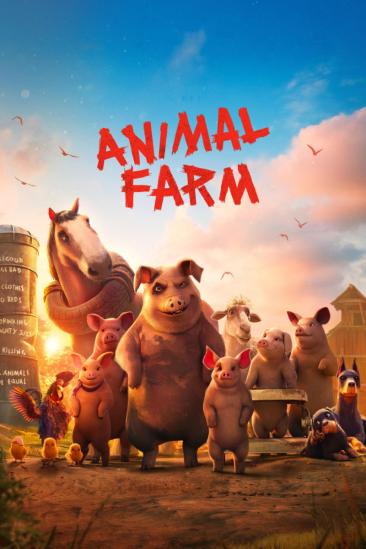
A satirical allegory of revolution and power that traces how a movement for equality is systematically corrupted. As the pigs consolidate control, truth is erased, dissent is crushed, and the farm...
Welp, I once swore to someone that I wasn’t gonna subject myself to this but curiosity yanked at where my ponytail used to be and since APPARENTLY I HAVEN’T SUFFERED ENOUGH ALREADY, my pain now redirects me……to “Animal Farm”. No, I am not yanking your chain, this is not an ill-conceived prank; this is an actual animated feature film that completely inverts the 1945 anti-communist fable of farm animals staging a revolution before taking it behind the bike shed and SHOOTING IT THROUGH THE BRAIN.
I could just end the review there but…….fuck it.
Normally I’d chalk up bad directing like this to behind-the-scenes constraints and demands, or just putting every egg in the wrong basket but then I remember other films Andy Serkis directed and its clear that his reputation as a director is, shall we say, not exactly the thing he’s known for. This is a very plug-and-play direction on Andy’s part, one that doesn’t offer much conviction in the overall throughline that stretches from scene to scene; just this aimless moral drift that metastasizes quickly before locking the entire project in a Vise grip that would make The Great Khali grunt in confusion; just this prudish, awfully misguided Disneyfication of effort that carries no personality.
God, I do not like this animation; it’s nowhere near Shark Tale levels of ugly but nothing about how this film looks is even remotely appealing to the eye. Cheap, dead-eyed, geometric and very low-budget, there is evidence of cut corners everywhere like someone traced storyboards on a napkin with a dying sharpie, then handed the napkin to an unpaid intern and whispered, “Make it pop.” Even the occasional small textures in the animals furs and the crosshatching with the background don’t make up for the stiff movement or limited facial expressions of the animals. And its heavily inconsistent too with certain sequences popping out more than others, looking polished one moment and then noticeably undercooked the next, like the budget kept getting rationed by someone with the attention span of a ferret. Amos Sussigan’s production design only further exemplifies the generic template feel of this thing, and the contemporary US setting deserves its own paragraph of grief—the kind of aggressively nowhere Americana that could be anywhere and therefore means nothing (even when it should mean everything), all of it conspiring to sand down every last jagged edge of Orwell’s original geography.
So many words I can use to describe this presentation, but the best that comes to mind is….lazy. Even putting to one side the very idea of updating a pointed text from 1945 into the modern day to reflect more current political realities not being that bad in hindsight, the execution is so condescending, it makes its intentions look stupid. Nothing is wrong with universalizing a story this specific and particular, but the end result is like widening a scalpel—you don’t get more precision, you just get a bigger wound that heals wrong. If you put a gun to my head and forced me to say ONE positive thing about this travesty, I’d tell a half-truth regarding the cinematography. Olaf Skjenna’s camerawork gets the basics down pat—competent framing, occasionally a shot that almost earns the word “composed”, the color palette doesn’t have the warmth and vibrancy of a DMV waiting room—and look, I’ll be honest, there are two or three moments where the camera actually seems to give a damn about what it’s pointing at, where you can almost squint and see the ghost of a better film haunting the frame with a vague sense of intention. But that’s the full extent of it; it functions and points at things.
I guess the editing is also tolerable on Kevin Pavlovic’s part; nothing egregious comes out of it but I’m not giving points for mediocrity here.
How do I best describe the pacing here? Because it’s literally both breathless and interminable, a sprinter and a glacier—97 minutes (and even that sort of runtime is being generous) that barrel past every meaningful beat like it's late to clock in, yet still drags on like you’ve aged visibly by eight years. It literally has the mobility of a MAC truck in park. Every
forced attempt at humor is bottom-of-the-barrel, it kills every iota of tension within mere seconds of booting up, and the tone is distractingly scattershot. It just spreads all over the goddamn place with barely any rhyme or reason, wavering between something that feels aimed at younger audiences and something that gestures toward darker themes without fully committing. That darkness, the general sense of unease bubbling over is completely absent here.
Heitor Pereira, let me apologize to you right off the bat because you did the absolute best you could with your musical composition; I just couldn’t remember a single damn note of it. I mean, it serves its purpose for the type of tale it wants to tell but what it wants to tell….just doesn’t congeal together, context be damned. Sound design is probably the most basic and tokenistic I’ve heard in a while, costume design doesn’t fare much better, given how unsubtle and obvious it ends up being like a foghorn in a library and to my eternal shame, the MPAA rating is a strictly safe PG. A PG. As in, a rating that exists to reassure parents that nothing in the next 97 minutes will disturb, unsettle, or in any meaningful way challenge their child’s understanding of the world—which, for a story about the systematic corruption of a workers’ revolution and the slow rot of idealism into blood-soaked authoritarianism, is not a feature. It’s a confession.
Begrudgingly, the cast is pretty okay…..and I mean that in the most backhanded way my vocabulary will allow. It’s a who’s-who of a big ensemble, so I guess it’s no surprise they perform as comfortably as they do; when you’ve assembled this many people who actually know what they’re doing, basic competence has a way of showing up uninvited even when everything around it is on fire. Sucks to be them however since nearly all the dialogue is either cliche or remedial and honestly, one brief glance at every individual character here, and it becomes apparent nobody was gonna walk out of this looking good. If they’re not exaggerated or tonally mismatched due to the movie also being lobotomized, they’re just straight-up caricatures.
Glenn Close surprisingly chews the scenery out of the most bog-standard greedy Elon Musk stand-in ever, Woody Harrelson brings this droopy-eyed, aw-shucks sincerity and tenderness to both Boxer and the narrator (yes, really) that somehow lands exactly halfway between heartfelt and pitiable and Seth Rogen as Napoleon didn’t annoy me as much as I thought he would.
As someone who was actually tasked with watching, reading and doing an introspective on both the original book and the 1954 film back in charter school, I don’t need to tell anybody how royally fucked up this story is; bleak, unsettling, and quietly haunting in how it traces a movement for equality being systematically corrupted from the inside out before ballooning into a ruthless dictatorship; none of that needed to be dumbed down….but here we are. The basic structure of Orwell’s allegorical tale has been mostly retained, but that’s as far as I’m willing to extend the positives to. There’s an identifiable rising action, climax, falling action and resolution and only the barest outlines remain to be stroked away like pinpoints on a checklist: Snowball is still exiled, Boxer is still exploited, Napoleon gradually takes over and changes the hierarchy of the farm while everything goes into disarray. It’s literally the entire production around that that makes this updated narrative difficult to sit through.
Proper shepherding for the parables of absolute power corrupting and crude fart jokes coexisting are all but abolished in favor of just stripping the place for parts more suitable for the Back At The Barnyard series, leaving only the most naked, market-ready skeleton. So by-the-numbers, so creatively threadbare, so grotesquely uninspired just getting from Point A to Point B and shaved down just enough to cram in every annoying animated cliché under the goddamn sun, the entire script reads like the bastard child of a content algorithm; this gripping cautionary tale has been jackhammered into this noisy good-vs-evil sideshow with zero nuance, actively strangling the parts that would’ve been acceptable updates and overcooking the added anti-capitalism grandiosity to where many of the stakes are immediately undercut and rendered comatose before they ever fully accumulate. For what’s meant to be this veritable sandbox of power dynamics firmly eating itself inside-out, the structure is too disorderly and dismissive of its own narrative momentum for that concept to stand on its own. Nothing is genuine, nothing is earned.
The sharp, allegorical edge of absolute power corrupting, revolution cycling from hope to brutality, any kind of authentic struggle between the old guard and the new order is replaced with a rather blunt lecture on capitalism on top of adding a billionaire human villain, making it a critique of "corporate greed" and including an extended corporate war arc and a metaphor for dopamine consumption, all the while distracting from the real point: freedom is the ephemeral thing that rots first and fastest, while humans, inherently piggish by nature, will seize the first opportunity to take more than their share. One can argue that replacing Stalinism with capitalism could’ve worked just as fine, but really, all this does is bloat the length while simultaneously sucking dry whatever allegorical clarity remained in this corpse. Not to mention as vital as such a message is to be taken seriously in this day and age, it doesn’t tell us anything new that we didn’t know already and don’t even get me started on how they changed fundamentally everything about the ending; it’s a confusing, quasi-biblical anti-climatic catastrophe because there needs to be some way for the bad guys to be toppled, so a fresh note of hope can be struck in the end. I’d love nothing more for this type of narrative to give me some kind of levity for the inevitable downward spiral we’re still drowning under, but this so-called climax can’t even be bothered to do it in a way that feels moderately comforting. It rings so hollow you could strike it like a bell and still get no tone.
Honestly, I would rather watch two hyenas fucking each other to death in a piss-soaked Applebees parking lot than have to sit through this…this….desecration. You guys do realize this might as well be cultural vandalism, right? Actually, no, this is cultural erosion. Flattening the book's message into something more palatable and PG-friendly only serves to destabilize the integrity of the text itself, tricking people to run directly into the situation Orwell was warning about; literally evil incarnate to put this out in the state that it’s in, especially in a day and age where media literacy has either grown increasingly more fragile or just evaporated altogether. It’s hard not to compare this film to Illumination’s The Lorax regarding how both of them butcher texts with well-meaning, bleak messages in the most sanitized sense possible. It trades poetry for pandering, universality for extremes that actually manage to alienate the very truth it’s trying to sell you and subtlety for a sledgehammer—which in doing so, buries its own message under the weight of screaming it at you with devastating irony. But hey, at least The Lorax had one awesome song (that wasn’t used but at least it was there). Foodfight can be looked at ironically and be laughed at for its idiocy. Eight Crazy Nights was decent on the eyes despite not sticking to its mean-spirited tone. Norm of the North makes for an incredible drinking game with how batshit insane it gets. For fucks sake, the GODDAMN EMOJI MOVIE had more decency and self-respect than this one and that film literally has a talking a pile of shit played by Sir Patrick Stewart!
Why adapt this story now, when its warning about authoritarianism and manipulated populism feels so immediate and potent today and then go out of its way to make it so damn small? That’s the insult I can’t shrug off: not the betrayals, the flattening, the emulsified thinly-coded politics, but the arrogant assumption that we’ll swallow it because God forbid a children’s cartoon ever leave a child colder or wiser to how the world might treat them.
No, this is not the most perversely wrongheaded mega-budget desecration of a literary work ever conceived—that bar is lower than a limbo stick in hell—but doing this to ORWELL of all people is so nightmarishly ironic it could have been assigned by Screwtape to Wormwood. Yet it takes NOTHING away from the reality that this iteration of “Animal Farm” is an infection that creeps into the brain and loudly evicts the original’s iron teeth for a lumpy burlap sack of flattened morals, emoji-grade satire, and half-assed finger-painted sparkles still wet from the craft table. As Rerez would put it: IT’S. JUST. BAD.