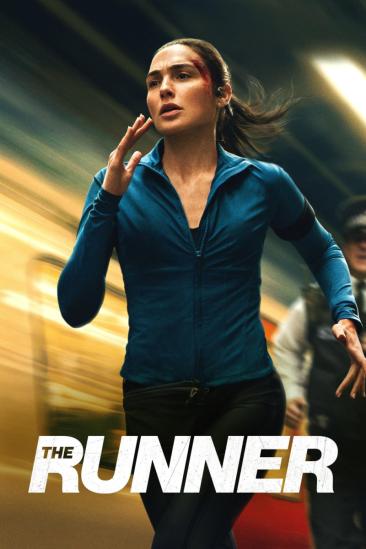
Maia Marten, a brilliant London lawyer, has her life shattered by a single call on her morning run: her son has been taken. To get him back, she must keep running, obey every ruthless command, and...
Again, I swear to you guys, I don’t actively wish to run a damn marathon every time there’s a new punching bag to target, but when you make as much noise or ruffle as many feathers as this one apparently does, there has to be some monochrome of truth to it. Yet, does “The Runner” actually deserve it?
Do I really need to answer that?
Fitting himself RIGHT IN with the meandering, disposable, undemanding albatross that orbits an already dour endurance test and traps it in lockjaw, Kevin Macdonald’s directorial flourishes are early 2000’s levels of dated. It’s every bit as streamlined and algorithmic as the vast majority of efforts released in the streaming era nowadays (looking at you, Ghosted and Back In Action), and his direction is almost offensively dumbed-down, eschewing narrative complexity for adrenaline that never even materializes.
I wonder if Kevin Timon Hill really stood a chance with this production design; from the outside looking in and the inside looking out, it matches the criteria for the type of glorified tourist advert we see all the time on Netflix, especially when every brief snippet of a location comes across as a stock footage vignette hogtied to a SEARS commercial. The intent was to turn the streets of London into a relentlessly crowded obstacle course and to be fair, it does a fairly decent job showcasing how much of London is an overcrowded and claustrophobic mess that is a nightmare to navigate with its overpopulated foot and vehicle traffic (as someone who’s only been there once, that’s more than enough for me), but its still practically window-dressing. On top of that, none of the geography for any of this rarely makes much sense and is constantly muddled to such an extent that it’s difficult to tell where our protagonist is relative to her destination.
Somebody explain this to me like I’m twelve, ok? You got a global movie star paired with a trillion-dollar streaming company, and yet the entire presentation of this movie is outfitted with this mind-boggling mentality of “Be as cheap as possible with the entire budget”. And this isn’t like Big Shark where THE ENTIRE THING both looks and acts the part of a disheveled high school project passing as a deliberate “audience-only” riot; this film is brazenly over-the-top with its set-up with almost every other technical aspect actively fighting against the other, constantly calling attention to itself and draining the production of anything resembling an actual practical dilemma. You honestly wouldn’t be able to tell Anthony Dod Mantle, the cinematographer behind the first and most recent 28 Days Later films, was behind this. Ok, I’m exaggerating a bit; you see flashes of the frenetic and claustrophobic anchoring that defines him, but it gets to the point where the stylistic excess feels like legit panicking—it literally does not suit the material here. Most of the lighting is maddeningly flat, the color grading is just muted enough, there’s an infuriating slow shutter speed effect that borders on laughable, and the constant awkward shots, blurry close-ups, dizzying camera placement shifts, and unflattering angles are nothing short of crowded, hyperbolic visual and editorial gimmicks.
Sam Rice-Edwards’ editing doesn’t help matters; it’s so sped up that we can never get a consistent sense of movement, geography, or distance; it’s sugar-rush editing that’s as equal parts nauseating as it is a constant distraction.
At this point, it should go without saying: the only overwhelming positive to this is how short it ends up being. Mercifully short at one hour and 25 minutes, the pacing is swift enough that theoretically, we shouldn’t ask too many questions. Being faintly propulsive, however, is not a get-out-of-jail-free card, for there’s simply no care or poise in how it flows—and that clunkiness makes an insanely short 'thriller' feel longer than a Nolan/Scorsese epic. Visual effects are subpar at best and low-rent at worst; momentum doesn’t seem to exist here or isn’t kinetic with enough ebb and flow to pass as a successful smokescreen; tension, urgency and suspense have been siphoned and disposed of at the drop of a hat, and it should go without saying, but the action is thoroughly unimpressive. It’s actually one of the few action movies where you’re waiting for it to slow the fuck down to pop in an Ibuprofen.
I guess the tone is consistent in the way it’s supposed to matter: absolutely boneheaded in how seriously it takes itself while constantly running face first into certain sequences and implausibilities ripped straight out of a parody of such events, and the film is nowhere near ridiculous or elevated enough to support that faint shift.
Oh, and the music isn’t much better either. I can decipher a few separate notes and melodies from Tom Hodge’s composition but for the most part, it just doesn’t do anything to differentiate itself or stand out. Even when the soundtrack tries to take the piss out of The Runner by playing “Running” by Fat Dog as a semi-comedic riff on the theme of the film, it’s more distracting than anything else. So much of the sound design from Glenn Freemantle is disappointing in how irritating or distracting it comes off as (take a shot at how many times I find myself saying that); the costume design is not deep, only going as far as picking out the faint allure of what a certain person is doing that day and not much else, and for a movie that surprisingly tightropes itself between the PG-13 and R ratings seemingly on a dime, I’m not surprised that it ends up being the former. There are a few sequences that had me double-guessing whether or not this was a very VERY tame R-rating, but for what it was given before us, this is pretty par for the course.
I really wanted to try and give the acting a fair shake here, but there’s practically fuck all to say; as this is a one-woman show 95% of the time here, the rest of the performers don’t really stick around long enough to make a lasting impression, and the only impressions they can make are either milquetoast expressions or dull surprise for a couple seconds. The dialogue goes on a looped course, with how fixated it is on painfully on-the-nose attempts at providing phony psychological depth, and the characterization (or the second-hand embarrassing attempt at characterization) is bafflingly juvenile.
By default, Damian Lewis is “the best” out of this ensemble….if only because his contributions are mostly vocal and he’s enigmatic enough to be the only one given a character close enough to chew on. Rory Wilmot is given very little to work with as the child actor, but he does the bare minimum of what’s required of him; Alfred Enoch continues to be wasted post-HTGAWM; and, to the surprise of absolutely no one, Gal Gadot remains the reverent black hole where all acting potential goes to shrivel up and die. Oh, let’s not get it twisted; she can EMOTE, but as far as giving a convincing performance, given the physically taxing demands she has to abide by, this is the stiffest I’ve seen her. Her speech patterns are robotic; any emotion she has to convey feels performative and awkward, and she still gives off a thousand different variations of “Kal-El, no!” every other scene. She can run…but she can’t hide from the emergency roast.
Look, on paper, this is far from a foreign premise: You got a lead character with relevant personal trauma revealed to us as if it’s a surprise, a sinister voice on the phone saying allegedly creepy things to coerce something out of them, and a seemingly impossible race against the clock hardening into an inevitable turn of the tables; plenty of avenues to sprint toward to stir up some new degrees of tension. But every waking moment, I’m reminded of how badly it wants to be ‘Run Lola Run’ meets ‘Cellular’ meets ‘Speed’ and how insipidly second-rate its attempt at maintaining a visceral, ticking-clock nature turns out to be….and that’s when I realized the slight of how hopelessly cut-and-paste it is is the least of this narrative’s worries. Assimilating and accentuating nearly all the tired, recycled clichés from Nick of Time, Red Eye, Eagle Eye, Carry-On, or Drop among many others (because they all have the same basic formula), we’re stuck with too plain a script, too generic a protagonist/antagonist dynamic and a narrative that simply doesn’t trust its own premise or is aware it might not be enough, so it has to script Maia into more heightened and dangerous situations in the classic mishap of characters being used to serve the chaos rather than the other way around. The mystery behind the Caller’s motives falls apart under any real scrutiny; the courtroom subplot tied to Maia’s case barely factors into the final act in a way that feels earned; every predicament that comes along just makes the Caller look dumber and dumber—like, why is the Caller kidnapping Maia’s son to force her into this predicament his PLAN A instead of doing literally anything else to intimidate the witness—and the list keeps going.
It’s like trying to get the track team to do trials, but they have a one-track mind.
On top of that, it’s another one of those movies that actively seeks to inconvenience the audience every chance it gets, constantly disavowing and breaking its own rules and internal logic as long as it ends the movie faster and, once more, with feeling, plays to everyone’s disadvantage. Rule consistency and the very regulations set in stone for both emotional and literal storytelling are laughed at with every new question that pops up here. The more I think about the foundation and structure, the quicker its internal logic tightens its hamstrings and collapses, thus ripping away the urgency it wants to convey while simultaneously breaking our illusion by jumping the shark early and often. Yes, I know movies such as these are all about suspension of disbelief, but all of this is rolled out with the reckless abandon of a credit card commercial parodying these cheesy action movies rather than accentuating its absurdities or hiding its other weaknesses. Here, the stupidity is front-and-center…and not in the out-of-this-world, gloriously shit, ‘it-needs-to-be-seen-to-be-believed’ endearing way like Big Shark or War Of The Worlds.
Thematically, this wants to rely on the emotional framework of parenthood and self-sacrifice to give us more realistic consequences on top of modern anxiety being constantly connected to everything, the flimsy juxtaposition of Maia's frantic, life-or-death sprint with the indifferent, oblivious public, and how the one who controls the narrative holds all the psychological power; all of that attempted messaging is annoyingly surface-level, especially since it doesn’t stop at all to really dig into Maia’s childhood, the socioeconomic climate and history of London, whether the kidnapper’s hostility toward her is either society’s fault or him being a misogynistic asswipe. Also, can we stop cramming in A.I into plots that don’t need it? Can we just stop making it such a lazy storytelling crutch altogether? The shallow commentary on international screen addiction doesn’t even center around the narrative as it does with Heart Of Stone, and even if you wanna make the very charitable decision to say this movie actually picks a side—a good portion of the final twist does require analog techniques far from the digital cloud—you cannot deny how incredibly half-assed it comes off as. It’s so flimsy how pathetically non-committal the film is about its stance on the over-reliance on, and prevalence of, technology (also, very hypocritical digging a dig at the very thing you’re actively supporting, Amazon).
By default, the actual final twist is what finally piqued my interest in this perpetual cinematic NyQuill; it was shocking, it did throw me for a loop, and it did subvert my expectations a little bit…..but only because the movie had to pull some utterly INSANE coincidences, contrivances, complete ass-pulls, every C word you can imagine out of its bare, naked ass to compensate for how over-contrived this “subversion” really is. And you know the worst part of all of that? It literally amounts to nothing: constant teases, setups for something exciting, the bad guy gets stopped, and his dangerous backup plan is thwarted the same way the Penguins’ conveyor belt of backup plans gets immediately trounced in Batman Returns; the movie practically rolls out the red carpet for one last accomplice reveal to really drive it all home….
….and it goes ABSOLUTELY NOWHERE. One of the stupidest endings I’ve seen yet that blatantly cheats to produce a cheap thrill.
An abrasive, hyperactive exercise in aggressive one-dimensionality and illogical plotting, further aggravated by a stunted lead performance and this empty void of nonexistent emotional weight that never materializes, “The Runner” is cheap where it counts, loud where it doesn’t, and afflicted with an overwhelming dearth of personality. It’s hard to think of a single thing that it gets right and I tried. I really did.