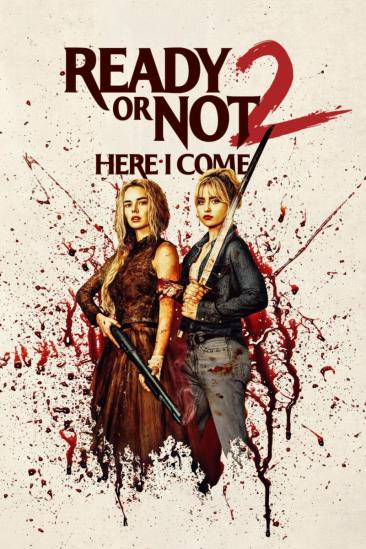
Moments after surviving an all-out attack from the Le Domas family, Grace discovers she’s reached the next level of the nightmarish game — and this time with her estranged sister Faith at her s...
To date, the first Ready Or Not film from 2019 remains Radio Silence’s only genuinely great film—or, at the very least, the only one I actively enjoyed the most. Their subsequent outputs, from 5CREAM to Scream VI to Abigail, has left me progressively disappointed and less convinced about the collective’s staying power, each new project arriving with diminishing returns and with that, a growing suspicion that Ready Or Not may have been a happy accident: the one time it knew exactly what it was and didn’t blink.
Admittedly though, I was curious about the potential of “Ready or Not: Here I Come” because it felt like it actually could build upon the foundation of its predecessor.
It did not. At least not in the way it matters.
One thing to keep note of when Radio Silence is directing? They’re always very shrewd and playful with how they approach the material they’re given; Matt Bettinelli-Olpin and Tyler Gillett know their toolkit intimately and rarely stray the well-worn path, staying squarely within their comfort zone and not daring to come out of it. And that is what bites them in the ass, for their direction is both aggressively safe and routine. The entire thing feels garish, shoddy and overstuffed for the sake of it.
For such a project that seemingly demanded a visible evolution, Andrew Stearn can’t quite step up; his production design still has this solid stylistic foundation within that carries over from before, though it lacks the distinctiveness and cohesion that made the Le Domas house feel so singularly itself—one location, one family, one rotting monument to inherited cruelty. Yes, the constant shuffling around and spawning outwards to golf courses, country clubs and even a temple ripped straight out of Chilling Adventures of Sabrina has each new setting gestures toward status and hierarchy, but that’s all it is: gesturing. In expanding the scope and scale of this world, Stearn loses the territory—that suffocating gothic opulence, that sense of a world with walls closing in, doesn’t survive the move and it trades the atmosphere for acreage as a result.
I get what they wanted out of this presentation: much like several other continuing stories, a sequel’s purpose is to broaden the fictitious world within the text, thus raising the scope and scale of the project while elevating the physical and emotional stakes and on paper, this achieves exactly that. Something could’ve come out of taking the blood-soaked absurdity, and comedy-forward sensibility of the first film and pushing them outward but unfortunately, it doesn’t enrich nor enhance the actual content of the tale and what came before it. That pretty much sums up most of the technical elements also; Brett Jutkiewicz’s cinematography is clean, legible, and expressive enough—competently lit, spatially coherent, occasionally handsome in the wider establishing shots where the new locations get room to breathe and assert themselves, handling the geography with a steady hand; it’s just hard to think of much else that stands out.
Editing isn’t as tight as before but it does its job. It still holds everything together well enough despite not being as clean or clever with the transitions or by-the-by structure.
Feverish and relentless in how badly it wants to keep you locked in, the pacing ends up paradoxically dragging more than it should, mistaking momentum for motion when it doesn’t have much of the former. Keep in mind, the first film was only and hour and a half. This sequel’s thirteen extra minutes aren’t just felt; they accumulate, pooling in the quieter stretches like standing water, making what should feel propulsive feel instead like a long hallway you keep expecting to end. Strong practical effects and convincing makeup work carry over from the first film with nary much downgrade, the claustrophobic tension and suspense and the surprise factor from before has been sacrificed and siphoned away and tonally speaking, it’s weird. The comedy takes more center stage than the thriller or horror aspects from previously and while there is still a balance, everything feels exaggerated, especially when the humor doesn’t even land half the time now.
Sver Faulconer does well enough with his musical composition, carrying over his elegant yet eerie "baroque-meets-slaughter" style from the first film but it just doesn’t hit the same this time. Nothing about it is outright terrible but everything just blends together outside the occasional soundtrack zinger. Thankfully, the sound design, being still crisp and spatially aware, remains one of the more reliable holdovers, Avery Plewes’s costume design does well once again—Grace’s wedding dress continues its symbolic deterioration until it’s replaced entirely by black, a dark coronation—but the rest don’t carry that same weight or intention until the last twenty minutes, none of the action set pieces were all that inventive—not much stood out in the first film either but at least each encounter contributed to Grace putting her body through literal hell to fight to survive and come out more battle-hardened, and need I say more about the MPAA rating? It’s R-rated up the wahzoo and the gore was never not going to be like that; splattery, exaggerated and theatrical in the way it needs to be.
The ensemble cast was always going to be the best part of this movie, and to their credit, they arrive fully loaded: a roster of recognizable faces with enough collective wattage to paper over the cracks, at least for a while. Dialogue has three modes: “well, that just happened” dialogue, jokes constantly revolving around shouting and swearing or suffocating exposition; none of which are generally endearing and the large foray of characters here feels like the film juggling more than it could handle. Some of them do have the occasional fun quirk but not much of them stand out this time around with only two exceptions.
Samara Weaving once again is scarily impressive despite being given even less to do than before, Kathryn Newton is high volume but low wattage, gamely trying to bounce off of Samara and sell the already flimsy sister dynamic to mixed results and Elijah Wood, as this mysterious Lawyer, delivers the dry, precise delivery the film thinks it needs without overplaying his role.
For anybody even remotely familiar with the first film, the basic formula is more or less the same here: Grace is forced into another game of Hide and Seek after surviving the first one, this time with four other families bound to the same pact to Mr. Le Bail trying to hunt her down and assume the throne of the High Table….and while Grace has to protect her sister from becoming collateral along the way. Outside of a few superficial differences and the added anchor of Grace needing to protect someone, it’s exactly the damn same plot as the first Ready Or Not; no exaggeration, this is the same narrative blueprint and trajectory, only with a more repetitive and routine execution. When we’re not dealing with the implausible specifics of the hunt, it cycles our duo through increasingly tiresome patterns of running, getting caught, engaging in stiffly staged and shot fight sequences, and then running again; too clumsily calculated and telegraphed to where it’s not even trying to hid that it’s a loop and the film almost seems proud of it. Well, I say that when I can also actively see the narrative straining under the weight of the vastly expanded lore it creates for itself, and it barely even tries to take advantage of the few advantages it does have because it treats itself like furniture in a storage unit. What little actually is expanded upon mostly comes off as superfluous, the new rules to the game and new characters alongside them almost immediately get lost in the shuffle, and the stakes ballooning up to MCU-levels of supersized gilded cage confinement leaves little space for remixing the infectious energy from before beyond the bloat and thinner bars.
Really, the very existence of this movie effectively renders the events of the first one pointless already but it’s even more damning how brazen it is being loud, ineffective and hollow at the center, implications be damned. Yes, I’m aware this is supposed to be some cozy escapism but bigger is not always better, people.
As expected, the themes of bourgeois entitlement, critiques on out-of-touch wealth, tradition, atavistic rules and female solidarity and cooperation against patriarchal systems carry over from before but unlike previously, none of those are executed through a set-up that supports and takes advantage of the setting. It’s not exactly lip-service but it does next to nothing with a concept we’ve all gotten sick of seeing like this; compare this to other films and TV shows like Succession, White Lotus and Glass Onion among others which have dissected these topics with much more nuance, precision and the type of general situational awareness that, at least, keeps the topic fresh to where you’re not beating the same dead horse from multiple angles. For a horror franchise ostensibly about finding a way to play the game of life on your own terms and not by the cruel rules of the wealthy, everything about how it presents that played out “rich people suck” messaging that it so gleefully picked apart before in the first film comes off so basic and awkward now. And that’s on top of this globe-spanning cabal NOW including families from India, China, and Spain all portraying some type of stereotype while participating in a ritual that essentially serves as one big antisemitic trope.
Not to mention the emotional framing of the story should have had more legs to stand on. The first film had a clear, visceral core: Grace as the outsider, thrown into an elite and murderous world and forced to claw her way out of it. Here, it tries to add to that with the Grace-Faith sister dynamic, positioning Faith as foil and shadow, a new emotional engine meant to claw at Grace’s dormant desire at finding a new family or keeping the one she didn’t want to leave behind—but it never fully turns over. Newton’s addition doesn’t add much value to the proceedings beyond superficial sibling bickering and a forced sentimentality the film doesn’t earn, and it actually fragments the structure in certain areas that actually would’ve benefited from calling out comparisons and contractions from the other families.
A throne built on hollow ground, “Ready Or Not: Here I Come” is yet another opulent husk on the pile comprised of every other sequel that clearly wants to capitalize on a semi-popular thing without understanding why it worked the first time. Limping across the finish line bloody but stripped of its bite, it’s an echo so loud it practically drowns itself out, no matter how much mild entertainment you get out of it.