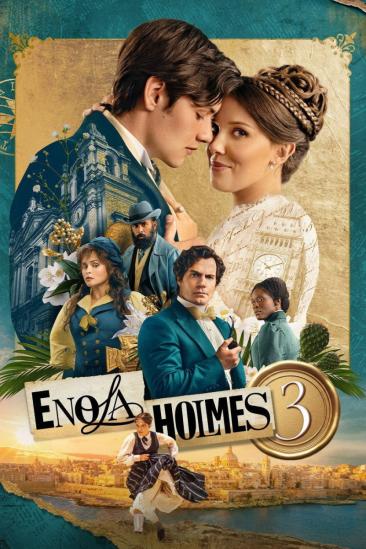
Adventure follows detective Enola Holmes to Malta, where her plans to tie the knot unravel when Sherlock's disappearance plunges her into a perilous case.
My thoughts on the Enola Holmes series is pretty lukewarm, despite me liking the previous two movies. Carrying a dependable and adaptable wit, charm and adventurous spirit without sacrificing the parameters of what makes an enjoyable mystery story, they’re competent and occasionally delightful—their greatest strength and the ceiling they never seem interested in breaking through.
Enola Holmes 3 is somehow more of the same….and somehow less to its own detriment.
This is the first time one of these movies has been made without Harry Bradbeer at the helm of the directors chair, but it’s not like Philip Barantini had some big shoes to fill. For what it’s worth, as a director, he proves to be more thoughtful and nifty with shifting towards slightly more grounded, spatially aware instincts regarding the mechanics of each scene besides the mood. But the material keeps pulling him back, and he mostly lets it—those more interesting impulses flickering briefly before the formula closes over them; it makes him a capable replacement. He’s also, ultimately, an anonymous one at the end of the day.
Trading in the familiar streets of London from the first two movies for the sun-drenched landscapes of Malta, it does make for a visual refreshing pivot and a beautiful backdrop in and of itself. Gary Williamson’s production design is mostly content on letting the island do the heavy lifting, dressing what’s already there rather than build anything on top of it, which is fine….until the seams start to show. Despite the initial allure of the location, the scope and scale of it feels a little too contained and manicured to fully immerse us into the world they set up for later, and it never quite opens up into the sprawling, lived-in world the story seems to think it’s inhabiting. It should feel lived in but that feeling never manifests as the production leaning on the island’s natural beauty as a substitute for texture can’t conjure the density of a world with history baked into its walls.
Credit where it’s due on the presentation front: it’s consistent with its predecessors, not content in recycling the static Sherlock Holmes formula and there’s a genuine sense that this one seems rather adamant in keeping pace and maturing with its audience that’s grown up alongside it, trading in the wide-eyed novelty of the first film for something with more grit behind it. I just wish the overall look of the film better reflected that. Matthew Lewis’s cinematography at least keeps the visual consistency of the series intact as it never has been that visually impressive, but there’s a quiet diligence to how he does his damnedest to push against that ceiling. There’s a genuine effort to make things feel more immersive and cinematic this time: the staging shows real spatial awareness, and finds angles that actually breathe and are shot with some ambition behind the lens. The lighting is actually halfway decent too (which for these Netflix productions might as well be a godsend).
If you wanna be technical, Tommy Boulding’s editing was it’s own kind of roller-coaster— jarring transitions and a fast-and-furious pace that blows past most of the story before you’ve had a chance to settle into it, only for the rest to just level out, steadying into something unremarkable with nothing particularly damning to leave a comment on.
Speaking of that pacing, I could tell it was trying really hard to be energetic and keep that forward momentum by any means. It’s thankfully never break-neck to a nauseating degree or jarring or distracting enough to discombobulate you from taking notice, but when you consider the runtime is actually half-an-hour shorter than Enola Holmes 2, you can’t help but ponder just how much is missing. Tension and suspense briefly materializes on a whim before dissipating just as quickly, most of the humor is nigh non-existent, or I just simply didn’t find it funny or endearing in a way, the stakes never quite scale with the narrative’s own ambitions and as per tradition, the action sequences remain almost stubbornly rudimentary: the stilted choreography is telegraphed well in advance and moves through its paces like it’s been blocked for a stage rehearsal that never quite graduated into a real performance. Now tonally speaking, it’s in line with its predecessors….but it’s very muted this time. The charm that made those movies work in spite of themselves has thinned to the point of transparency here, and what’s left underneath isn’t quite enough to carry the weight of a mystery that asks you to care about it.
Aaron May and David Ridley’s efforts are fairly serviceable for a musical score. It portrays the exact emotional beats needed to convey suspense, whimsy, mystery—competent, diligent work where the shapes are right, the instincts are reasonable, the homework was clearly done. You can hear them reaching for the register that Daniel Pemberton occupied so naturally in the first two films. But Pemberton’s score had a personality of its own, a kind of buoyancy and wit that felt genuinely native to the material rather than applied to it, and no amount of careful imitation can fully close that gap. I felt a little underwhelmed with the sound design for reasons I couldn’t quite grasp, Consolata Boyle’s costume design remains spiffy, impeccably tailored and period appropriate to this Victorian era and….well, you don’t need to guess what the MPAA rating here is—a PG-13 so comfortable it might as well have been contractually obligated.
You guys know I do my damnedest to be fair with everything regarding a film production and honestly? The acting from the cast is fairly solid all around, by far the most reliable thing the film has going for it. Nobody is phoning it in, nobody is visibly lost, and in a film that often struggles giving them some meaty to work with, that’s not nothing. Both the dialogue exchanges and the characters they’re tasked with portraying reach the same level of dependability: middling some of the time, vaguely captivating other times. It does kinda suck since this one gives the supporting cast the least to do out of all the Enola films and it shows.
Millie Bobby Brown still commits and gives herself entirely to this role, balancing precocious intelligence and sass with genuine vulnerability just enough to keep her character from becoming insufferable and that infectious enthusiasm does gradually bounce off the supporting cast enough to where nobody is really slacking. The only two who come close to matching her energy, however, is a returning Sharon Duncan-Brewster, doubling down on her cartoonish antics from the previous film with delicious wickedness, and surprisingly, Himish Patel as a reserved Watson.
As a sleuth/mystery junkie, it pains me to say the actual narrative meant to condense and anchor that mystery is clogged and polluted by some muddied waters; the semi-tight construction that kept its predecessor's somewhat engaging is still here in spades, but the execution takes the “What if BLANK went on vacation” set-up and turns all the moving pieces around it into something interminably boring and if you guys know anything about me, boring me to tears is one of the worst offenses a movie could do to me. It’s less much of a whodunit than a ‘whydunit’ if that makes sense —and I’ll be honest, I’m not sure even that framing flatters it because even when that conclusion is made and the entire perception of the film shifts on its head, not much about it really clicks into place. I swear, I don’t remember the mysteries from the previous two movies being this oversimplified or drained of urgency or lacking significant powder to a formula this universal, this road-tested, this practically impossible to drain of all momentum; whatever their faults, they understood that a mystery lives and dies on a current running underneath it—some low hum of stakes or misdirection or wit to keep you leaning forward and barely any of that bubbles up to the surface.
Marrying the personal with the political is something this series is not shy in attempting, and every film has dabbled in that to mixed results as far as the execution is concerned; this probably is the most ambitious with its commentary the series gets. Instead of grounding the film in universal suffrage or basing it around a real-life feminist movement like the previous parts, they attempt to widen the scope not just by focusing on one case per se but by winding that back around to the constant injustices and historical wrongs caused by the British across centuries, the legacy of empire, gender and class inequality and the weight of familial legacy. I can appreciate this to an extent; despite the series having never settled the question of whether race is something it means to actively interrogate or simply paper over in the Bridgerton tradition of polite revisionism, it still counts as an acknowledgement of the realities of the romanticized period. Not so much a history lesson but merely a reflection of the context the film is set within, it does make sense somewhat considering what Enola’s character wrestles with; having fought so hard to distinguish herself within the Holmes family tree only to contemplate giving that up to marry into a British lineage, giving in to a restrictive and sexist institution.
But between that, the island’s murky history and Britain’s colonial rule providing a wee-bit more substance than one might expect, all of the gesturing never blossoms into something concrete. All of these rough edges, and it's handled with such careful, bloodless tidiness that’s sandpapered over too easily to where the edges never get a chance to cut, and that’s not even going into the side plots involving the freedom fighters of Malta, the horrors of the First Anglo-Afghan War, a military cover-up with stolen items, and Tewkesbury’s complicated feelings toward his father. Too many side plots peer around the corner and none of them are actually explored; they’re relegated to lip service at best and in this listless narrative with a painfully drawn out conclusion, there’s a curious timidity to how exhausting it gets tracking which thread we’re supposed to be pulling at any given moment, only to find most of them lead nowhere particularly interesting.
Adding more layers to the narrative at play might not have complicated matters and the general relationship between Enola and Tewkesbury remains passably tender, but you get the general sense that it doesn’t consistently compel you to put your full attention on it either.
Just like its predecessors, this is one of those strictly one-time-watch, time-pass movie experiences. Stumble into “Enola Holmes 3” cold, with no particular investment in mystery as a genre or the series as a whole, you might survive but that’s a narrow window. Come in as a fan of the series, or someone who takes their mysteries seriously, and the diminishing returns will clock you before the second act— charm reserves this low can only stretch so far and there’s not enough left in the tank to make up the difference.