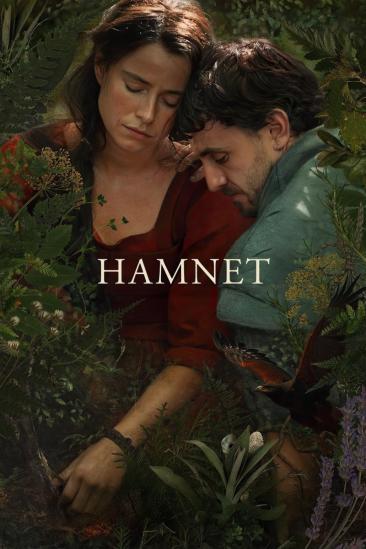
If Romeo and Juliet is my personal favorite work of Shakespeare, Hamlet would have to be a close second just behind it, as a quiet but persistent shadow. The Danish prince’s tortured soliloquies, fevered unraveling of mind and fate, and lingering somberness regarding loss and twisted tragedy have always held me spellbound, going all the way back to charter school. So the fascination to learn what inspired such a story with such a bleak meditation on loss and madness always nudged at me; little did I know the absolute mess it would’ve left me in.
Chloe Zhao’s sensorial directorial style was a match made in heaven for this movie; putting aside how her near-documentary naturalism, ethereal imagery and precise intuition operates like restless lyricism, her discipline in corralling that deluge within this alive, liminal state is nothing short of hypnotic and even hallucinogenic. As single minded as her vision occasionally is, and how that deliberateness urges the viewer to feel a certain way rather than allowing one to surrender naturally, there’s still this delicate ablation of form and content she pulls off that very few directors could pull off. Intentional to the point of self-consciousness? Yes. But it’s still Zhao at her most confident.
Fiona Crombie fuses a decent scope and scale with both a tangible, porous world mirroring a period piece and the framing of O’Farrell’s poetic cadence from her book to anchor this domestic production design in a peculiar bind, making the familiar unfamiliar until the sharp line between history and myth dissolves. Even if what the time period demands to admit to the impossibility of truly reconstruct Tallis and Stratford-upon-Avon becomes a creative friction, there’s beauty to be found in those very limitations and Zhao’s natural communion with nature reframes the entire production design as a spiritual spine, having the constant reoccurrence of forests and nature speak towards liminality, ancestral connection, and escape from social strictures. As someone who went abroad to Wales back in 2017 and wandered through a few woodlands, I would’ve killed to be back in that type of nature again.
Looking back at now, this presentation not only utilizes but actively encourages the same kind of “close reading” and symbolic analysis that literary critics often apply to Shakespeare’s works and that we had to pick apart ourselves watching the films and reading his works growing up. And when you consider the structure itself—oscillating between the brief boundaries between performance and reality, the sweaty, bodily presence of grief and the vaporous, atemporal logic of memory—its controlled with the almost obsessive rigor one would detect in a stage play. Much of Lukasz Zal’s cinematography veers away from the showy or picturesque and uses its cloudy vistas and earthy tones to cast a transfixing spell, simultaneously grounding the narrative in a tactile sense of place and unmooring the viewer; the natural lighting and framing upgrades that paintery, ethereal look.
Let’s not forget Chloe Zhao co-editing with Affonso Goncalves with such restraint that it drifts almost into impressionism.
To land on an overall rhythm here, the pacing is almost maddeningly patient; stretching each moment to its fullest expression without ever tipping into tedium while the two-hour runtime anchored beside it ensures it stretches out like honey from a spoon—slow, purposeful, and sweet enough to savor rather than endure. Costuming is resolutely minimalist while prioritizing elemental, earthbound, and subtly coded color physiology with a logic that feels both period-appropriate and fiercely symbolic; plus, it changes infrequently much like costuming in a play, the atmosphere is never aimless and in regards to the tone, it goes beyond simple consistency: it’s meditative to the point of inviting contemplation like incense in still air.
Some will say Max Richter’s score does most of the emotional lifting; calm and tranquil but sometimes too towering in how atmospheric it is….and they’re right. But at the same time, there’s anguish behind every familiar note that amplifies every other big or small moment. The sound design maintains this precision throughout, with visual effects deployed sparingly but effectively. And while the PG-13 rating seems almost incidental to mention, the film inhabits those boundaries with thoughtful restraint.
I can say with full clarity that everybody in this cast is uniformly strong in the way only a rare ensemble can be—every minor role, every fleeting walk-on, feels inhabited with private weather, interiority, and just the right amount of frailty to shiver the illusion of time and place back to human scale. The dialogue does admittedly feel a bit wobbly with anachronistic phrasings that pulled me from the period setting but each character is given just enough sufficient depth and dimension to anchor their emotional journeys in something genuine and invest in their fates.
Yeah, think I might found my favorite performances of the entire year; Jessie Buckley’s sonorous vocal control and magnetic oracular clarity balances feral, intuitive, exhausted, and unbreakable all at once and I do solely believe its her best performance as of yet. Paul Mescal oozes bruised pride and melancholic restraint as Shakespeare, his eyes carrying the weight of a man torn between artistic ambition and familial duty and not to be outdone, Jacobi Jupe’s radiates wide-eyed innocence and raw vulnerability without a hint of child-actor artifice; easily one of the best child performances I’ve seen in recent memory.
Based off of a novel from Maggie O’Farrell, I do have to stress this is historical fiction and historical drama that does dramatize Agnes and Shakespeare’s life and marriage before, after and around the real death of their 11 year old son and whether or not that tragedy did play into the creation of Hamlet with a few historically accurate events thrown in. But those liberties should not detract from how well the deftness of the film’s central conceit is handled with a deftness that mirrors the Bard's own works while staying honest to its own compassion and curiosity. As badly as this will come off as Oscar-bait—and the warning bells are obvious—it earns that label, warts and all. For a story that balances, love, family, mourning, relief, etc, it’s yet another case of a presentation with such unadorned clarity that you might mistake its simplicity for lack of depth, when in fact it's the opposite: a profound truth hiding in plain sight.
Unlike say, Shakespeare in Love, that romanticizes the genius, this movie keenly turns inward into the intimate world he created and shared with his wife and children and in doing so, fully humanizes and gives a voice to his wife Agnes while mostly shattering the crystalized image of him as a romantic icon. Aside the many fruitful and alluring Easter eggs for Shakespeare devotees (Shakespeare penning “Romeo and Juliet” as he courts Agnes, contemplating “to be or not to be” after his son’s death, rehearsing a haphazard, playful version of the witches’ chant from “Macbeth” with his children), this more introverted philosophical approach imparts an acute sense of longing and rough-hewn authenticity (or something close to it) and unfolds it like a delicate sonnet, each scene a carefully crafted line in a beautifully tortured soliloquy despite occasionally telegraphing its themes rather frequently for a film that didn't need it.
For a story rooted in constant speculation, this iteration, despite not wrapping itself within the bow of an origin story, is very careful to tiptoe through Hamnet’s death just enough to make him the center axis the events rotate around while not exploiting the inevitable tragedy and the decisions made in both screenplay and direction cultivate a sense of generational inheritance—of genius, of grief, of stories that cannot be contained….the type that can only be acted out and shared through storytelling. Storytelling becomes a conduit for reviving the dead, as Shakespeare uses theater to regain the goodbye he was robbed of in real life and the persuasive idea does justify the speculative nature of the long-running rumor……even if it takes some literary contortions to really buy into it. And despite sometimes straining itself to sell us on that notion, it still earns every tear it draws from you, executing an intuitive form of long-term storytelling, pulling every quiet image, every long pause, every composition that seemed too still to matter into this one devoted, lingering evidence of clinical love: a private sorrow blossoming into this grand meditation, this visceral atomization of creativity so universal it touches people all over the world…..and that to care for someone means letting them go, a high cost for honoring the dead.
There is no love without loss…..and what is grief, if not love persevering?
You can make the argument as whether or not this film deserves to hold itself in bloated esteem simply because of its lofty attributes and subject matter. Let’s not get it twisted: this is not a film that coddles its viewer or seduces them with easy pleasures. At many moments, you will be acutely aware that you are not invited all the way in through parts of the film and it will test your patience and tolerance for ambiguity, like a kind of glass pane, keeping your breath fogged on the other side. The narrative is lopsided enough to where it sits somewhere between admiration and emotional exhaustion, strong-arming you to submit to its rhythm rather than cruise towards your own…..but perhaps that is the point; to find meaning in the negative space, to garner closure in letting go and that some forms of grief are so vast that the very orbit around the “bloat” and self-consciousness of the piece becomes its truth—a kind of monument to the impossibility of ever knowing the real story behind Shakespeare’s most famous tragedy, or the real heart of the man who wrote it.
To be or not to be a visceral meditation on parenthood, loss, and the mysterious alchemy through which tragedy becomes art, that is the question. “Hamnet” is not simply another biographical surrogate: it is a cipher, a prism, a wound and, like many Shakespeare stories we grew up reading, rewards careful attention, symbolic interpretation and our solace in the strange.