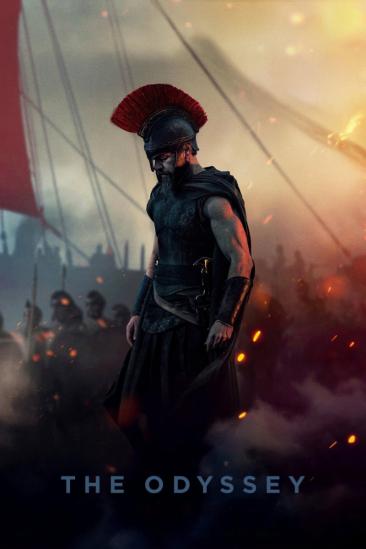
Odysseus, the legendary King of Ithaca, embarks on a long and perilous journey home following the Trojan War. Throughout his voyage, he is forced to confront the whims of gods, mythological monster...
Feels rather redundant to say I grew up on “The Odyssey”, right? I mean, how could I not? It’s one of the most-read and oldest surviving works of literature ever conceived, translated, adapted, reimagined, and argued over for centuries across every medium humans have managed to invent. My first introduction to the text was back in high school, and unfortunately, I carried it around for years in that vague, half-remembered way you carry the things you were made to read before you were ready for them. It wasn’t until Jorge Rivera’s EPIC the Musical that the whole thing cracked back open for me—the wandering, the gods, the grief, the homecoming— and I found myself genuinely moved by a story I thought I’d already filed away. So when I heard Christopher Nolan was taking a shot at adapting it to live action, my mind and heart felt ready.
Upon careful reflection, though? I think I can say I can’t call it a love affair. It’s more of a deep, complicated respect for a film of great craft and intention.
The thing about Christopher Nolan as a director that always fascinated me is his persistence in taking a more critical, outsider’s perspective while taking this fundamental distrust of stories and the world as they’re usually presented, and peeling back layers to expose the raw machinery of belief underneath. Needless to say, his direction once again flirts with immense intimacy for the more wandering, picaresque spirit this text exudes, and there’s a kind of thrill involved watching him wrestle epic poetry and ancient text down to the ground and force it to confess real anxieties, even if his typical chasteness keeps rearing its head again.
Ruth de Jong’s production design baffles me to some degree, though not in a bad way, because we can tell how well it tries to distinguish itself from the polished perfection and frictionless sheen of many contemporary blockbusters. The abject roughness, practicality and attention to detail she brings always stops just short of full immersion but she makes every location at least feel assertive and present to an almost archaeological level and for as enormous the scope and scale are, the atmosphere accompanying it feels far compressed and airless yet concentrated all at once. It’s where Nolan’s commitment to (mostly) analog filmmaking and real, practical construction pays its dividends. Yet, to me, except for the siege on Troy and Ithaca’s palace, most of these sets and locales don’t truly pop off the screen the way the format should’ve allowed it to.
Sober, reflective, and weary, the presentation doesn’t strive for a flawless visualization of an ancient legend, nor the sanitized grandeur typical of mythological epics, but fluidly rewires every event and story beat in a kind of present tense, treating time less as a straight line than as a map spread out before us. Workmanlike without losing its potency and sturdy without being boring, it mostly gets away with holding you at arms length to feel the weight of myth without ever quite letting you touch it, which the technical elements do a great deal to buoy. Hoyte van Hoytema’s camerawork here crystallizes the basic fundamentals of simple but effective cinematography, earning its keep in the quieter moments between unhurried wide shots, close-ups that linger just long enough and a general IMAX 70 mm framing that never overreaches or calls attention to itself…..which I think is precisely why it works. Only fit to serve the story rather than decorate it, the tactility of its monochromatic imagery is graceful.
If only the editing from Jennifer Lame wasn’t so schizophrenic. On one hand, it possesses a strange, poetic rhythm that sometimes sweeps you off your feet—cut with clear intent but bustling about with a mind of its own—and it eases up once we get halfway through and the end goal comes into focus. All that being said, the editing is distractingly apparent; you never stop noticing how jarring and rough much of it feels.
For a movie that’s supposed to be testing our patience for three hours, this was the easiest three hours I’ve had to sit through. Never once feeling like an endurance test and opening up rather than closing in on you, it flies by with almost no issue….with the added caveat of the opening ten to fifteen minutes because they’re ungainly and slow to find their footing. Once they do, though, it tightens up. In comparison to the original text, the overall visual aesthetics do feel stylistically disjointed, at least in comparison to what came before, but I do admire how far they go with the practical and visual effects. There are some sloppy focus pulls but immersion was never really in doubt, much of the tension is in this weird, pressurized holding pattern that breaks out in only a few isolated moments, regardless of whether you’re familiar with the epic or not, and whatever action exists here is stripped down and abecedarian at best—some of the editing during it is clumsy, leaning heavily on the sound design to carry the weight— but none of it is egregious enough to derail or damage anything. The tone lands more or less where I thought it would: bleakness and solemnity, but with a quieter, funereal poise and composure that exposes the false sense of triumphalism and usual swell of orchestral promises of glory, settling instead on something closer to a eulogy.
How the hell does Ludwig Göransson keep finding ways to outdo himself with his musical compositions? Rather than bank on a regular orchestra, he relied entirely on ancient Greek instruments (lyres, aulos, bronze gongs, etc), to create a quiet restraint that either explodes in relentless fury or re-enforces the disquieting atmosphere. Every track feels heavy like a helpless weight you can’t shake off. I do concur that the sound design from Richard King but the overall sound mixing being too loud can make it rather overbearing, Ellen Mirojnick’s semi-anachronistic costume design threads the needle between vaguely resembling the time period its set in or reimagining it through a modern lens; neither fully ancient nor modern, and I had to do a double take on the MPAA rating; it’s a looser R-rating than I thought it was going to be, revealing in the type of muck and oddity that highlights the willingness to lean into the grotesque absurdity of the myth.
Maybe this is just me being a stuck-up hardass, but the acting varied a lot for me; while half the cast were pouring everything into their portrayals hook, line and sinker, the others were just marginally passable but not in a way that they brought down the entire experience. Dialogue was a major point of contention for this film since the trailers released and ironically, it didn’t bother me that much. Yes, the plain, modern English sacrifices some of the elevated, mythic tone and poetic scale found in more traditional versions but my issue with it comes from how much they rely on heavy exposition, showing and not telling. Characters are distinctly two-dimensional in their presence and desires, but with just enough idiosyncratic texture to feel memorable beyond their narrative functions…..and even that occasionally varies.
Anne Hathaway blew me away with her portrayal as Penelope, the right amount of regality and poise mixed with Spartan tenaciousness and fierce resolve, both Robert Pattinson and John Leguizamo surprisingly came close to matching her (the former leaning into this bitter, sleazy pomposity that curdled into outright cowardice, the latter finding something rawer and more genuinely vulnerable than I expected), and for how brief they appear, both Samantha Morton and Lupita Nyoung’o own every second of their broken, yet terrifying portrayals of Circe and Helen of Troy. The rest of the cast is interminably fine. Matt Damon is solid as the lead but nothing else, Jon Bernthal plays the same gruff tough guy he’s gotten so well at portraying, and painfully, it breaks my heart to say Tom Holland was just sort of lost in the shuffle here as Telemachus. Not to say he was terrible, but everyone else is just acting in circles around him.
There are multiple avenues in which you can dissect The Odyssey’s narrative—this one is actually based on a very specific translation on the narrative by Emily Wilson, one of the first few woman to publish a translation of this story— but in Christopher Nolan’s hands, this interpretation (not adaptation, because there is a difference) of Homer’s text is relatively accessible, closer to some of his more straightforward character-driven films than to his most complex and structurally demanding works. Like the other iterations before it, though, it legitimizes the classic drama while subverting the hero’s journey, and for the most part, it’s structurally sound enough to deliver the story familiar to what we grew up on. As the quintessential “And then” storyline in existence, it’s very episodic and repetitive (sometimes I didn’t mind the repetitiveness but other times I did) and is home to many concepts and ideas that have since become well-worn tropes and clichés in the centuries since its original inception, but it manages to find purpose and intent in the familiar beats by foregrounding exhaustion over exhilaration. The cyclical nature of Odysseus’s trials—escape one trap, stumble into another, repeat—only just becomes something of a meditation on the inexhaustibility of self-inflicted human suffering rather than mere narrative padding and the affinity for non-linear storytelling feeds into the overall guise of time-hopping and transformation Nolan normally specializes in on top of staying mostly faithful to the source material.
It remains compelling until the very end and rewards its long build-up with a conclusion that feels both emotionally and thematically anchored.
Many Homeric themes were taken and settled into place here only to manipulate the tale into something more moralistic, molding that to create something OH SO CLOSE to becoming one of Nolan’s most thematically coherent films in a long while. As what’s supposed to be one giant character study about a man forced to confront the consequences of his choices, pride wrapped in a homecoming party, hubris and ego stripping you bare of all you care for until you practice humility, the added factors of hospitality and abject moral failure having ongoing consequences to emphasize regret, redemption and the fragmented nature of memory itself are almost dutifully arranged for Nolan to take advantage of. Adding in elements from the Aeneid, the Oresteia and a little bit of Virgil thickens the thematic stew in a way that doesn’t feel either like collision or synthesis, to where even when you feel the uneven strands wobbling a bit, that thematic ambition sustains itself.
And the constant cracking down about “Zeus’s/Begger’s Law” essentially being one giant traumatic PTSD war allegory, atoning for the sacred law of hospitality broken while turning the Trojan Horse into the story’s original sin? Chef’s kiss. I can see what people mean when they say this feels like it’s in direct conversation with Oppenheimer: upon exploiting trust and corrupting the very foundation that held the civilized world together, one act of deception shattered an unwritten covenant between men. Once honor proved exploitable, trust became a liability, and civilization never fully returned to what it had been.….nor has it yet. Civilization is only held together by agreement on being civilized and it's really fragile; once hard-won rules for how we interact as humans and as peoples are broken, it's almost impossible to return to them. It is yet another warning beyond the collapse of empires and how we will continue to make and unmake the world for flimsy means in an era where being fearful of your neighbors because they are different than you allowed society to be on the brink of collapse.
Yet, annoyances are inevitable. The episodic nature of this story can end up biting itself as certain journeys and encounters expand the world, but don’t always deepen it as much as they could have. Not to say that the present day story in general lacks a clear goal, but when you really boil it down, the rinse-and-repeat nature of each encounter registers more like checkpoints on a predetermined itinerary and some events feel more mechanical and perfunctory rather than mythic. And that’s on top of the more bizarre changes they made: cutting out the ’Nobody’ scene, which is essentially THE mistake of Odysseus’s voyage where his wrath and hubris condemn him, removing the bed trick that highlighted Penelope’s intellect and again, the chasteness from Nolan means it feel like he doesn’t really trust the audience to fully grapple with this hero’s moral complexity or the ones of other characters within the context of this story.
Just the general need to smooth the myth’s rougher edges into something more palatable, more controlled, more his can register like hollow determination. Then again, what do you expect from a fantasy made by a skeptic at heart?
“Complete” but not grand in the way the original epic truly deserves outside of a few isolated sequences, what Christopher Nolan’s interpretation on “The Odyssey” trades in scale, it earns back in something quieter: it makes for a convincing anti-war piece and meditation on trauma’s inheritance that hits harder than spectacle ever could. And in that, at least, it earns its keep.