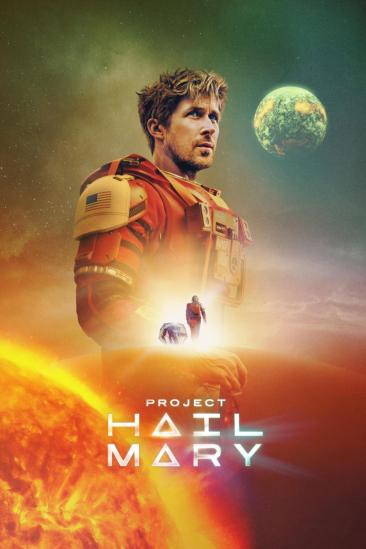
Science teacher Ryland Grace wakes up on a spaceship light years from home with no recollection of who he is or how he got there. As his memory returns, he begins to uncover his mission: solve the...
My history with space movies is complicated in the sense that even with the good ones I’ve seen, they almost always seem to orbit around the same celestial bodies: sense of self-discovery, the possibility of other life forms, the monsters of distrust within ourselves, etc. There’s definitely a gravitas and sense of wonder to how these movies keep pulling me into its gravitational field every time, so the fact that so many people marked “Project Hail Mary” as the potential first great film of 2026? It wasn’t just anticipation anymore—it was the desperate reach of a cinephile starving for something transcendent among the constellations of mediocrity I had been subjected to for months.
Amaze amaze amaze, it fulfills that promise.
Lord and Miller have already established themselves as directors that supply an overwrought sensibility to everything they touch no matter how off-kilter—the Jump Street movies, Lego movies, Spiderverse movies and Cloudy With a Chance of Meatball films—but there’s something particularly puppyish in how they buoy and showcase that heart. With such a casual confidence and dense understanding on what to preserve and what to let go, they take the bare necessities of the novel and re-inflate them to get to the bleeding core.
In a day and age where space often becomes abstract in modern filmmaking, it can be refreshing to see movies such as this make the very pillar of space look like a lived-in, immediate, even tactile environment to be stuck in for how visceral and matter-of-fact the situation surrounding the circumstances are and Charles Wood’s production design has the dense authenticity and tangible practicality to sell every bit of the illusion. Somehow cluttered, hectic, cramped and streamlined all at once, there’s nonetheless this blend of futurism and melancholy that permeates the atmosphere, grounding the set in a retro yet timeless aesthetic even if the grand visual scope and scale it wants to shoot for does come unglued more times than I’d care to admit. It doesn’t come off as wholly hypnotic but the leap feels mostly earned.
Presentation-wise, there’s a looseness and easygoingness here that is disarming at first but easy to win you over completely. It doesn’t aim for the stunned awe and rapture of, say, 2001: A Space Odyssey, nor does it try to but it also makes sure the setup, as overly somber as it is, never spirals into something cold, procedural or manufactured; a fate that most of the technical elements here managed to avoid. Greig Frasier continues to supply some of the most atmospheric, drop-dead gorgeous cinematography I’ve ever seen with a real sense of clarity and expansive framework; using the ARRI ALEXA 65 with custom anamorphic lenses, he creates an immersive, high-contrast, and deeply textured look that’s simultaneously stark, lush and appropriate of the story’s vastness.
Editing is just as strong, propelling the narrative forward while allowing moments of contemplation to breathe when necessary….even with the occasional jarring flashbacks.
For a two and a half hour runtime, the pacing is surprisingly smooth with how it glides with little friction and deadweight holding it back and no boring parts; while not quite eradicating the bloat, it still carries the momentum of a well-calibrated spacecraft. Blending practical effects with CGI and LED lighting does a stellar job in fully immersing us through such life-affirming circumstances, the stakes are pretty abstract but they do crystallize the further we progress and the tone often has to juggle a lot. The goofiness does clash with moments of profound despair often, especially in lieu of the somber, fatalistic setup because it is so exasperatingly insistent on feeling as Amblin-esque as possible. Now carrying over the same cheerful, breezy humor and tonal commitment to unseriousness as The Martian doesn’t make this film emotionally dishonest; it’s meant to feel peculiar. But it does find its stride eventually.
Splashy, piercing and dead-set on being spellbinding, Daniel Pemberton’s composition may not differ from other works of the genre but it is no less ethereal and well attuned to the film’s emotional cartography—at times delicate as starlight filtering through dust, at others thunderous as a supernova. Erik Aadahl and Ethan Van der Ryn’s sound design expands from mechanical whispers and deafening silence to the ancient instruments, whippoorwill cheeps, jugs, and other ingredients that shape Rocky’s alien speech, David Crossman and Glyn Dillion’s combined costume design really only sticks out for Ryland Grace’s character but isn't half bad on its own and the PG-13 rating is a comfortable one that feels like a well-tailored suit rather than a straitjacket.
Look, the acting in this movie speaks for itself; what they very in intensity, they all make up for with intent and on that front, everyone does a remarkable job. Dialogue finds a nice balance between science and math-word jargon and otherwise mostly natural and while realistically every character here is more or less a cliche, they’re all infused with enough personality, quirks, mirth and wryness to transcend their familiar archetypes and become genuinely endearing no matter the duration of time they receive.
Sandra Hüller takes a character designed to feel cold and imbues her with just the right amount of warmth and puppeteer James Ortiz comes mere millimeters away from stealing the show as Rocky…..but c’mon now. This is Ryan Gosling's movie and his performance is calibrated to anchor the entire movie shackled to his feet. Ever the quiet conductor of charm, he plays Ryland Grace with the hollowed-out humility of someone specifically constructed against the archetype of a hero and his gradual shift toward reluctant savior is charted in tiny fractures.
Based on Andy Weir's second novel, the narrative has some similarities in structure to The Martian, in that a lone spaceman must use science and wits to save himself, and in this case, both humanity and his newfound friend but this is a non-linear isolation tale that eventually turns into a buddy hang-out movie with an intergalactic canvas….and from a purely page-to-screen perspective, unlike the usual dichotomy of either good adaptations that are bad movies and bad adaptations that are good movies, this high-wire act threads the needle with remarkable precision—honoring Weir’s novel while standing confidently on its own. The set-up has to do a lot of the heavy lifting with the first act being a labyrinth of amnesia and flash-cuts that could have capsized the whole thing if Gosling’s eyes weren’t so good at begging the audience to trust the scramble but its when Rocky finally appears—when the film stops worrying about lifting and simply lets the air out—that you feel the whole thing breathe. Even putting aside the space cliches, everything about it feels cheeky and touching and unapologetically science-heavy….yet also quite successful in weaving together complex formulas and theories alongside experiments both exceedingly technical and “can do this at home” relatable with aplomb. It isn't all simplified to where every solution can be solved stupidly easily, thank god, but it does play fast and loose with it—all in service of an emotional narrative that squarely lands the beats that matter about unlikely friendship, teamwork, and self-sacrifice.
The entire structure in general unsheathes multiple philosophical and ethical layerings that contrasts two systems: nature and consciousness and the duality between them both. Is it simplified? Yes. But simplification isn’t the same as hollowness, and the movie knows the difference. It keeps its ethical questions lean—barely voiced, really—and the end result is an experience that feels like it’s thinking out loud with you rather you rather than at you. It also works as a natural evolution to Grace’s character as someone who once avoided responsibility before gradually embracing it without realizing it, not because he’s fearless, but because he understands the weight of consequence.
Operating on multiple layers—scientific curiosity, existential isolation, moral hesitation, and ultimately, the emergence of meaning through connection—it turns intellectually intimate-not driven by spectacle alone, but by ideas, transformation, and the quiet evolution of a human mind under extreme conditions. Yes, there have been vastly better and even deeper stories that embrace the flaws of human error, biology, loneliness and mortality that just so happens to have sci-fi elements; it doesn’t come close to reaching the philosophical depth of Arrival or the cosmic grandeur of Interstellar, but it definitely touches on the latter’s emotional ambition and the former’s linguistic curiosity for compassion and understanding. And the questions it does raise actually linger like the afterglow of a thruster burn, but it does so in a way intended to make you optimistic in spite of the damning circumstances ahead and it feels like a balm from the otherwise crushing realities of the current daily news cycle.
Some people do mourn that more of the novel’s big-picture geopolitical problems aren’t addressed (the end justifying the means, what the cost of salvation should be, and whether any authority should have the power to decide our individual fates); me personally, I can agree with that as well as the third act overstaying its welcome a little bit, especially considering the litany of redundant false endings in the last 30 to 35 minutes but I was able to forgive the structural indulgence of both; after all, it didn’t kill my appreciation for the overall product. My main point of contention with this film is because its so intent on telegraphing everything, it often overreaches trying to balance its many ambitions and dilutes the potency of the already familiar ideas it uses.
But I digress.
A cosmic collision of the past decade’s most ambitious sci-fi narratives that somehow still carves out its own identity through Lord and Miller’s signature irreverence, the end result is a film that not only understands and honors the general guise and traditions of science fiction but how important the human capacity for hope, bravery and optimism is in the face of the unknown. “Project Hail Mary”, like its title suggests, is a desperate, beautiful gamble—one that soars just beyond expectation and lands with remarkable grace.