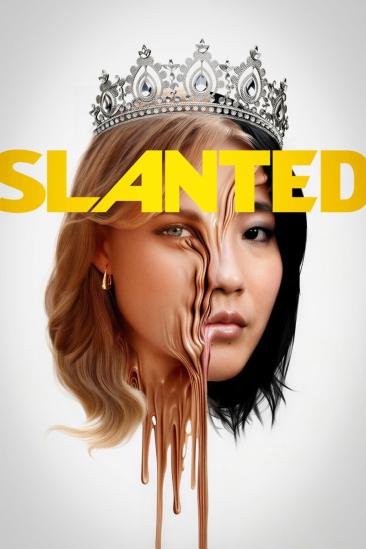
It feels a bit disingenuous to just label “Slanted” as the Asian version of ‘Get Out’; its ambitions want to reach beyond that simple comparison but the final product plays like a half-baked experiment with the right ingredients baked into the wrong concoction.
As per the case of most stories centered around identity in the past couple years, go figure this one is a body horror; one that unfolds in a manner that still manages to hit a little close to home if you’ve ever seen Mean Girls, Didi, The Substance….or if you really want to go old-school with this, George Schuyler’s novel ‘Black No More’ because that feels like the proper reminiscent distant half to this. Its equal parts a coming-of-age story and a cautionary tale that has the wherewithal to not simply create a replica of the American social experience but warp it in a way that’s almost aggressively inert; the rather overcomplicated set-ups that come with it reveal a narrative that wants to anchor its more tropey teenage selfishness and vanity basics with a psychological fallout, shifting the focus away from the gross-out potential.
There is clear evident intent to create an incisive sociological statement here between the intensity of vying for high school popularity, insecurities blossoming within American social structures and doing what it takes not to stand out to the point of obscuring yourself. As jarring as it is to full on replace the first actress with another, it was necessary to lock in on the unfortunate psychosis that comes from how severe one’s own distaste of their own cultural identity will cause them to discard it in exchange for something more glossy, Americanized and shallow. The very temptation of hanging out with the more privileged people to bolster your own status is high but not at the cost of your own self-esteem; for such a simple moral in not trying to be something you’re not, the movie does just enough for the audience to oscillate between the literal and the allegorical in a way that feels both deliberate and disorienting. Despite the bluntness of the messaging being rarely, if ever, subtle, it does explore a very vulnerable, depressing kind of heartbreak underneath it all because that’s the movie at its most authentic.
Here’s the conundrum, however: everything the story is saying is true and the juxtaposition between minorities in predominantly white communities in America is flirted with just enough to make the rather reductive cliches and wrap-up feel like the destination was never in doubt (even if the conclusion was a bit of a cop-out). So why is the execution to everything so safe, timid and tepid?
For all the focus and time it actually places on assimilation and internalized racism affecting POC’s in the communities they inhabit, it’s all surface level dissections with hardly any bite to it and the practical ramifications of how such a life-altering decision will impact Joan’s life does not bubble up to the surface as often as it should. Immigrant tales like this have a tendency to focus extra hard on exercising the cliche of intergenerational disappointment, the narrative’s great cruelty—that the cost of belonging is perpetual shape-shifting—remains largely thematic, rarely spilling over into the film’s own structure. And that’s on top of the reality that the downside here of the irreversible procedure has nothing to do with learning that self-acceptance is more important than the affirmation of one’s peers; the film probably didn’t intend for it to play out like a trans allegory but the fact that it does anyway only muddies those waters even further.
If I didn’t know any better, I’d say Amy Wang’s direction holding fast with this lack of idiosyncrasy is perhaps the movie’s biggest missed opportunity. There is a calm confidence and sense of intent in the specificity of where and why she places her focus the way she does, digging up a lot of rigor and purpose; this so nearly comes close to feeling like a voice for the voiceless, for the third-culture kids tempted to surrender their autonomy for comfort and its a valid play for her directorial debut….but it can’t help feeling meek and shy in said approach. Her reluctance to firmly assert and probe deeper beyond its surface smoothness does arguably mirror the pathologies of its main character but otherwise taints the bigger picture surrounding her.
Yet another factor that only just goes far enough and then basically stops itself from going further is the titular production design from Ying-Te Julie Chen. The American landscape we see here is very heightened and stretches itself into this thinly-veiled panoramic vision of exaggerated surburbia with a bunch of reskins on top of corporate and nationalist imagery throughout these spaces, creating an almost suffocating visual commentary on the protagonist’s social pressures. I think Chen brings just the right amount of discomfort to certain class distinctions, particularly in the stark visual contrast between Joan’s modest family home—warm but cramped, with cultural artifacts that suddenly seem to occupy too much space—and the sprawling, antiseptic wealth of her white peers.
Really, this presentation doesn’t play off like anything that couldn’t already be shown in a thirty-minute Twilight Zone episode…..or a Key & Peele skit. Don’t get me wrong: its conceptual architecture provides a sturdy, if familiar, foundation that keeps the world grounded in a straightforward reality that isn’t entirely at odds with the fantastical basics of the premise but it bolsters itself on creating expectations only to quickly scale them down and disperse them and that unfortunately bleeds over into its stylistic elasticity, or the lack thereof, with the technical elements. Ed Wu’s cinematography is competent in showcasing his workmanship through framework and lighting but is otherwise pretty remedial and rarely ventures beyond the serviceable; the aspect ratio shifting from boxed-in Academy standard to widescreen 16:9 upon swapping personas is the most interesting thing about it.
Nothing of any major discernment comes up in regards to the editing; Ryan Chen is acceptable in this role.
Realistically, I should have no issue with the pacing here; I just wish it was a few minutes longer. But at a lean 98 minutes, it crams in everything it can at a respectable speed and duration without overbloating itself—initially hesitant, then accelerating through the middle act as her identity crisis deepens, before settling into a more contemplative tempo for its denouement. Makeup and visual effects here are use sparingly but are reliably firm and consistent whenever used, tension doesn’t wholly commit to the type of feverish urgency or heightened stakes that infected The Substance, whatever the films counts as comedy is stuck in stagnancy unless you count the constant brand renaming, and the tone isn't lopsided more than it is uncertain of itself. Earnestly and satirically, whatever edge the story wants to achieve is so quickly quarantined by the films’ own modesty, this barely even qualifies as a body-horror at all. I wasn’t expecting any Cronenbergian spectacles or French extremism levels of body disfigurement or face melting but at least something to properly imitate the body dysmorphia it was building to.
Muted and minimalist musical scores have the potential to branch out in several separate scenarios melodically but Shirley Song’s crack at it has this gradual music box-esque decay that gradually deteriorates, suggesting innocence lost. While it’s far from a bad composition and puts us firmly into Joans mindset, hinting at building toward something explosive only to fail to detonate is a bit of a sticking point. Sound design, while not particularly innovative, maintains a competent subtlety throughout, the costume design from Michelle J. Li stands out in regards to Joan Huang (her attires altering from mostly sleeves and muted colors to no sleeves and bright colors to indicate her supposed illumination to what she did) and her family, and thankfully, the MMPA is rightfully rated-R….although that’s more for the face-drooping and attempted disfigurement.
Every character is a straight-up flat stereotype and when they are privileged, they feel even more flat. Sure, the assumption can be made that the audible decrease in bombast in the performances depend on who’s taken the procedure and who hasn’t—an intentional flatness—but I’m not sure how much it holds water when considering the disconnect between the script’s pedestrian dialogue and the cast’s admirable efforts to elevate it.
Shirley Chen and McKenna Grace have the hardest jobs here, wrestling the dichotomy between authentic vulnerability and shallow guarded angst to sell internalized racism and both excel. But co-stars Vivian Wu and Fang Du who really emote and support them with their authentic roles as Joan’s parents.
Ironically caught between two worlds, Slanted is not so much a failure of imagination as a refusal to indulge the story’s own potential for chaos. No matter how relevant its social satire and commentary stand out, erring so far on the side of restraint means the film often leaves its sharper observations floating, unmoored from any cathartic impact.