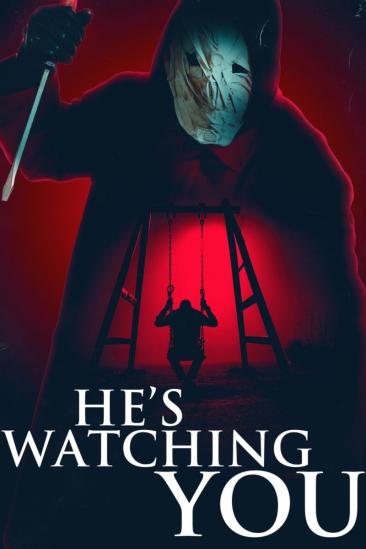
The film transports us to the sleepy town of Page Hollow, where a string of gruesome murders shatters the quiet community. Shortly after the first killings, outcast high school photographer Cameron...
Since I got time to kill before the next big release, might as well check out how Cobra Kai alumni Vanessa Rubio and Gianni DeCenzo hold up in this obscure but otherwise passable looking slasher film: “He’s Watching You”, formally known as Black Spines.
Welp, this went about as well as I expected.
From the second it starts up, the movie has a clear affinity for the old-and-timey bare necessities and Jordan Foss hones in on that for his first time behind the directors chair. Regardless of what I have to say about his writing and how very embryonic and threadbare his direction comes across as, I can see someone else getting a kick out of his rough-around-the-edges, back-to-basics approach for a simple story. For what's supposed to represent a unified artistic vision, however, its a frustrating portrait.
Okay, I don’t know why this particular detail bothers me but having the synopsis and the official website for this movie constantly promote this as being ‘Inspired by true events’ in a fictional town in Detroit despite this being filmed in Pomona, California? It took a while for me to clock that ludonarrative dissonance but I got taken out of the experience once I did and it pains me to write off Adri Siriwatt’s work here…but stark construction aside, the desolate sterility of the town doesn’t feel as claustrophobic as the production design wants to convey; no haunting ambience or crippling unease meant to wear you down--it’s just this weird disconnect. While the limited locations draw a lot on both the tactile nature and analog aesthetic of a bygone time period, juxtaposed with contemporary elements, the intended sense of confinement feels oddly absent, and with hardly any visual storytelling to explore any potential psychological depths within this derelict town, there’s only so much leeway it can supply to the narrative and vise versa.
For a presentation that distinctly embraces this retro aesthetic deliberately coded in the styles of the 80s and 90s, I don’t understand why this feels as barren as it does. You feel more like you’re observing rather than being up-close and personal with a genuine enclosing threat….which is baffling considering how durable Benjamin Kitchens manages to make everything look. His cinematography does all the heavy lifting in establishing the visual identity—decent lighting and a thoughtfully muted mixture of warm and cool color grading—while experimenting with a lot of varied angles and shots (as well as the repeated use of the dolly) to conserve some movement and dynamism. That being said, it still leaves the viewer on the periphery rather than drawing them into whatever the heart of the story is supposed to be.
Editing isn’t sluggish nor is it sharp either; it just sits in this weird competent yet unremarkable limbo.
Momentum and rhythm have to answer to some of the slowest pacing I’ve been subjected to in a while; the leisurely molasses-esque strolling of it is meant to invite reflection, and the 1hr 42 minute runtime gives the feature plenty of time to make use of those moments of introspection, but with how sluggish everything moves, its guaranteed to test your patience. And it all plays out to a mostly nihilistic tone without bordering too hard on gritty stonery for the sake of it; maybe I can make peace with the film being all purposefully tame and low energy but not when the feature is this demonstrably, relentlessly boring. Tension is nigh-nonexistent, and I can only count ONE instance where the film got me to chuckle unintentionally.
Combined, Alexander Bornstein and Tujiko Noriko’s morose, restrained take on a throwback whispery synth score (fourth time in a row for me, btw) does much better at embodying an unsettling ambiance than the actual atmosphere surrounding it ever could--an actual sense of disquieting trepidation—and even those efforts, compared to the entire insipidity around it, are just fairly adequate. Sound design is strictly fine with very few standout moments, Allison Calhoun’s costume design is very routine and unappealing with the exception of the attire of The Pill and honestly, I’ll be talking my head in circles with all the different ways I can praise the R-rating in a film. Many of the kills here are the dictionary definition of bog-standard; they’re simple, gruesome, uniformly basic in execution and sports a level of brutality that doesn’t pull its punches but that comes at the expense of both style and substance.
Very disappointed in this cast; I won’t pretend none of them don’t actively try or even look the part but between the limp dialogue and the wishy-washy state of the gaumless character roster before they inevitably tumble down the rabbit hole of idiotic decision-making, it’s next to impossible to care about anybody. They all have quirks hinting at a personality, but the lack of any fleshing out leaves everyone anchored to their hollow archetypes, and it doesn’t help that we have to follow a colorless, dry as dust, very pedestrian protagonist who spends nearly the entire runtime underacting to everything while endlessly dicking around.
As nice as it was seeing Gianni DeCenzo and Vanessa Rubio again, they do the bare minimum to spruce up their prototypical roles and Jan Luis Castellanos, whether it be his own acting or the script’s limitations, could not carry the weight of this entire production as a leading man.
Despite what the synopsis may suggest, this film's story is loosely inspired by a Detroit urban legend about the "Nain Rouge"—a red, demonic dwarf believed to herald doom and tragedy, mostly evident during massive tragedies like 1763’s Battle of Bloody Run, the 1805 fire and the 12th Street Riot of 1967. It was almost inevitable that this myth would be twisted into a slasher film, retooled with multiple fresh coats of paint and primer, since that template has always kept creeping back in from the nostalgia vault. That being said, despite these familiar roots, that’s not to say the film didn’t have potential to break out. With the 80’s and 90’s being the default playground for many modern horror filmmakers and writers to draw blood from, Jordon’s writing clearly wants to aim at the heart of both horror zeitgeists, where paranoia, societal anxiety, our fascination with serial killers and the overall complexion surrounding the true cost of safety all congeals into this crockpot of feverish uncertainty that more or less still sweeps into the bowels of our modern society. For a few precious moments, the narrative does peel back the curtain a little to highlight this general malaise clouding everyone in this town.
Major downsides to that mostly boil down to this: it’s all in service of a formulaic that boxed itself in and I mean that quite literally. The entirety of this film is the equivalent of a safe, dud, fuck-all, nothing happening tractor ride sputtering its way to the finish line.
Yes, the VHS tape angle does add a slight layer of mystery and a light found footage flavor without fully committing to that format to keep you somewhat engrossed but it all leads down to multiple boulevards, off-ramps and avenues we’ve ventured down a million other times before, often leading towards the same destination. You could say the film embraces its banality but this narrative doesn’t feel inclined to give you the decent courtesy of expressive amplification. Every horror cliche you can imagine is present here: the dorky, bullied protagonist, the strained nuclear family following a tragedy, the stereotypical jock bullies and mean girls, the killer serving some kind of connection to the ‘hero’, research into the killer’s past activities, infuriating low brain cellular activity when the plot requires it, the slow/incompetent police force; I could fill out an entire whiteboard with how many hackneyed platitudes it crams in, regurgitates and follows to the letter. The family drama that takes up a vast 65% of the runtime is rigged out and draped under the very fragile undercurrent of imperfect father figures; how the way one chooses to raise their offspring will often differ to those with vastly different upbringings or stylings….even if it means going to the extreme and yet it’s the only semi-consistent theme this movie has going for it.
Despite that though, the execution of said trajectory leads itself to a twist that I both saw coming and I did not want to be right about and most damningly, builds itself around an ending that leaves more questions than answers (to me, at least).
Amongst the morass of finicky but well-meaning copycats and inconsequential formulaic slasher slogs over the years, this really does not do much to stand out…..although admittedly, it’s hard to do that in today’s current climate. The dedication to the extensive lore it crafts for itself hinting at actual worldbuilding only just saves “He’s Watching You” from being a complete non-entity of a slasher movie….but that isn’t enough to hide the shaky performances, a complete lack of atmosphere or the flimsy plot twist anyone with half a decades of horror experience can piece together.