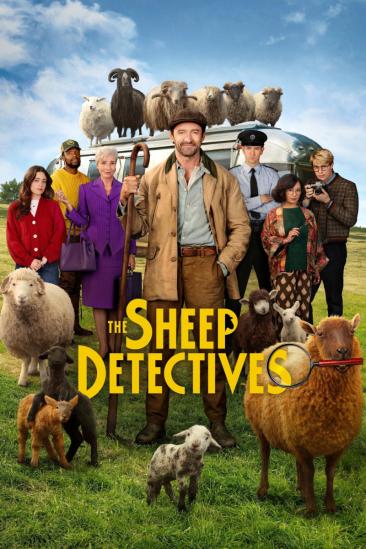
George is a shepherd who reads detective novels to his beloved sheep every night, assuming they can't possibly understand. But when a mysterious incident disrupts life on the farm, the sheep realiz...
Despite fearlessly gloating the phrase “Don’t judge a book by its cover”, the state of Hollywood has made it SO EASY to pick apart literally anything that smells like a disaster or just plain mediocrity. So let me preface this by eating a little bit of dirt here: “The Sheep Detectives” was everything I expected it to be….
…and it somehow ended up being just a little bit more.
I wasn’t expecting the director behind the bloody Minions movie and Despicable Me series to supply this much warmth and delightful coziness, let alone possessing the unhurried, patient confidence that feels like a natural exhale to stick the landing to something like this. Alas, Kyle Balda takes that ball and rolls with it in his very first live-action film. Deliberately packaging a bright, energetic surface that cleverly conceals a darker undercurrent, he does more than skillfully level out the cloying silliness of his earlier children’s projects—he actually gives it a pulse and a purpose.
If there’s one thing I quickly learned from Suzie Davies based on what I’ve seen from her, it’s that her production designs insist on this codependency for aggressive over-extravagance and this is the first time I’ve seen the inverse to that equation. Its vision of a (remarkably sunny and cheery) British countryside feels a bit too sanitized, even more so than the characters that inhabit it, and you could make the argument that Denbrook feeling as generic as it does fares as an extension to how seamlessly people can overlook what’s in front of them, blending in like the sheep do. The flip-side to that, though, is because Davies isn’t operating in that register of maximalist excess, the scope and scale of the project are much more defined, and it leans entirely into the atmosphere: foggy hillsides, quiet villages, nervous conversations in barns, and the strange little social hierarchy of the flock itself. There’s not much there in terms of personality but unlike films like Saltburn and Wuthering Heights that sacrifice the visual storytelling for excessive shock value, at least this one feels like it actually belongs here; more in line with a classic British mystery novel.
The overall presentation takes a very intriguing perspective that morphs throughout. Warping from childlike innocence to adolescent stubbornness to a begrudging acceptance toward adulthood, that gradual transition actively modulates the structural fluidity without losing its tactile sense of place and through that gradual framing device, that consistency keeps the whole thing from feeling unmoored. And you could tell those notes were well taken from George Steel; his cinematography is vibrant in the way it has to be a whodunit to feel lively and lived in. A softer, more defused approach that favors long, patient takes, low angle framing through an anamorphic lens and an alternating lighting system (saturated naturalistic tones for the meadow settings that gradually shift into darker, moody neo-noir) to embrace the films cozy, pastoralist aesthetic, it’s purely picturesque through and through.
You wouldn’t be able to tell the editing was a three-person job, considering how well it actively plays out. Al LeVine, Paul Machiss, and Martin Walsh forge a sturdy consistency that keeps things remarkably seamless. Only one great transition actively stood out to me but let's not pretend the rest wasn’t part of an otherwise clean, solid, confident cut.
Despite clocking in a few minutes shy of two hours, it made almost no difference: the pacing is methodically poised. Gentle, deliberate, sauntering and one that quietly builds toward something actually meaningful. Visually speaking, I’m impressed with how impeccable the special effects and CGI are, mostly because of how well they integrate into the world around them and stay out of their own way; even when they do show their hand, it’s far and few between enough that they read less like cracks and more like texture. The humor unfortunately didn’t completely win me over but I can understand if it does for others, considering they emerge naturally from character rather than constant winking at the audience; it’s a linear focus that respects the general structure of whodunits, and both the emotional and physical stakes land with enough weight that the inevitable happy ending feels earned rather than handed out for free. Honestly, the tone is where this film earns its keep. Whimsical without tipping into smugness, strange without feeling algorithmic or performative—and crucially, it never condescends. None of that hyperactive, joke-every-three-seconds energy that makes so many modern family movies feel like a hostage situation. And it doesn’t yank at your heartstrings for cheap emotional manipulation, which, for a children’s movie, is practically a miracle.
Christophe Beck’s musical composition isn’t quite chameleon-esque as it thinks; much of the score is cut from the same cloth as a dozen other children’s films—the kind that knows exactly which emotional register it’s in, what to land and where to stay—and it knows it. Yet, there’s a generosity behind its gentle presence and grace that separates it from being formulaic and tips toward being dependable, and Beck understands that assignment. Sound design more or less operates among much of the same lines, Rosa Dias’s costume design classifies itself through simplistic, intuitive color theory that were very deliberate in the wardrobe choices (Molly Gordon and Nicholas Galitzine's characters stand out in particular to me), and let’s not jump out of our skins here; a PG rating was never not going to happen here. What matters is that the film doesn’t treat it as a cage so much as a natural habitat; it works well within those parameters and doesn’t strain against it while occasionally finding cute little ways to get around it.
Universally solid and aloofly vibrant, I can’t think of much to complain or criticize from the ensemble cast here; every performance lands with either quiet confidence or a lived-in specificity that nearly makes you forget you’re watching actors perform. Infrequently, the dialogue would surprise me, straddling the line between stilted, mildly amusing, and intriguingly philosophical, all while our colorful cast of characters dance to and around each other’s tempo with enough chemistry to sell the illusion. Only a select few of the human characters—the ones portrayed by Nicholas Braun, Molly Gordon, and Emma Thompson respectively—actively stand out while the actual sheep characters have very specific, understated, and unhurried personalities that are distinct, and without a single moment that feels like the script is leaning over and nudging you to laugh.
Julia Louis-Dreyfus wrings genuine emotional range out of Lily, the main sheep character, while Bryan Cranston’s dry humor and easy-going presence as Sebastian quietly supply much of the film’s heart without overplaying a single beat. And circling back to Nicholas Braun one last time: beyond being the only human character handed a real arc, his portrayal of a naive, over-his-head doof who slowly rises to the occasion never once feels like a gift from the script—he earns it himself.
On its face, it’s a simple talking-animal caper with a deceptively simple exterior, but this narrative reveals itself as something far richer: a remarkably self-assured hybrid of pastoral whodunit, wry British humor, and earnest character study. The setup—sheep solving their shepherd’s murder—feels like the kind of high-concept pitch that writes itself (Babe by way of Agatha Christie), yet the film embraces its own strangeness with such conviction that any whiff of silliness and absurdity dissolves into something quietly remarkable…and that’s no small feat for something intended to be this gloriously offbeat and unremarkably accessible. It’s a fair play mystery in the truest sense—where all the clues are laid out plainly for the discerning sharp enough to spot them. And despite the actual whodunit taking a backseat to the film’s deeper thematic trappings, it’s actually pretty decent. Drawing attention to the tropes of the genre without ever truly challenging them, content to simply trot out the familiar rather than forge new ground, it nevertheless relies on the sharp contrast between the sheep’s guileless perspective and the harsh realities of a genuine murder investigation to operate on multiple frequencies.
Working better as a proper introduction to the genre, it’s somber, humanistic and sincere.
Thematically, this is where the film finds the most success outside of its tone; it is rife with pathos and the dedicated mediations on how we deal with death, the necessary pain of memory, and the importance of not erasing the past if we ever want to break the cycles it founded all hit harder than expected. And the story does right by said themes, not shying away from the realities of life or sugarcoating its peril or its heartbreaks; basically separating the wheat from the chaff when it comes to family entertainment. The dedication to play into its simplicity and focus on the overarching nature of the consequences of the sheep detectives’ circumstances and beyond bounces off well with the main humans because even us humans, despite being given the ability to learn as much as we want and live well beyond a century, have just as much limited knowledge of the world and not enough emotional intelligence to make sense of it properly. This is a story about creatures trying to make sense of a world they only partially understand and only the few who aren’t blinded by lust, gluttony, greed, or just plain sloth are the ones who come out in the end feeling more whole; we’re all guilty of some degree to submitting to complacency or following the herd rather than confronting the truth and making peace with it in a way that isn’t destructive to ourselves or others. And when you consider how much we’re under threat of making bad decisions and/or living a terrible life under the leadership and direct result of a foolish or corrupt shepherd? There are too many parallels to name.
Using sheep or animals as a metaphor for groupthink versus individualism, commodification, prejudice and anti-intellectualism? Dare I say, this film explores those dynamics better than the actual Animal Farm film I reviewed earlier this year. Like, IT WASN’T THAT HARD, GUYS!
That being said, it does struggle to balance its ensemble and turn every member into a believable wrongdoer. After the rogue’s gallery is introduced early on, nearly everyone except for a select few fades into the background and gets checked off the suspect list; the red herrings aren’t difficult to waddle through, and the killer reveal proves relatively easy to spot upon closer inspection (although I admit being taken aback by the reveal the first time). It never really opens up to give us this unlimited canvas of possibilities to further expand the scope of the mystery, and there are other slapdash moments and missed opportunities that don’t get taken full advantage of (not commenting on the ethics of industrial farming, religious existentialism, the pro-vegetarian subtext and undertones, etc).
Color me shocked, “The Sheep Detectives” is far from baa-baaa-baaaad. Ripe with a wooly heart despite the fairly generic story, it expands into something far more expansive and emotionally textured than its premise suggests, sidestepping its own genre conventions to deliver a mystery that’s less about the crime and more about quiet grief, memory, and the small acts of courage it takes to face the truth—all while somehow making a barnyard whodunit feel both plausible and profound. Definitely one of the year’s most unexpected highlights.